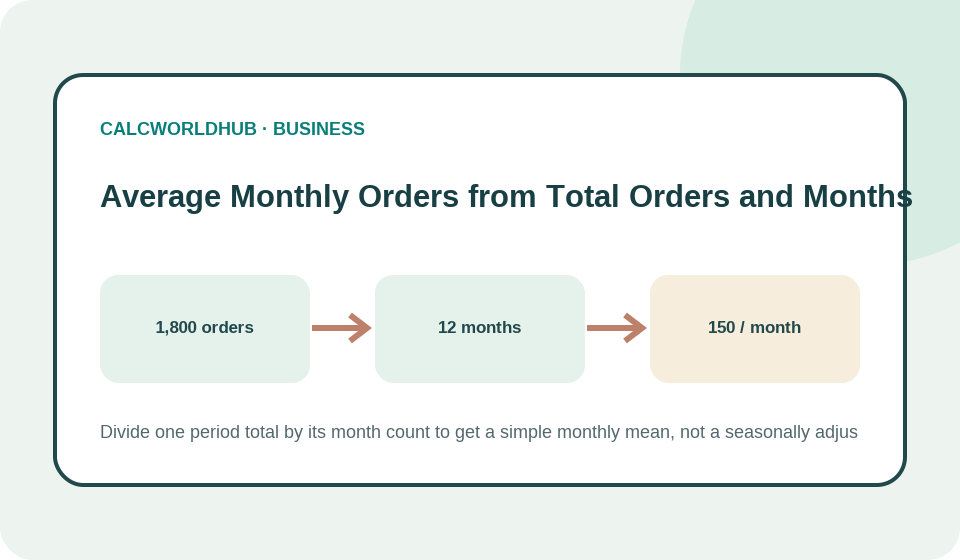

Define what counts as an order
Before dividing, choose a consistent order definition. A placed order, a paid order, a fulfilled order, and an order net of cancellations are not always the same population. Use one source and one inclusion rule for the whole interval. If returns are relevant, they do not erase the fact that an order was placed unless your stated metric defines the count differently.
The calculator accepts a total order count and a period in months. The order count should be a nonnegative whole number; the period must be greater than zero. A zero-order interval is valid and returns zero per month. A period that crosses a partial first or last month can be entered as a fractional duration only if that is how the source defines its elapsed months.
The average is total orders divided by months
Average orders per month = total orders ÷ measurement months. The calculation does not require equal sales in every month; it spreads the total arithmetically across the stated duration. The result is displayed to four decimal places, so round it further only as the planning context warrants.
Keep the measurement period, order definition, and data source with the result. A rolling twelve-month total, a calendar-year total, and a seven-month launch period answer different questions even when the average happens to match. If months are missing from the data export, use a complete interval or state how the available period was measured instead of silently dividing by the intended number of months.
Worked examples
Each example divides the complete order count by the stated number of months; no seasonal adjustment is applied.
One full year of order history
Inputs: Total orders = 1,800; measurement period = 12 months.
Calculation: Average monthly orders = 1,800 ÷ 12 = 150 orders/month.
The interval averaged 150 orders per month; individual months may be above or below that mean.
A seven-month operating period
Inputs: Total orders = 925; measurement period = 7 months.
Calculation: Average monthly orders = 925 ÷ 7 = 132.142857… ≈ 132.14 orders/month.
The period averaged about 132.14 orders per month, which should not be read as the count in any one month.

A mean can hide the pattern that drives operations
A monthly mean is useful as a compact baseline, but it is not a forecast for every month. Promotions, holidays, weather, stockouts, and business growth can create peaks and troughs. A business that averages 150 orders monthly might see 80 in a quiet month and 240 in a peak month; staffing solely to the mean could be inadequate at busy times.
Pair the average with a monthly chart, median, range, and peak-month count when capacity is the decision. If intervals differ in length, compare rates per month rather than averaging their reported monthly means without weighting. The weighted combined mean is the combined order total divided by the combined month duration.
Keep the numerator aligned with the denominator
The numerator and duration should describe the same business, channel, and time window. Do not combine web orders for one period with all-channel orders for another. If you compare two campaigns, include the full active duration for each and state whether delayed fulfillment or cancellation changes the order count. A clean definition makes the arithmetic reproducible.
Shopify analytics can report different order-related measures and date ranges. Use the platform’s field definition rather than treating every dashboard count as interchangeable. This calculator does not import a store report or resolve duplicate, test, draft, canceled, or marketplace orders. It only divides the two supplied values.
Use the result as one planning input
For inventory planning, orders per month is only a first step. Items per order, product mix, lead time, backorders, and reserve stock affect replenishment. For customer support or fulfillment, workload per order and the timing of arrivals may matter more than the monthly average. Use a finer daily or weekly view when a bottleneck depends on short bursts.
A rounded monthly average is a summary of historical input, not a guarantee that future demand will match it. Recalculate after the measurement period or order definition changes, and keep enough precision to avoid compounding rounding errors in later planning. The calculator offers no seasonality or growth adjustment, so apply those separately with an explicit method.