
Define one comparable sample
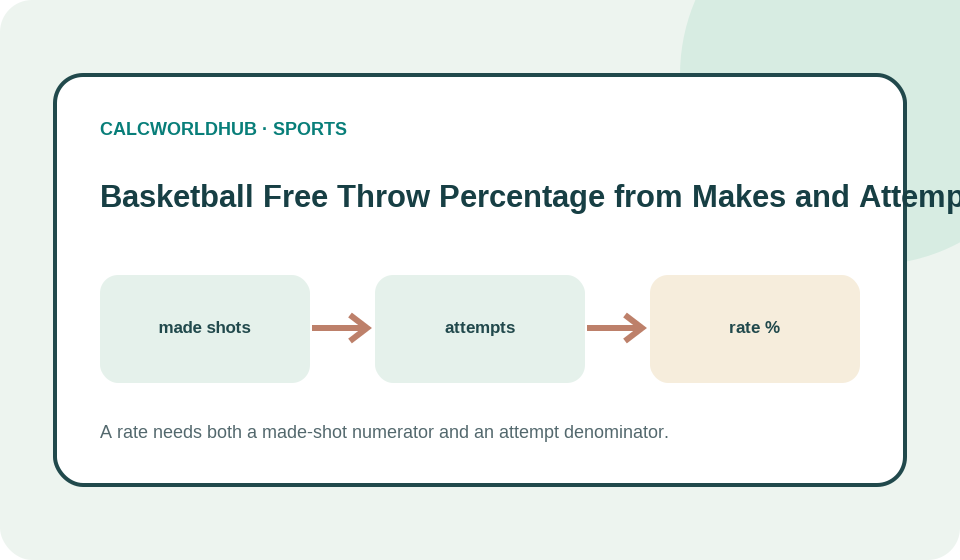
Choose a sample that answers one question: a single game, a set of games, a season segment, or a team’s total over a period. Enter the number of free throws made and the number attempted in that same sample. Mixing a player’s makes with team attempts would produce a valid division but a meaningless statistic.
The attempts denominator must be greater than zero, and makes cannot exceed attempts. The runtime expects whole-shot counts. Use the official box score or the same scorekeeping source for both values, and check that technical or administrative free throws are included consistently with the competition’s statistical rules.
Apply the ratio before rounding
Free throw percentage = made ÷ attempted × 100%. The unit is a percentage, not points per game or shots per minute. Convert the ratio to a percentage by multiplying by 100; do not add percentage points to a count or treat a decimal such as 0.8 as 0.8 percent.
Keep the unrounded fraction for comparisons, then round only for display. Two athletes can have the same displayed percentage with very different attempt totals, especially in a small sample. The rate summarizes conversion share, while the raw counts reveal the amount of evidence behind that rate.
Interpret accuracy and volume together
A higher percentage means a larger share of the entered attempts went in. It does not say that the shooter took more attempts, scored more total points, or performed better under every game condition. The NBA’s official statistics glossary identifies FT% as free throw percentage; a box score also preserves makes and attempts so the ratio can be interpreted with its denominator.
When aggregating several games, calculate the combined rate from total makes divided by total attempts. Averaging the individual game percentages without weighting can give a low-attempt game as much influence as a high-attempt game. Keep the time period and population explicit when you label the result.
Check the source and scoring rules
Use an official league or competition box score where possible. NCAA basketball statistics rules describe how attempts and makes are credited, including situations where a free throw is attempted and made. If you are reconciling a stat feed, follow the rules for the competition and season rather than inferring what the scorer should have recorded from the percentage.
Do not use this calculator to resolve disputed scorekeeping. It only checks whether the two entered integers form an allowed ratio. A corrected box score changes both the numerator or denominator and potentially the rate; record the source and revision date when a comparison needs to be reproducible.
Know what the rate leaves out
The result does not include field goals, three-point shots, fouls drawn, points scored in the paint, or a player’s total offensive contribution. It also cannot establish shooting skill from a very small number of attempts. A descriptive percentage is not a forecast that the same rate will hold in another game.
For team or player comparisons, pair the percentage with attempts and a clearly defined sample. If the question concerns trend, split the period consistently and keep the scoring rules and data source stable. The calculator provides the arithmetic summary; competition context and statistical interpretation remain with the reader.
Worked examples
A player across a game segment
Inputs: Free throws made = 37; attempted = 46.
Calculation: Free throw percentage = 37 ÷ 46 × 100 = 80.4347826…% ≈ 80.43%. Missed shots = 46 − 37 = 9.
The player made about 80.43% of the 46 attempts in this sample; the rate should be read with that volume.
A shorter sample with fewer attempts
Inputs: Free throws made = 17; attempted = 20.
Calculation: Free throw percentage = 17 ÷ 20 × 100 = 85%. Missed shots = 20 − 17 = 3.
The displayed rate is 85%, but this sample has fewer attempts than the first example.
