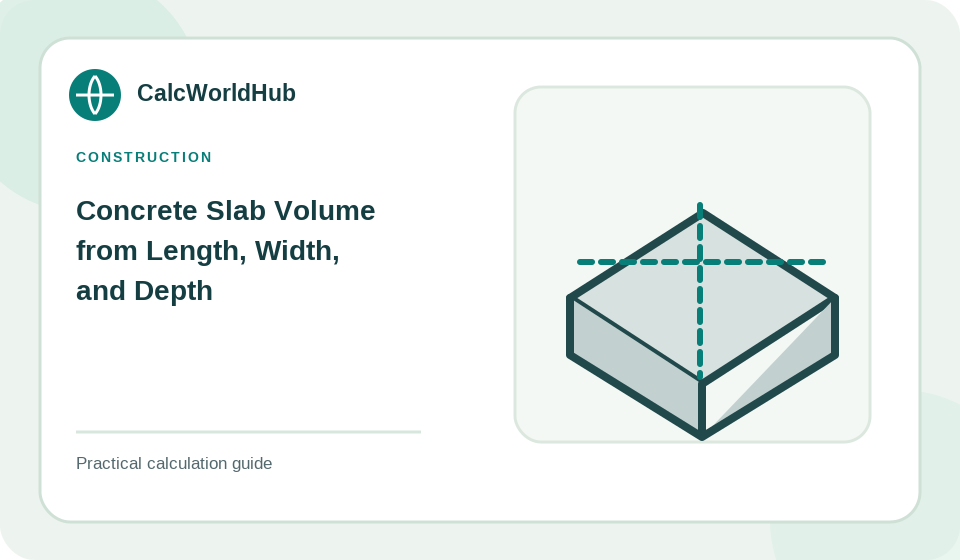

Measure the concrete geometry
The three dimensions are slab length, width, and thickness, all in metres. Measure the planned concrete footprint, not the surrounding excavation. A variable-depth slab, thickened edge, step, or tapered section should be split into simpler shapes and summed; one average dimension may hide a material difference. Convert millimetres to metres by dividing by 1,000 before entry.
Compute the base volume
For a rectangular slab, V = L×W×t. Multiplying metres by metres by metres gives cubic metres. The base geometric volume represents only the measured shape; it does not include over-excavation, uneven subgrade, spillage, reinforcement displacement, or a procurement allowance. Add those considerations separately using project measurements and the supplier’s ordering units.
Apply the waste percentage
The calculator multiplies base volume by 1+w/100 to produce an adjusted order volume. A waste allowance can cover a chosen margin for uneven subgrade, spillage, or measurement tolerance; it is not a substitute for correcting a bad dimension. The main result is the adjusted quantity; calculate and retain the base volume separately when you need to show the geometry.
Use sensible precision in ordering
The mathematical output may include more decimal places than a ready-mix supplier will deliver or a form can hold. Do not round the base volume early, especially before applying the allowance. Use the final precision required by the supplier’s ordering increments and project specification. The calculation does not round up to a standard truck size automatically.
Check the construction details
The model assumes a flat rectangular slab with uniform thickness. It does not account for subbase settlement, reinforcement displacement, embedded services, slopes, thickened perimeter beams, or a separate footing. Those details can increase or alter the actual pour. A structural drawing and field measurements should govern dimensions where the slab carries loads or must meet code.
Treat volume as one part of planning
The adjusted cubic-metre result is not a concrete strength, mix design, water ratio, or curing instruction. The supplier may specify a minimum load, delivery tolerance, or unit conversion. Match the calculation to the material schedule and confirm whether the allowance is already included elsewhere to avoid adding it twice.
Worked examples
Both examples show geometric base volume and the adjusted volume after the stated allowance.
A 4.2 m by 3.6 m slab at 100 mm
Inputs: Length = 4.2 m; width = 3.6 m; thickness = 0.10 m; allowance = 8%.
Calculation: Base = 4.2×3.6×0.10 = 1.512 m³; adjusted = 1.512×1.08 = 1.63296 m³ ≈ 1.633 m³.
The base shape is 1.512 m³, and the selected allowance raises the order estimate to about 1.633 m³. Confirm delivery rounding separately.
A thicker 8 m by 5 m slab
Inputs: Length = 8 m; width = 5 m; thickness = 0.15 m; allowance = 5%.
Calculation: Base = 8×5×0.15 = 6 m³; adjusted = 6×1.05 = 6.3 m³.
The selected allowance adds 0.3 m³ to the geometric volume. This is a planning quantity, not a supplier’s truck-load rounding rule.

Split nonrectangular features into separate shapes
An opening, thickened edge, step, trench, or isolated pier changes volume beyond one uniform slab prism. Estimate each positive addition as its own shape and subtract a genuine void only when it will remain empty. Then add the components before applying one documented allowance, or apply allowances consistently to each quantity. This avoids hiding geometry in a guessed thickness and makes the takeoff easier to review.
Check thickness because it multiplies the full footprint
A small thickness error applies across the entire length and width. For a broad slab, a difference of one centimetre can change the volume by footprint area multiplied by 0.01 m. Verify whether a drawing gives nominal thickness, minimum thickness, or a slope before calculating. The calculator treats one entered thickness as uniform and cannot represent a crown or drainage fall. Keep the final order quantity tied to the approved slab drawing revision so later dimensional changes are reflected.