
Start with a consistent unit and time basis
Selling price and variable cost must describe the same product, currency, and sales basis. Convert a case price to a per-item amount if needed. Contribution is a currency amount per unit, not a percentage; the contribution margin ratio uses a separate division.
Variable cost changes with the quantity produced or sold under the chosen model. Materials, per-unit packaging, or transaction charges may behave that way, while rent and a salaried supervisor are usually treated as fixed within a stated range and period. Mixed costs may need to be split consistently.
The per-unit formula is subtraction
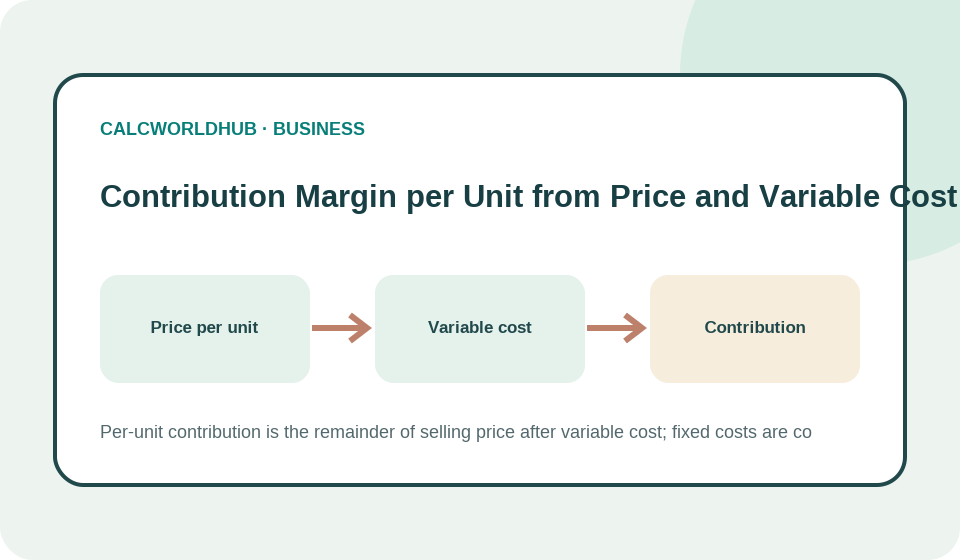
Contribution per unit = selling price per unit − variable cost per unit. The difference is available first to cover fixed costs; only what remains after costs is profit. If variable cost equals price, contribution is zero. If variable cost is higher, the contribution is negative and each additional sale increases the shortfall under those assumptions.
This calculator has visible fields for fixed operating costs and target unit sales, but its current result uses only the selling-price and variable-cost fields. Changing fixed costs or target volume leaves the displayed contribution per unit unchanged. Use this output for the subtraction only, and use a separate verified break-even calculation when fixed costs and sales volume are part of the question. The amount is displayed without forcing trailing zeroes.
Worked examples
The arithmetic below uses price and variable cost only, matching the displayed per-unit result.
A $48 item with $29.50 variable cost
Inputs: Selling price = $48.00 per unit; variable cost = $29.50 per unit; fixed operating costs = $12,000; target unit sales = 800.
Calculation: Contribution per unit = $48.00 − $29.50 = $18.50.
Each unit contributes $18.50 toward fixed costs before any remaining amount can be profit; the other visible inputs do not enter this result.
A lower price and cost combination
Inputs: Selling price = $32.75 per unit; variable cost = $21.20 per unit; fixed operating costs = $5,000; target unit sales = 400.
Calculation: Contribution per unit = $32.75 − $21.20 = $11.55.
The unit contribution is $11.55. It cannot be multiplied into an overall profit estimate without actual units and the full cost assumptions.

Do not confuse contribution with margin percentage
Per-unit contribution is an amount such as $18.50 per item. The contribution margin ratio is contribution divided by selling price, usually multiplied by 100 to express a percentage. Those are related but not interchangeable: $18.50 is not 18.5 percent unless a separate calculation supports that number. A contribution ratio can help compare products with different prices, while a unit contribution helps estimate how much each sale contributes to a fixed-cost total.
Total contribution is unit contribution × units sold, assuming the same price and variable cost for each unit. Tiered prices, volume discounts, commissions, or cost changes should be modeled separately. The per-unit result is not an income statement and excludes taxes, financing, and other operating costs.
Use fixed costs only in the next calculation
In a conventional single-product break-even model, break-even units are fixed costs divided by positive contribution per unit. That additional step requires a defined period and a fixed-cost total for that same period. If the contribution is zero or negative, the ordinary positive-unit break-even quotient is not meaningful. OpenStax presents contribution margin as part of a wider cost-volume-profit framework rather than as profit by itself.
The result also depends on assumptions such as a stable selling price, stable variable cost per unit, and a consistent product mix. For multiple products, the sales mix affects the weighted contribution. Capacity limits, step-fixed costs, discounts, spoilage, and inventory changes can alter the decision. Record which items are included in each cost figure so a later comparison does not silently change the model.
Use the number as a traceable input
Keep the calculation beside each input source: realized price, variable-cost method, currency, and period. If pricing is the decision, include only costs that are incremental under the scenario and account for special freight or setup charges when they apply.
The calculator does not classify costs, judge whether a price is commercially acceptable, or compute profit. It also does not solve for target quantity despite showing that field. Treat the displayed amount as the per-unit difference, then use accounting records for a broader decision.