
Choose one reporting boundary
Match the spend and delivered gross rating points to the same schedule, market, target group, and reporting dates. Decide which costs are included before doing the division. A schedule cost that includes fees cannot be compared directly with another cost that excludes them unless the difference is made explicit.
Keep the media plan, currency, rating service, audience universe, and daypart with the exported figures. Gross rating points sum rating points across placements, so repeated exposure contributes to the total; it is not a count of unique people reached.
GRPs are commonly described as reach percentage multiplied by average frequency, or as the sum of rating points across placements. The total can therefore exceed 100; that does not mean more than the entire population was reached, because the same person may contribute repeated exposures. Keep the ratings source’s universe definition with the schedule.
Read the source fields carefully
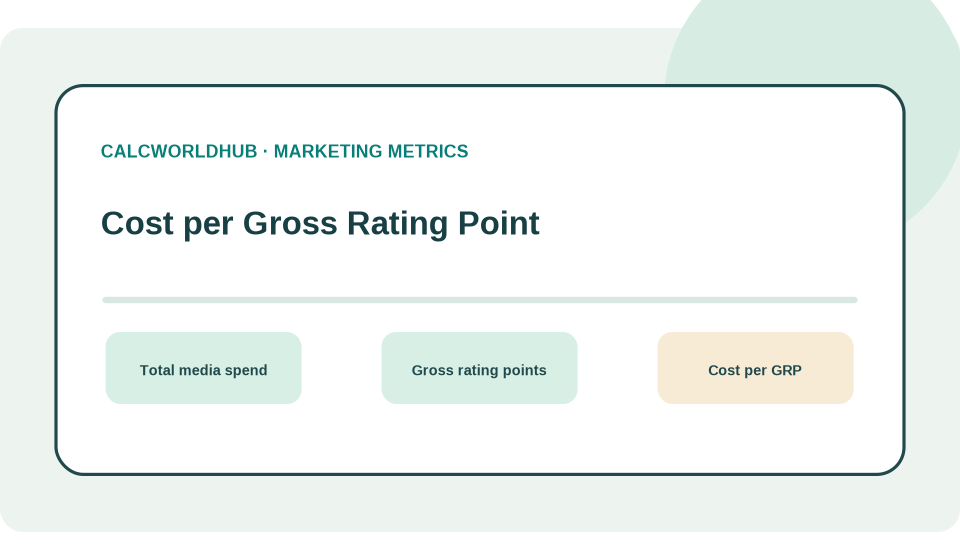
The fields are Total media spend and Gross rating points delivered. Spend is a nonnegative amount in the currency of the plan; GRPs must be greater than zero. The result is that same currency per GRP. A rating point is based on a specified audience universe, so its meaning depends on geography and target group.
Match the cost coverage to the exact schedule and ratings period. If one report uses projected points and another uses delivered points, they do not share the same basis. Preserve the source report’s audience label and measurement service rather than assuming two values called GRP are interchangeable.
Calculate cost per gross rating point
Cost per rating point = media spend ÷ gross rating points (GRPs). The quotient is normally shown in the currency used for spend per point. Keep the unrounded division through the calculation and round the final displayed cost to the chosen currency precision. This is not cost per unique person: one point represents a percentage of the specified audience universe.
A lower cost per point can indicate less spend for the reported delivery, but it says nothing on its own about audience quality, duplication, or business response.
Compare like with like
Compare schedules only when their markets, target audiences, dates, rating service, and spend coverage align. Gross rating points combine exposure across placements; reach and frequency describe different parts of that delivery and should be reviewed alongside the quotient.
Write down whether the spend is gross or net of agency discounts, commissions, production, or other fees. Those items are not automatically adjusted by the quotient, so including them for one plan but omitting them for another changes the comparison basis. A brief schedule note should identify the market, target group, dates, ratings service, and cost basis. That makes a later cost-per-point comparison traceable instead of relying on a bare currency figure.
Distinguish planned from delivered delivery. Dividing booked spend by a target GRP goal estimates a planned cost per point; the calculator’s delivered-points field describes what the report says was actually delivered. If a schedule is still in flight, label the result provisional and rerun the comparison with final delivery data.
Worked examples
The schedules compare media spend with gross rating points within their own market and audience basis.
A regional media schedule
Inputs: Total media spend = $120,000; Gross rating points delivered = 260.
Calculation: Cost per GRP = $120,000 ÷ 260 = $461.54 per point.
This is media currency per delivered GRP for the specified market and schedule.
A second market schedule
Inputs: Total media spend = $85,000; Gross rating points delivered = 170.
Calculation: Cost per GRP = $85,000 ÷ 170 = $500 per point.
Compare the second schedule only within the same audience universe and rating method.

Check the limits before acting
Ratings universes and measurement providers can differ, and this result does not calculate unique reach, response, or audience value. Treat the output as a cost normalization for a specified schedule, not a complete media-efficiency verdict.