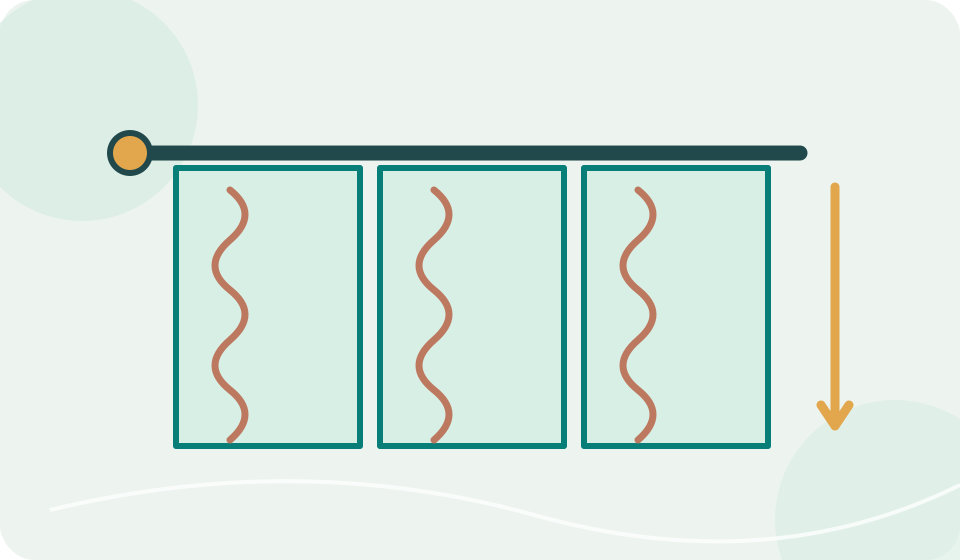

Separate fullness, panel count, and usable width
The calculator first multiplies track width by the fullness multiplier, divides that total across the entered number of equal panels, then divides each panel’s required flat width by usable fabric width. It rounds up to whole fabric widths per panel. Track width and usable width are in metres; fullness is a multiplier; panel count is a whole number. Use the fabric’s usable width after allowing for selvages or other unusable edges.
Fullness describes how much fabric width is gathered or pleated relative to the track coverage. A multiplier of 2 means twice the track width in flat fabric before dividing into panels. It does not account for a center overlap, side returns, heading type, lining, or decorative border because those are not fields. Add them to the measured plan or use a more detailed workroom calculation when they materially change the order.
Worked examples
Two panels with a 0.4-m vertical repeat
Inputs: Track width = 2.4 m; fullness = 2; panels = 2; usable width = 1.4 m; drop = 2.2 m; allowance = 0.3 m; repeat = 0.4 m
Calculation: Widths/panel = ceil(2.4×2/2/1.4) = 2; cut = ceil((2.2+0.3)/0.4)×0.4 = 2.8 m; total = 2×2×2.8
Estimated fabric length is 11.2 m.
A 0.45-m pattern repeat rounds a 2.75-m drop upward
Inputs: Track width = 3.0 m; fullness = 2.2; panels = 2; usable width = 1.5 m; drop = 2.45 m; allowance = 0.30 m; repeat = 0.45 m
Calculation: Widths/panel = ceil(3.0×2.2/2/1.5) = 3; cut = ceil(2.75/0.45)×0.45 = 3.15 m; total = 2×3×3.15
Estimated fabric length is 18.9 m before any extra allowance for specialized matching or waste.

Round cut drops to the fabric repeat
For each fabric width, the model adds finished drop and combined top-and-bottom allowance. If vertical pattern repeat is greater than zero, it rounds that cut length up to the next whole repeat; if repeat is zero, it uses the unrounded drop plus allowance. Total purchased length equals panels × whole widths per panel × cut length per width. Pattern repeat is in metres, so convert a label in centimetres before entering it.
Repeat rounding prevents a cut from stopping at an arbitrary point in the motif when panels need to start on a matching repeat. The model assumes a straight vertical repeat aligned consistently from drop to drop. It does not solve a half-drop pattern, pattern centering, matching across seams with varying panel start positions, directional fabric, or shrinkage after cleaning.
Example: double fullness with a 40-cm repeat
For a 2.4 m track, 2× fullness, two panels, and 1.4 m usable fabric width, each panel needs 2.4 × 2/2 = 2.4 m flat width. Dividing by 1.4 m gives 1.7143 widths, so round up to two widths per panel. The finished drop plus allowance is 2.2 + 0.3 = 2.5 m; the next 0.4 m repeat boundary is 2.8 m. Two panels × two widths × 2.8 m equals 11.2 m total.
Without a pattern repeat, the same inputs would use 2.5 m per width, or 10.0 m overall. The pattern therefore adds 1.2 m in this example. The change comes from rounding each cut to a full repeat, not from changing the track width or fullness. This comparison can help explain why a patterned fabric order differs from a plain-fabric estimate.
Example: wider fabric changes the width count in steps
For a 3.0 m track at 2.2× fullness, two panels, and 1.5 m usable width, each panel’s flat requirement is 3.0 × 2.2/2 = 3.3 m. Dividing by 1.5 m gives 2.2 widths, so the model rounds up to three per panel. A 2.45 m finished drop plus 0.30 m allowance is 2.75 m. With a 0.45 m repeat, the next repeat boundary is 3.15 m, giving 2 × 3 × 3.15 = 18.9 m total.
If the usable width increased enough for the same panel to fit in two widths, the total would fall by one full cut per panel. The count changes in steps rather than continuously because you cannot generally buy a fractional fabric width and still make the planned panel. Check the bolt label and cutting plan before treating nominal roll width as usable width.
Check the finished measurements and sewing plan
Measure the track rather than assuming it matches the window opening, and record the finished drop from the intended hanging point. The Spotlight fabric worksheet explains that fullness, seam allowance, and a pattern repeat affect yardage; its worked method also rounds a drop to pattern units. This calculator uses its own explicit fields, including an equal-panel count and combined top/bottom allowance, so do not copy a worksheet’s allowance without checking what the calculator already includes.
Before purchasing, verify heading style, hem depth, returns, overlap, lining, seam allowance, repeat alignment, fabric direction, and shrinkage with the workroom or supplier. These factors can increase yardage. The estimate is a cut-length total under simplified equal-panel assumptions, not a complete sewing pattern or guarantee that a particular bolt can be cut without waste.