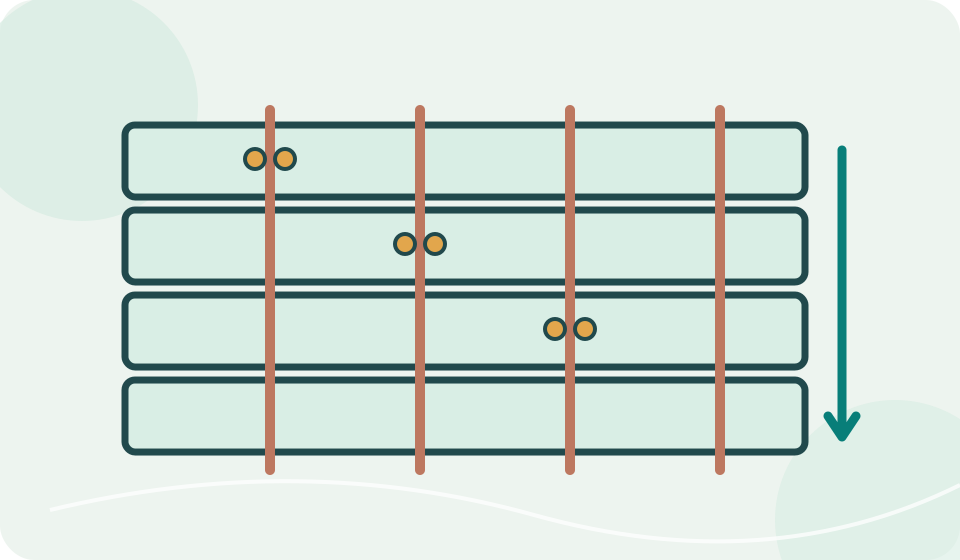

Count crossings before applying screws per crossing
The model starts with installed boards × joist lines crossed by each board. It adds the entered butt-end crossing equivalents, multiplies the total by screws per board/joist crossing, applies the spare percentage, and rounds up. The result is a piece count. For consistent counting, a joist line is one support position crossed by a board, and a butt-end crossing equivalent is an additional modeled support-and-fastener event beyond the regular board-by-joist grid.
Use the as-installed board layout rather than the deck area alone. Picture frames, divider boards, stair edges, blocking, posts, and cutouts can change fastening locations. The calculator does not identify them automatically. Its spare allowance is applied after the raw screw count and before rounding, so it is a purchase buffer rather than a required installation pattern.
Worked examples
A regular field with 10% spares
Inputs: Installed boards = 30; joist lines per board = 12; screws per crossing = 2; extra crossing equivalents = 10; spare allowance = 10%
Calculation: ceil((30×12 + 10) × 2 × 1.10) = ceil(370 × 2.2) = 814
Estimate 814 face screws under the entered uniform crossing rule.
A fractional spare quantity rounds upward
Inputs: Installed boards = 24; joist lines per board = 10; screws per crossing = 2; extra crossing equivalents = 12; spare allowance = 8%
Calculation: Raw = (24×10 + 12) × 2 = 504; with spares = 504 × 1.08 = 544.32; purchase count = ceil(544.32)
The calculator estimates 545 screws before any separate package-size rounding.

Example: a regular field with a small extra-end allowance
For 30 boards and 12 joist lines per board, regular crossings are 30 × 12 = 360. Adding 10 butt-end crossing equivalents gives 370 modeled fastening locations. At two screws each, the base count is 740. A 10% spare allowance adds 74, yielding 814 screws exactly, so no further rounding changes the count.
This estimate is useful for building a shopping list when the deck layout is regular and the chosen product specifies the same screw count per crossing. Trex’s installation guidance, for example, shows two screws per joist for specified screw-fastened decking. That is a product installation rule, not a universal requirement for every board, clip system, framing material, or local design.
Example: round up a fractional spare count
With 24 boards, 10 joist lines per board, and 12 extra crossing equivalents, the modeled total is 24 × 10 + 12 = 252 crossings. At two screws each, that is 504. Adding 8% spares gives 504 × 1.08 = 544.32, which rounds up to 545 screws. The extra fraction cannot be purchased as a screw, so the final count is the next whole piece.
Changing the spare allowance from 8% to 10% raises the raw count to 554.4 and the purchase estimate to 555 screws. This single-input comparison shows that the spare field applies to the complete base count, including the extra-end equivalents. If the supplier sells fixed package sizes, round the package count separately after checking the package quantity.
Make the board layout match the manufacturer’s fastening guide
Board material and profile determine whether face screws, hidden clips, plugs, or a combination is recommended. Follow the specific decking manufacturer’s approved fasteners, edge distances, joist spacing, predrilling requirements, and fastening method. Some systems use a clip at each joist between boards, while exposed-edge or perimeter boards may need a different treatment. Do not use the calculator’s default of two screws as a substitute for those instructions.
For a field layout, count each board’s support crossings from the framing plan. A board that stops or starts at a butt joint may require blocking or paired joists, but the input is only a crossing-equivalent count; it does not design the framing. If two boards share support at a joint, enter the fastening events according to the product guide rather than assuming the `ends` field means simply the number of visible board ends.
Use the result as a quantity estimate, not a structural check
The output excludes hidden clips, perimeter blocking, ledger and railing fasteners, stair fasteners, replacement screws, and fastening needed around picture frames unless those are represented in the entered crossing equivalents and screws-per-crossing value. It also does not verify corrosion resistance, screw length, pull-out capacity, spacing, or framing adequacy. Keep those decisions tied to the deck system and its installation documents.
A practical check is to multiply regular board and joist counts by the specified per-crossing rule, add separately counted details, then apply the spare factor once. Compare the result with a scaled layout or a package estimator, especially when the deck has several board directions. The calculator helps turn a regularized takeoff into an approximate purchase count; it cannot determine whether the layout meets engineering or code requirements.