
Start with the finished surface area
Measure the surface that will actually receive flooring and enter its area in square feet. For a simple rectangle, length multiplied by width gives the plan area; for an L-shaped room, divide the floor into nonoverlapping rectangles and add them. Avoid counting closets, alcoves, or thresholds twice when they connect to a larger space.
The estimate assumes the area and package coverage use the same square-foot unit. If a product label gives square metres, convert before entering it or use a calculation that keeps both values metric. The NIST area conversion reference is useful when a supplier quotes coverage in a different unit system; rounding the input too early can shift a carton count near a boundary.
Read coverage from the exact product package
Coverage per box is the manufacturer’s stated floor area for the specific product and carton. Similar-looking planks or tiles can have different dimensions and quantities per package, so use the label or current product specification rather than a generic average. A carton count is a purchasing unit; it is not a promise that every square foot can be covered after cuts.
The extra allowance is a percentage applied to the measured area. It is not a separate room measurement and it does not change the coverage printed on the box. Choose an allowance that reflects the installation pattern, room shape, transitions, expected culling, and whether you want spare material for later repairs. The calculator does not choose that percentage for you.
Calculate order area before rounding boxes
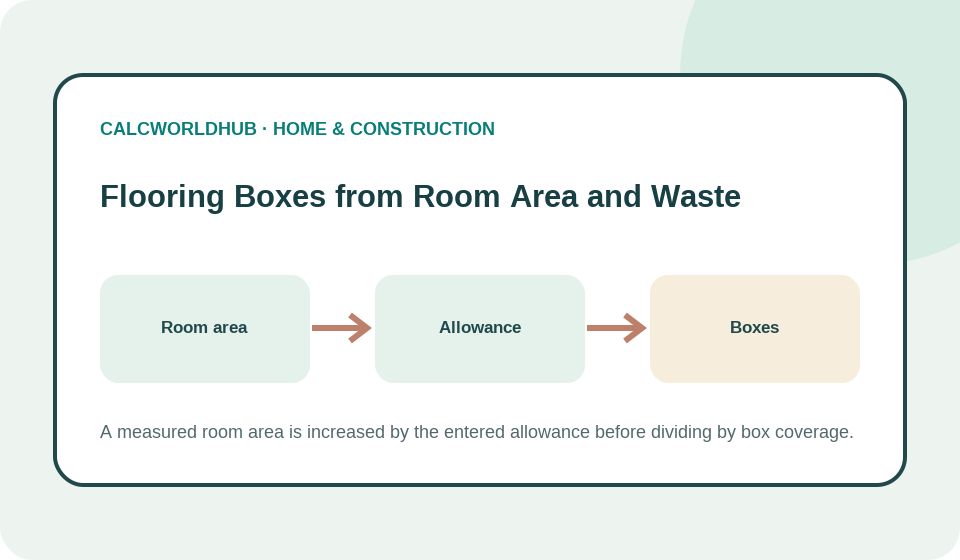
First multiply base area by one plus the allowance percentage expressed as a fraction. Then divide that order area by the coverage per box. Because flooring is normally sold in whole cartons, round the quotient upward to the next integer; rounding to the nearest carton could leave too little material even when the decimal part is small.
The order area is shown separately from the number of boxes so you can inspect both stages. A 10% allowance means the entered area is multiplied by 1.10, not that ten square feet are added regardless of room size. If the allowance is zero, the calculation still rounds cartons up whenever measured area is not an exact multiple of package coverage.
Treat the allowance as a project decision
Straight-lay layouts, diagonal patterns, herringbone, narrow corridors, many doorways, and rooms with angled walls create different cutting demands. A single percentage cannot model each board cut or salvage offcut. The NWFA installation guidelines describe installation considerations for wood flooring; product instructions and the installer’s layout determine how much usable material a real job needs.
Also decide whether the estimate includes a reserve carton. A future repair may be easier if spare pieces come from the same product run, but a reserve is a separate purchasing choice unless you include it in the allowance. Keep that choice visible in your notes instead of silently increasing the measured room area.
Translate the estimate into a purchase plan
Before ordering, compare the calculator’s whole-carton result with the package size, product batch, lead time, and the supplier’s return policy. Confirm the room dimensions on site and include adjoining rooms only if the flooring will be continuous across them. If the product has a required direction or pattern, make the measurement plan match that installation choice.
The result does not estimate underlayment, adhesive, transition strips, labor, price, or structural suitability of the substrate. It also does not check manufacturer installation instructions or moisture limits. Use the box count as a transparent material estimate, then confirm the final takeoff with the installer or supplier for complex layouts.
Worked examples
The order count is rounded up only after the waste-adjusted area is divided by package coverage.
A rectangular room with a 12% allowance
Inputs: Room area = 225 sq ft; coverage = 18.5 sq ft per box; extra allowance = 12%.
Calculation: Order area = 225 × (1 + 12/100) = 252 sq ft. Boxes = ceil(252 ÷ 18.5) = ceil(13.6216…) = 14 boxes.
Fourteen cartons provide 259 sq ft of nominal package coverage. That is the first whole-carton quantity above the 252 sq ft estimate; the surplus is not a prediction of exact offcut recovery.
A larger floor using 24 sq ft cartons
Inputs: Room area = 480 sq ft; coverage = 24 sq ft per box; extra allowance = 8%.
Calculation: Order area = 480 × 1.08 = 518.4 sq ft. Boxes = ceil(518.4 ÷ 24) = ceil(21.6) = 22 boxes.
Twenty-two cartons cover 528 nominal square feet. The calculation includes the selected 8% area allowance before rounding to a whole box.
