
Understand the denominator
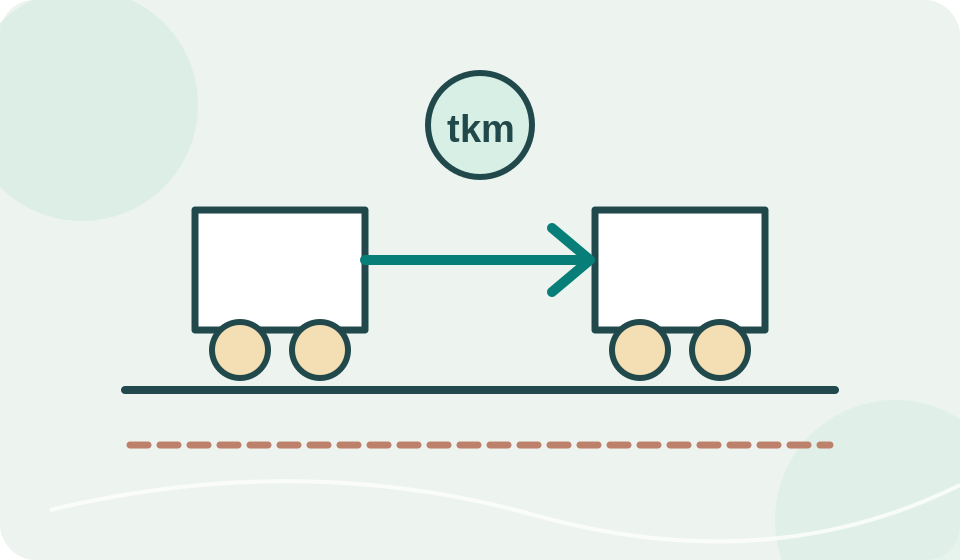
A tonne-kilometre represents one tonne of goods transported one kilometre. Eurostat describes the measure for freight transport and specifies that its statistical definition can include packaging and the tare weight of intermodal transport units. For a local operating comparison, state whether your tonne input is net product mass or gross transport mass and use the same convention across the lanes or periods being compared.
The calculator accepts cost in a chosen currency and freight work in tonne-kilometres. The cost must be finite and nonnegative; work must be finite and greater than zero. The result is cost ÷ tonne-kilometres, rounded to four decimal places. Currency is not converted automatically, so a USD figure and an EUR figure cannot be compared until exchange-rate timing and conversion method are made consistent.
Build tonne-kilometres from shipment legs
For one shipment leg, multiply the tonnes assigned to that leg by the kilometres actually used for the measure. A 12-tonne load travelling 500 kilometres produces 6,000 tonne-kilometres. For multiple legs or shipments, sum each leg’s tonnes × distance; do not multiply total network tonnes by average distance unless that average is weighted in a way that reproduces the same total freight work.
Use the transport mode and distance convention appropriate to your decision: road, rail, inland waterway, or a clearly defined multimodal aggregate. Eurostat publishes transport performance by mode and uses tonne-kilometres alongside tonnes and vehicle-kilometres. A route distance may be planned, shortest-path, or actual operated distance; select one and document detours, empty returns, and transshipment consistently.
Keep numerator and denominator aligned
Include costs that correspond to the same transport work. If the numerator includes fuel surcharge, tolls, accessorials, or terminal charges, say so. Exclude warehousing or customs costs only if that exclusion matches the comparison purpose. The calculator accepts a single cost amount, so it cannot separate line-haul, stop charges, storage, taxes, or other invoice components for you.
The numerator and denominator must cover the same cohort. Do not divide a month’s total road cost by only the loads with complete distance records, and do not mix shipment-level cost with network-level tonne-kilometres from a wider period. An incomplete denominator inflates the unit cost; a numerator that omits a surcharge can make service appear cheaper than the invoice total.
Use the rate as a benchmark with context
A lower cost per tonne-kilometre can reflect denser loads, longer average distances, or better routing, but also a different cost boundary, geography, commodity, service level, or mode. The ratio does not measure delivery reliability, emissions, damage, empty vehicle movement, or customer value. Use it with on-time performance, utilization, fuel use, handling, and lane characteristics rather than treating it as a complete efficiency score.
The output precision does not make the inputs precise. Distance estimates, scale data, cost accruals, and currency conversion may have uncertainty. Preserve the calculation period and source records, round only for display, and compare groups with the same denominator rule. If tonne-kilometres are zero, the calculator cannot produce a ratio; investigate missing distance or no transported mass instead of substituting an arbitrary small value.
Worked examples
Both examples assume that cost and freight work refer to the same mode, period, route cohort, and currency. The rate is a unit comparison, not a quoted carrier price.
A regional distribution lane
Inputs: Transport cost $4,200 and freight work 60,000 tonne-kilometres
Calculation: $4,200 ÷ 60,000 tkm = $0.07 per tkm
The calculator displays $0.0700 per tonne-kilometre. This interpretation is valid only if both inputs cover the same shipments and cost scope.
A longer-haul comparison period
Inputs: Transport cost $9,450 and freight work 105,000 tonne-kilometres
Calculation: $9,450 ÷ 105,000 tkm = $0.09 per tkm
The result is $0.0900 per tonne-kilometre. Compare this with the first lane only after aligning mode, currency, service, and included costs.
