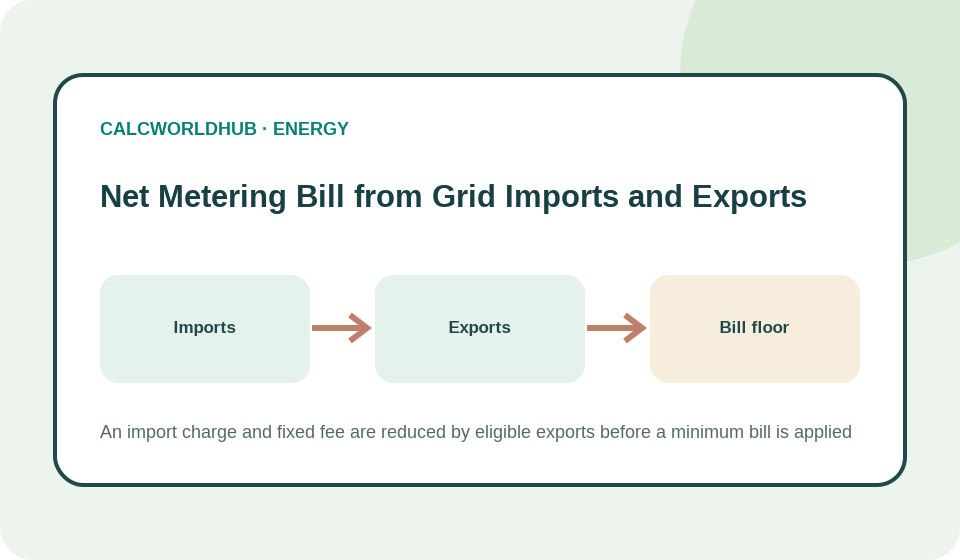

Separate grid imports from exports
Imported kWh are energy drawn from the grid during the selected bill period. Exported kWh are energy sent to the grid and eligible for the entered credit in this simplified model. They are separate measurements; netting them into one energy number before applying rates can be wrong when imports and exports receive different prices.
The model multiplies imports by the import rate and exports by the credit rate. Enter both rates in dollars per kWh for the same period and customer account. If exports are compensated at a time-varying or wholesale rate, use an appropriate period average only when that approximation is defensible.
Add fixed charges before the bill floor
The bill before the minimum is fixed charges + imported kWh × import rate − exported kWh × credit rate. The calculator then returns the larger of that amount and the minimum bill. A zero minimum can represent a tariff without a floor; it does not create a credit balance when exports exceed charges.
This order matters. The fixed charge remains in the pre-floor total in the current formula, then the floor is applied once. If the result is below the minimum, the estimated bill equals the floor. A negative pre-floor value is not paid as cash here, and unspent export credits are not carried forward into another billing period.
Read the tariff rather than assuming a universal rule
Net-metering arrangements vary by state, utility, customer class, and program date. A provider may value exports at the retail rate, a separate avoided-cost rate, a time-dependent value, or a credit bank that carries across periods. EIA’s policy overview describes this variation; the calculator cannot select the right rule for your service address.
Check whether the statement measures exports in the same billing interval as imports and whether a minimum charge applies before or after taxes and riders. Enter only charges covered by this model. Taxes, fixed delivery items, tiered import rates, demand fees, and carry-forward credits require additional tariff logic.
Use interval totals with matching meter boundaries
Use imported and exported energy from the same meter and dates. Do not mix inverter production with grid exports: on-site solar use may never pass through the export register. Similarly, an annual export total should not be combined with one month of imports or a one-month fixed fee.
Summing intervals can hide time-varying rates. A single average import or credit rate is appropriate only when the tariff is linear and the averages are weighted to match the billing period.
Understand what a one-period estimate cannot show
The calculator does not model a credit bank, annual true-up, meter-reading correction, taxes, rate tiers, time-of-use buckets, or a cap on eligible exports. It also does not estimate solar production or decide how much energy a home will self-consume. Those are separate system and tariff questions.
An export credit can lower the bill without representing a payment. A utility may carry remaining credits, expire them, or settle them under rules that differ from this simple floor. Keep the number labeled as a one-period estimate and consult the applicable tariff before making a financial decision.
Compare policy scenarios transparently
A scenario comparison can show how the bill changes when the credit rate, minimum, or imported energy changes. Keep one input at a time fixed when explaining the difference, and state whether the result is before or after the minimum floor. A claimed savings figure should also account for the solar system’s costs and any billing rules outside this equation.
For reproducibility, record the utility, tariff version, billing dates, meter totals, import rate, credit rate, fixed charges, and minimum. A tariff change can alter the comparison even when household usage stays constant. The calculator is an arithmetic aid, not a bill audit or guarantee of compensation.
Worked examples
The first case stays above the minimum bill; the second falls below it and is raised to the entered floor.
Exports reduce charges but do not reach the floor
Inputs: Imports = 450 kWh; exports = 180 kWh; import rate = $0.18/kWh; export credit = $0.07/kWh; fixed charges = $18; minimum bill = $25.
Calculation: Import charge = 450×$0.18 = $81. Export credit = 180×$0.07 = $12.60. Before floor = $18 + $81 − $12.60 = $86.40. Bill = max($25, $86.40) = $86.40.
The modeled bill remains above the $25 floor. No credit is carried to another period.
The minimum bill controls after export credit
Inputs: Imports = 120 kWh; exports = 600 kWh; import rate = $0.15/kWh; export credit = $0.05/kWh; fixed charges = $20; minimum bill = $10.
Calculation: Import charge = 120×$0.15 = $18. Export credit = 600×$0.05 = $30. Before floor = $20 + $18 − $30 = $8. Bill = max($10, $8) = $10.
The entered floor raises the estimate from $8 to $10. Any surplus credit is not reported as cash or carried forward.
