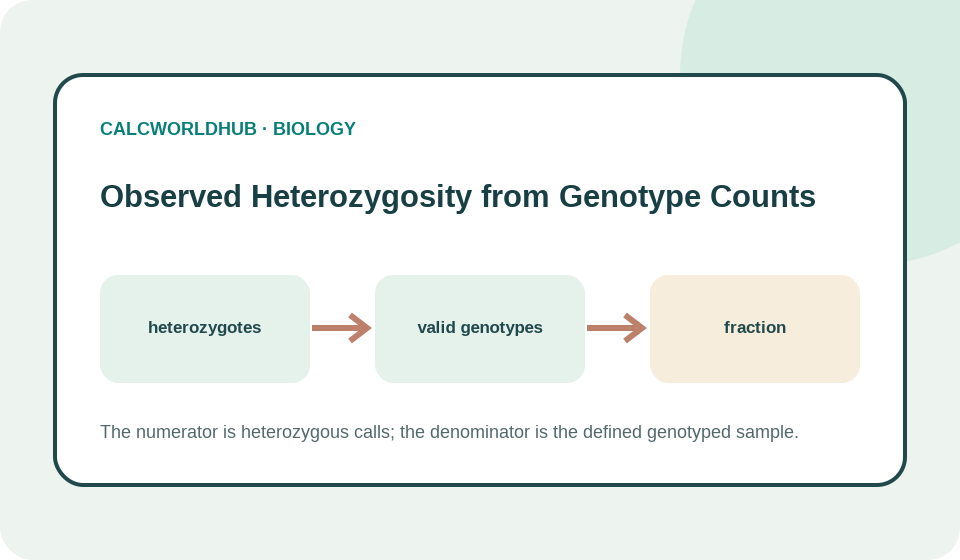

Define the genotyped sample
Use a heterozygote count and a sample size from the same locus, marker set, population, and filtering rules. The denominator should be the number of individuals with usable genotypes for the calculation you intend. If some calls are missing or fail quality criteria, do not silently include them as if they were homozygous.
The heterozygote count must be nonnegative and cannot exceed the positive sample size. For a single diploid biallelic locus, a heterozygous call carries one copy of each allele, but the precise genotype-calling and ploidy rules come from the assay and study design. Keep those definitions attached to the tally.
Calculate the observed fraction
Observed heterozygosity Hₒ = heterozygous individuals ÷ genotyped sample size. Multiply the fraction by 100 to express the same statistic as a percentage. The complement, sample size minus heterozygotes, is the number of observations counted as non-heterozygous under the entered classification.
NCBI’s dbSNP submission guidance describes reporting a heterozygosity count as a fraction of the sample size. That denominator is essential: 12 heterozygotes among 20 callable individuals is a different observed proportion from 12 among 40, even though the numerator matches. The calculator labels the remaining count homozygous; use that interpretation only when it matches the genotype classes and ploidy represented in your data.
Separate observed from expected heterozygosity
Observed heterozygosity is counted from called genotypes. Expected heterozygosity is a population-genetic quantity derived from allele frequencies under a model, often with assumptions about random mating and sampling. They answer different questions and should not share one label without qualification.
A high or low observed fraction does not by itself establish inbreeding, selection, population structure, or genotyping error. Such interpretations require an explicit comparison model and appropriate data. This calculator has no allele-frequency inputs, locus metadata, ploidy adjustment, or uncertainty calculation.
Make missingness and aggregation visible
If you summarize multiple loci, decide whether the intended result gives each genotype call equal weight, each locus equal weight, or each individual equal weight. Those aggregations can differ when missingness varies. A single pooled count divided by a pooled denominator weights loci according to how many valid genotypes they contribute.
Record the quality filters and the number of callable observations. If genotype calls are uncertain or low coverage, a hard heterozygote count may hide uncertainty in the underlying reads. The simple proportion treats each entered classification as correct and does not model genotype likelihoods or sequencing error.
Report the statistic with its scope
State whether the value is for one locus, one sample, or a defined set of loci, and include both the percentage and numerator/denominator. For comparisons, apply consistent call filters and sample definitions. A percentage without the denominator can hide whether it came from a small or large number of genotypes.
Use this result as an observed descriptive statistic only. A genetics analysis may require expected heterozygosity, allele frequencies, confidence intervals, or a multi-locus estimate. Those are separate calculations and should be performed using methods appropriate to the study design and data quality.
Worked examples
Twenty-eight heterozygotes among eighty calls
Inputs: Heterozygous genotypes = 28; genotyped sample size = 80.
Calculation: Observed heterozygosity = 28 ÷ 80 = 0.35. Percentage = 0.35 × 100 = 35%. Homozygous count = 80 − 28 = 52.
Thirty-five percent of the 80 included genotype observations are classified as heterozygous under the stated call rules.
Sixty-one heterozygotes in a larger sample
Inputs: Heterozygous genotypes = 61; genotyped sample size = 100.
Calculation: Observed heterozygosity = 61 ÷ 100 = 0.61. Percentage = 0.61 × 100 = 61%. Homozygous count = 100 − 61 = 39.
The observed heterozygote share is 61% in this sample; it is not an expected population-genetic value.
