
What grammage says about a material
Use grammage when comparing the mass per area of sheet materials or checking a sample against a stated nominal value. It is a material property expressed as a ratio, not the total mass of a finished carton. The same grammage can occur in papers or boards with different thickness, fibre composition, coatings, stiffness, and performance.
Measure the sample mass and area
The calculator asks for sample mass in grams and sample area in square metres. If the sample is measured in centimetres or millimetres, convert its dimensions to square metres before entering area. For a rectangular coupon, multiply its length by width in metres. Do not enter a linear sheet dimension as area, and do not mix mass units such as kilograms with grams.
Convert the ratio into g/m²
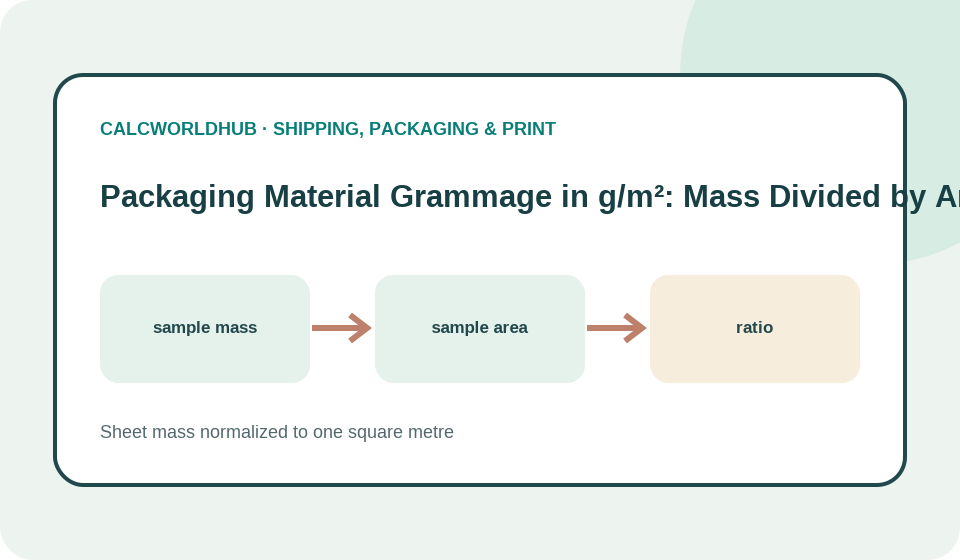
The equation is grammage = mass ÷ area. Because one gram divided by one square metre is one g/m², the units follow directly. A higher result means more mass per unit area for that sample. The tool does not apply a moisture correction or adjust for test atmosphere, conditioning, or material type.
Keep specimen condition consistent
Paper and board test methods specify how specimens are conditioned and weighed because moisture can change mass. Edge trim and nonuniform coatings can also shift the result. When comparing samples, use the same conditioning, area measurement, balance resolution, and treatment of printed or coated surfaces so that the comparison is meaningful.
Compare materials with context
A grammage result can help screen stock options or check a production sample, but it does not predict package strength on its own. Corrugated board performance depends on its construction and flute, while papers with equal grammage can differ in caliper and tensile properties. Use the relevant material specification and tests for the decision being made.
The arithmetic is simple, while reliable measurement depends on representative sampling. A tiny coupon can be affected by scale resolution, edge damage, moisture, and the way its area was cut. If the value will be used for purchasing, quality control, or a certificate, follow the applicable test method and sampling plan rather than treating one hand-cut piece as a definitive lot result.
When the result is compared with a mill certificate, confirm that both values refer to the same grade, surface treatment, and moisture-conditioning basis. A coated sheet’s total mass includes its coating if the entire specimen is weighed, while a certificate may report a nominal base-paper value. State the specimen definition so a difference is not mistaken for a process change.
If dimensions are measured after conditioning, record the conditioning interval and environment with the result. Moisture can change the measured mass, and a cut edge can expose layers that are not representative of the usable sheet. A consistent test setup makes small differences easier to interpret without confusing measurement variation with a genuine change in stock.
Worked examples
Both values are direct mass-to-area ratios; area must already be in square metres.
A 2.5 square metre sample
Inputs: Sample mass = 145 g; area = 2.5 m².
Calculation: Grammage = 145 g ÷ 2.5 m² = 58 g/m².
The sample has a calculated grammage of 58 g/m².
A smaller, heavier sample per area
Inputs: Sample mass = 350 g; area = 0.8 m².
Calculation: Grammage = 350 g ÷ 0.8 m² = 437.5 g/m².
The calculated mass per area is 437.5 g/m²; it does not by itself describe board strength.

A small sample is not a full specification
For a batch-level estimate, weigh and measure several representative pieces and report the method and spread, not only one rounded ratio. If the measured sample is 0.8 m², for example, a small scale error changes the quotient more than it would for a larger sample. Keep significant digits consistent with the instruments and sample preparation.
ISO 536 describes a standardized method for determining paper and board grammage, including the use of conditioned test pieces. The calculator implements only mass divided by area; it does not certify a result to that method. If a contract or quality plan names a standard, follow its specimen preparation, conditioning, balance, and reporting requirements.