
Plan strap loops around the load
Start by sketching the intended band pattern around one loaded pallet. The calculator estimates vertical loops that pass over the top and underneath or around the pallet base, following the length-height or width-height perimeter. It is a material-planning aid for a defined pattern; it does not design a safe restraint system or determine how many straps a load requires.
Record pallet and load dimensions
Enter pallet or load length, width, and total strapped height in millimetres. Use the outside path the strap will follow, including load overhang if it changes the loop. Add the number of loops in each direction. The calculator treats these as counts for one pallet and adds the entered overlap once for each loop.
Count loops by direction
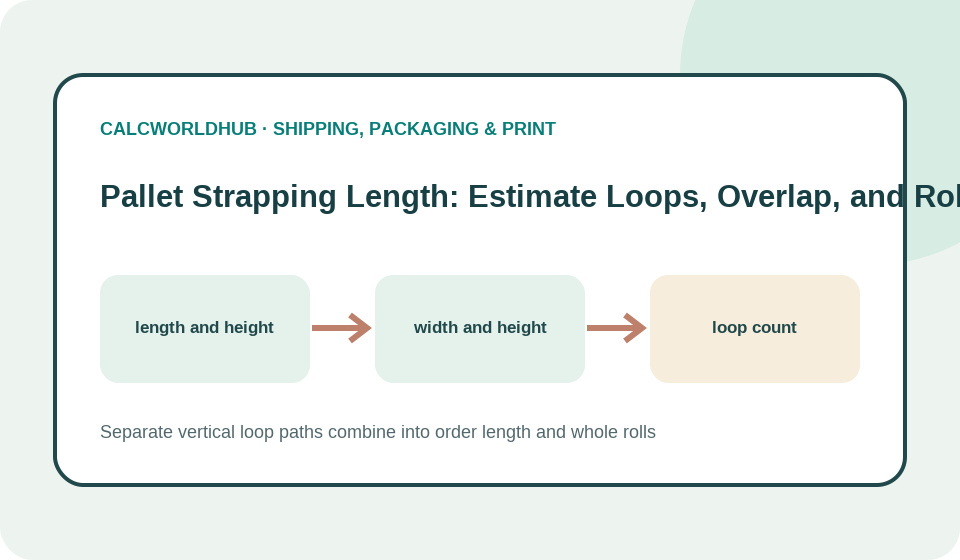
A length-direction loop uses twice the sum of length and height; a width-direction loop uses twice the sum of width and height. Multiply each perimeter by its loop count, then add the loop contributions. This assumes a rectangular load and a straight path along its faces. It does not add diagonal bracing or extra tails beyond the overlap field.
Add overlaps and order allowance
Overlap is specified in millimetres per loop and is added to the geometric perimeter. The per-pallet total is converted to metres, multiplied by the pallet count, and increased by the waste percentage. Waste can cover setup ends or expected cutoffs only if it matches the operation; do not count the same allowance in both overlap and waste.
Convert demand to full rolls
The calculator divides total order length by roll length and rounds up because a partial roll cannot satisfy the order if rolls are purchased as whole units. Keep the unrounded order length for this step. For example, 231 metres with 50-metre rolls requires five rolls, not four, even though the last roll will not be fully consumed by this estimate.
The result depends on the pattern definition. Here, one loop in the length direction travels around the pallet length and load height; a width-direction loop uses the width and height. If a real machine uses horizontal bands, cross-strapping, corner boards, a different seal overlap, or a different cut-off allowance, the entered loop counts and allowance need to represent that actual pattern.
Worked examples
Each loop count receives one overlap allowance; the total is then increased by the waste percentage before whole-roll rounding.
Ten pallets with four vertical loops each
Inputs: L = 1,200 mm; W = 1,000 mm; H = 1,500 mm; loops L = 2; loops W = 2; overlap = 300 mm; 10 pallets; waste = 5%; roll = 50 m.
Calculation: Per pallet = [2×2(1,200+1,500) + 2×2(1,000+1,500) + 4×300] ÷ 1,000 = 22 m. Order = 22×10×1.05 = 231 m; rolls = ceil(231/50) = 5.
Plan for 231 metres under the entered allowance, which requires five 50-metre rolls.
Four shorter pallets with an uneven loop pattern
Inputs: L = 1,200 mm; W = 800 mm; H = 1,400 mm; loops L = 3; loops W = 1; overlap = 250 mm; 4 pallets; waste = 8%; roll = 60 m.
Calculation: Per pallet = [3×2(1,200+1,400) + 1×2(800+1,400) + 4×250] ÷ 1,000 = 21 m. Order = 21×4×1.08 = 90.72 m; rolls = ceil(90.72/60) = 2.
The allowance-adjusted estimate is 90.72 metres, so two 60-metre rolls are needed.

A geometric estimate needs a packing check
Measure a packed pallet rather than relying only on a nominal pallet size when the cargo changes the strap path. Corner protectors and edge boards can increase the path; recesses or a different under-pallet route can change it in another direction. Trial a strap on a representative load, then compare measured consumption with the estimate to calibrate a realistic allowance.
Length alone does not establish restraint performance. Strap material, width, break strength, tension, seals, pallet integrity, load stability, and transport conditions all matter. Follow the packaging system supplier’s instructions and applicable load-securement rules. Use this result to plan approximate material quantity after the required pattern has been chosen.