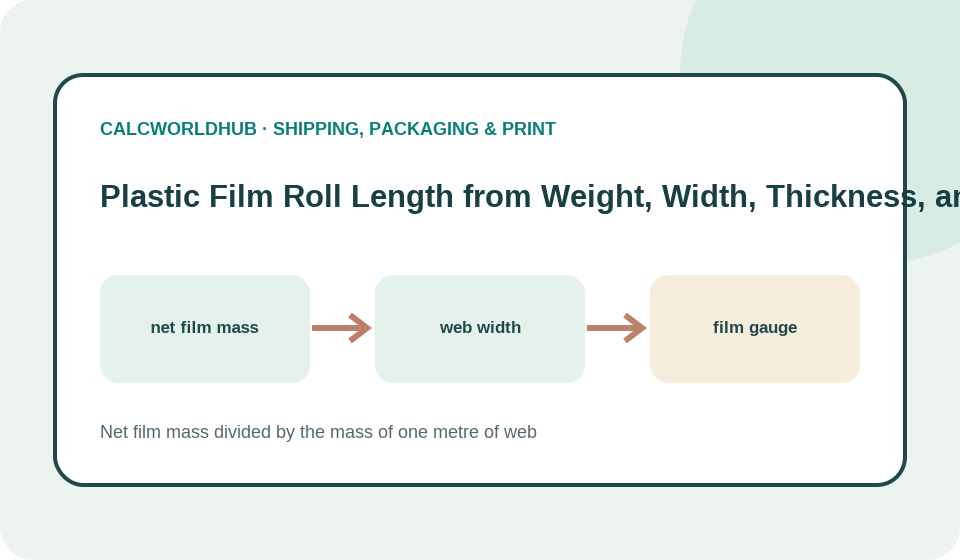

Estimate web length from a net roll mass
The roll-length question is different from measuring the outside diameter of a wound roll. If the net mass of plastic is known, density relates that mass to material volume; width and thickness describe how much volume one metre of web occupies. The resulting length is a theoretical value for the film itself, not a measurement of the roll’s wound geometry.
Use the film’s actual dimensions
Enter net film mass in kilograms, web width in millimetres, thickness in micrometres, and density in kilograms per cubic metre. Do not include the core, packaging, or other materials in net film mass. Density should come from a datasheet for the specific polymer grade or a reliable material measurement; generic resin values are only approximations when blends, fillers, or coatings are present.
Convert units before calculating
Convert width from millimetres to metres and thickness from micrometres to metres. Cross-sectional area is width × thickness in square metres. Multiply that area by density to obtain mass per metre, then divide the net film mass by that linear mass. Keeping the units visible shows why kg divided by kg/m produces metres.
Why mass divided by mass per metre works
The relation follows from mass = density × volume, with web volume equal to width × thickness × length for a uniform rectangular strip. Rearranging gives length = mass ÷ (density × width × thickness). The calculator does not infer density from a resin name and does not correct for edge trim, perforations, printed coatings, or multilayer composition unless those are reflected in the effective inputs.
Interpret the answer as nominal length
Use the result for an approximate roll-length check or to compare material scenarios. If width and density remain fixed, greater net mass means more length; if thickness increases, the same mass corresponds to less length. These relationships are useful for spotting an input unit error, such as entering 23 as millimetres when the field expects micrometres.
This method is sensitive to thickness because a thinner web contains less material per metre and therefore yields a longer estimated roll. A nominal thickness can conceal gauge variation across the web or along the roll. For inventory or production planning, compare the calculated length with a measured sample or supplier specification and retain the density and thickness source alongside the estimate.
For a multilayer structure, summing layer thicknesses and using one resin density may produce a misleading result if the layers have different densities or the stated gauge includes printed or coated layers. An effective areal mass from a supplier can be more representative. Keep the calculation’s inputs tied to one construction specification instead of mixing a base-film gauge with a finished-laminate density.
Worked examples
Width and thickness are converted to metres before multiplying by density, so the result is a nominal web length.
A 500 millimetre web with 23 micrometre film
Inputs: Net film mass = 18 kg; width = 500 mm; thickness = 23 μm; density = 920 kg/m³.
Calculation: L = 18 ÷ [920 × 0.500 × 0.000023] = 18 ÷ 0.01058 = 1,701.3233 m.
The ideal estimate is about 1,701 m of film, before process losses or gauge variation.
A wider, heavier-gauge roll
Inputs: Net film mass = 25 kg; width = 750 mm; thickness = 40 μm; density = 950 kg/m³.
Calculation: L = 25 ÷ [950 × 0.750 × 0.000040] = 25 ÷ 0.0285 = 877.1930 m.
The estimated web length is about 877.2 m under the uniform-film assumptions.

Material variation changes the estimate
Real film may vary in gauge and density, and net mass may be rounded. For coextruded films, the effective density depends on each layer’s material and thickness share. A coating or adhesive adds mass without necessarily changing the base-film thickness in the same way. Near-critical production decisions should use a calibrated line measurement or supplier data rather than this idealized estimate.
A longer computed roll does not automatically mean better yield. Splices, damaged edges, unusable leaders, winding tension, and process setup can reduce usable web. This calculation also does not convert length to roll diameter; that requires core diameter and winding geometry. State whether the reported length is theoretical film length or net usable length in any inventory record.