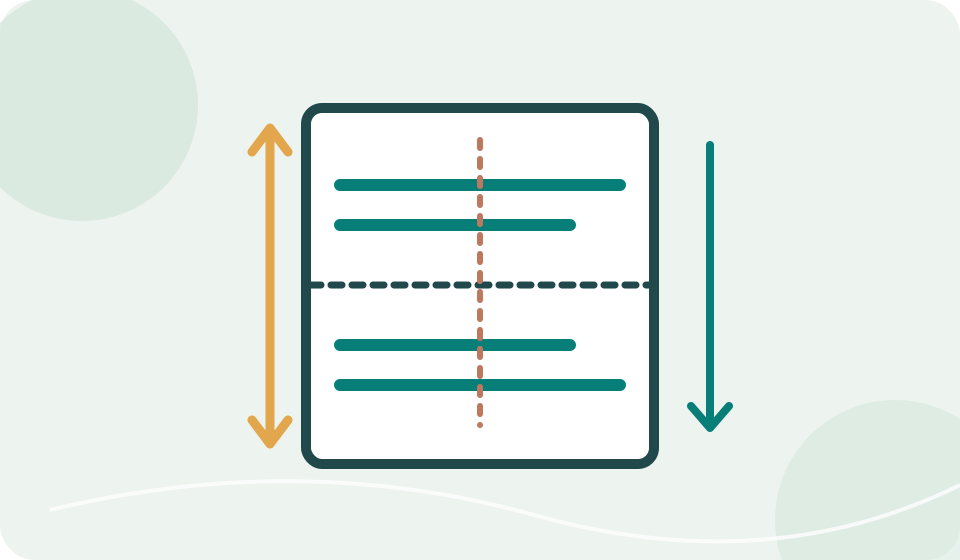

Define the axis before the dimensions
The second moment of area I measures how a cross-sectional area is distributed around an axis. For a rectangle of width b and depth h, the centroidal horizontal-axis value is I = bh³/12. The calculator uses width b and depth h in millimetres, and the result therefore has units mm⁴. Its description refers to the horizontal centroidal axis, with h measured vertically through the bending depth.
This I is an area property for beam bending, not the mass moment used in rotational dynamics or the polar area moment used for torsion. Its mm⁴ unit identifies the quantity.
What to enter
Enter positive width b and depth h in millimetres. The source runtime rejects zero or negative dimensions and evaluates b × h³ ÷ 12, formatting the number to five decimal places. No material, load, span, or mass input is used; those belong to later structural calculations. Keep the bending axis and dimension labels consistent with the drawing or section table from which the values came.
For a standard rectangle with b = 50 mm and h = 100 mm, the horizontal centroidal axis is midway through the depth. The calculator's orientation is important: if the 100 mm side is instead the width and the 50 mm side is the depth, it calculates about a different horizontal axis and returns a smaller value. A dimension pair alone is not enough unless the axis is identified.
Why depth has a cubic effect
With width fixed, I is proportional to h³. Doubling depth multiplies I by eight; doubling width only doubles it. In a beam deflection formula, I usually appears in the denominator, so a larger second moment means less elastic deflection under otherwise identical conditions. This scaling helps compare orientations before doing a full calculation, but it does not include local buckling or material changes.
The expression comes from integrating the squared distance to the centroidal axis across the area. For a rectangle, take a horizontal strip at vertical coordinate y: dA = b dy, and integrate y²dA from −h/2 to h/2. The result is b h³/12. This derivation clarifies why h is cubed and why the axis location matters.
Two numerical checks
For b = 50 mm and h = 100 mm, I = 50 × 100³/12 = 50,000,000/12 = 4,166,666.66667 mm⁴. The area is 5,000 mm², but area is not the answer: the extra squared-distance weighting is what gives I its fourth-power unit. The calculator returns the same value to five decimal places.
For b = 75 mm and h = 120 mm, I = 75 × 120³/12 = 129,600,000/12 = 10,800,000 mm⁴. Compared with the first section, both dimensions changed. To isolate depth alone, keep b = 50 mm and double h from 100 to 200 mm; I rises from 4,166,666.66667 to 33,333,333.33333 mm⁴, exactly eight times as large.
Worked examples
50 mm wide and 100 mm deep
Inputs: b = 50 mm, h = 100 mm.
Calculation: I = b h³/12 = 50 × 100³/12 = 4,166,666.66667 mm⁴.
The calculator's numerical output is 4,166,666.66667; the area-moment unit is mm⁴.
75 mm wide and 120 mm deep
Inputs: b = 75 mm, h = 120 mm.
Calculation: I = 75 × 120³/12 = 10,800,000 mm⁴.
The calculator's numerical output is 10,800,000; the area-moment unit is mm⁴.

Connect I to a beam calculation
In the Euler–Bernoulli elastic beam model, curvature is related to bending moment through M/(EI), where E is Young's modulus and I is this area property about the bending axis. In a common simply supported beam formula, deflection is inversely proportional to EI. The calculator supplies only I; use a modulus, span, load case, and boundary conditions from the corresponding model before interpreting displacement.
When combining units, convert consistently. If I is in mm⁴ and E is in N/mm², their product is in newton-millimetres squared; moments and lengths must be expressed in compatible units. Avoid mixing mm⁴ with a modulus in Pa without conversion. Check dimensions symbolically before rounding because unit errors can overwhelm the five displayed decimal places.
When the rectangle is not enough
The formula assumes a solid homogeneous rectangle and an axis through its centroid. For a hollow rectangle, subtract the inner rectangle's contribution using the parallel-axis theorem when needed. For an I-section, channel, composite member, or shape with an offset neutral axis, sum component contributions about the correct axis rather than entering an overall bounding-box width and depth as though the section were solid.
A larger I may improve elastic bending stiffness, but it is not a direct strength verdict. Strength depends on material stress limits and the moment demand; stability may depend on unbraced length and restraint. Use the property as a geometry input and verify that it matches the actual section orientation, then check the larger structural model separately.