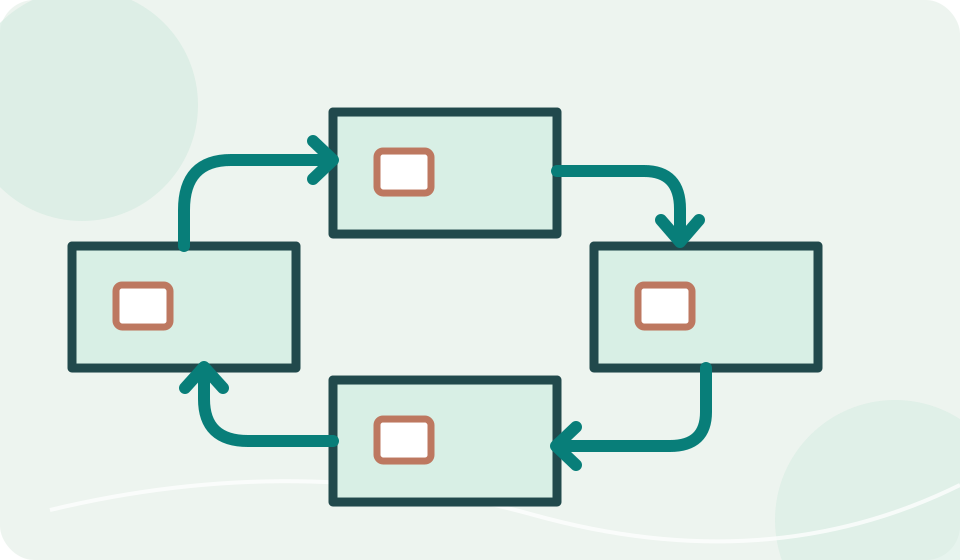

Define a complete container cycle
Round-trip days should cover the interval from a filled container leaving the issue point until it is again available to be filled. Include outbound transit, time at the customer, empty return, receiving, inspection, cleaning, and any scheduled dwell that actually occupies the pool. Counting only driving time understates the number of containers tied up outside the filling operation.
Throughput is product units per day on the same operating-day basis used for round-trip time. Units per container is the usable capacity for the product being shipped. If output varies by weekday, shift, or season, a single average can hide shortages during peaks. Use a representative planning rate and separately test peak scenarios when service continuity matters.
Calculate containers in circulation
Base containers equal throughput × round-trip days ÷ units per container. The product of daily unit flow and days gives the units committed to the loop; dividing by container capacity converts committed units into container count. The tool then multiplies that base by (1 + allowance/100) and rounds upward to a whole container.
The allowance is a reserve above the circulating requirement. It can represent a planning buffer, but the calculator does not infer its correct size from return variability, damage rate, or cleaning capacity. Choose it from observed operating data or policy and keep the assumption visible. A zero allowance returns only the arithmetic base, rounded up.
Gather the operating inputs
Use average daily units issued, not gross annual output divided by calendar days if the facility operates on fewer production days. Convert the time basis consistently: a five-operating-day week with a three-week loop may require 15 working days rather than 21 calendar days if containers move only on operating days. The calculator accepts a single number of days and cannot transform calendars for you.
If containers have a maximum rated capacity, do not assume every unit is filled to that maximum. Product size, dunnage, stacking rules, and mixed-SKU loads can reduce usable units per container. Use the actual planned fill count that matches the throughput numerator.
Calculate a circulating container pool
Enter units per day, full return-loop days, units per container, and extra fleet percentage. The base count scales directly with throughput and cycle time and inversely with capacity. Doubling turnaround while leaving the other inputs constant doubles the base pool; doubling units per container halves it before rounding. These are useful scenario checks, not operational recommendations to change the route or packaging.
Because the final output is rounded up, a small input change can add a whole unit near a rounding threshold. Keep the unrounded intermediate count in the planning worksheet if comparing options; then apply the reserve percentage and ceiling once at the end, matching the runtime.
Worked examples
500 units/day on a three-day loop
Inputs: Throughput = 500 units/day; round trip = 3 days; capacity = 25 units/container; allowance = 20%
Calculation: Base = 500×3/25 = 60; reserve = 60×1.20 = 72; ceiling = 72
Estimated fleet = 72 containers.
350 units/day with an 18-unit container
Inputs: Throughput = 350 units/day; round trip = 4.5 days; capacity = 18 units/container; allowance = 10%
Calculation: Base = 350×4.5/18 = 87.5; reserve = 87.5×1.10 = 96.25; round up to 97 containers
Estimated fleet = 97 containers.

Interpret the estimate against real loop data
Once a reusable pool is operating, track issue, return, cleaning, repair, and retire dates for each asset or batch. The actual cycle-time distribution matters: a few long customer holds can tie up more containers than the average suggests. Compare the theoretical pool with observed shortages and idle stock before setting purchase quantities.
Use the estimate to compare container capacity or turnaround scenarios. If a larger container saves fleet units but is harder to load or return, the formula does not price labor, freight cube, cleaning, or reverse-logistics expense. Fleet count is only one input to a reusable-packaging business case.
Common errors and limits
Common errors include omitting customer dwell, dividing by the number of containers when the field is units per container, and using throughput per calendar day with turnaround in workdays. A pool can be numerically sufficient on average and still run out on peak days if return timing is variable.
Reusable-packaging guidance treats the full cycle, including idle or dwell time, as part of the pool requirement. The calculator uses a single cycle-time estimate and an explicit percentage buffer. It is not a stochastic simulation, demand forecast, asset-tracking report, or guarantee that every shipment will have an available container.