
Keep ratio, percent, and angle distinct
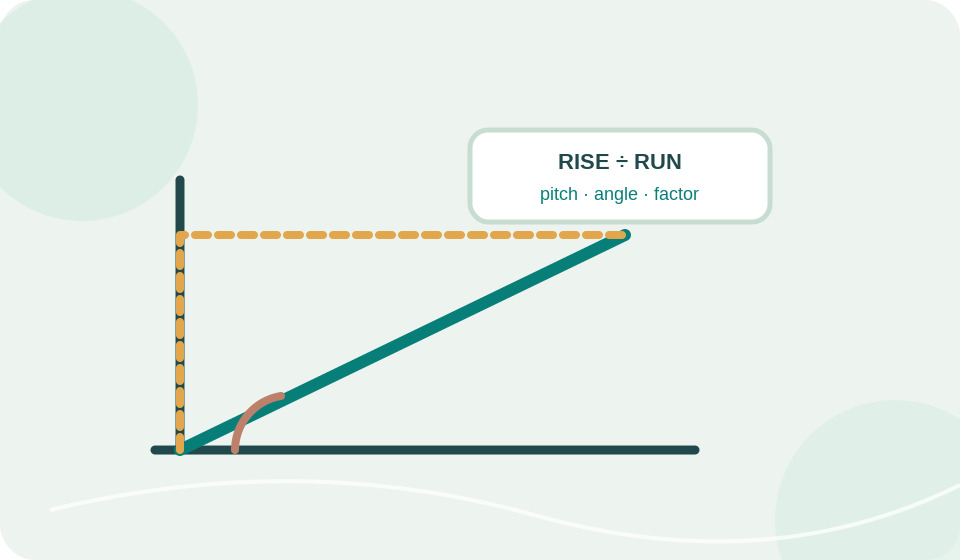
Rise divided by run is a dimensionless ratio. A roof with 6 units of rise over 12 horizontal units has a 6:12 pitch, a ratio of 0.5, and a 50 percent grade. Its angle is arctan(0.5), or about 26.57 degrees. These values describe the same steepness in different forms, but they are not interchangeable input numbers.
The calculator displays pitch as rise per 12 of run even if you measured another consistent pair. Enter rise 9 and run 12 for a 9:12 result. If you measured 18 inches over 24 inches, enter those values together; the ratio is unchanged. Do not enter a roof pitch label such as 6:12 as a decimal in one field.
Measure the horizontal leg
Run is the level horizontal distance from the eave toward the ridge. It is not the length along the rafter. Rise is the vertical change across that run. Measure them in one unit system: inches with inches, feet with feet, or another matching length pair. The runtime accepts a nonnegative rise and requires a positive run.
For an existing roof, a level-based measurement or a documented cross-section reduces ambiguity. A framing drawing may show a full span, while the calculator expects the actual run used with the rise. On a centered gable that may be half the span; on other roof shapes, it depends on which plane or direction is being measured.
Read the angle and slope factor
The angle is arctan(rise ÷ run), converted from radians to degrees and displayed to two decimal places. The slope factor is √[1 + (rise ÷ run)²], displayed to four decimal places. That factor is the sloping length divided by its horizontal projection. It can multiply a corresponding horizontal plane area when the same slope applies in that direction.
The calculator rounds the displayed values, not the underlying mathematical relationship used to form them. A value such as 1.1180 is an abbreviated display of a factor near 1.11803399. Keep enough precision when chaining calculations, and do not calculate a second result from rounded display text if the exact entered dimensions are available.
Use the optional footprint area carefully
When a horizontal footprint area is entered, the calculator multiplies it by the slope factor and shows an approximate sloped area to one decimal place. A zero footprint is accepted and returns zero area; the pitch and angle can still be interpreted from rise and run. The footprint is an area in square feet, not the length or width of the building.
The optional result assumes one uniform slope factor applies to that entire footprint. For a gable, that can help compare two matching planes when the footprint is defined consistently. Hip roofs, dormers, valleys, and intersecting sections may have several plane directions and require separate measurements. The gable roof area calculator uses explicit ridge/run/rise inputs for the two planes of a simple symmetric gable.
Apply building and product rules outside this conversion
A mathematical pitch does not say whether a roof covering is allowed or suitable. Codes and product instructions can specify minimum slopes, underlayment, fastening, exposure, and special treatment for low-slope or steep installations. The adopted code edition and manufacturer guide matter; a conversion tool cannot decide which rule applies to your project.
Use a documented measurement and the applicable instructions before ordering or building. This calculator does not evaluate structural capacity, drainage, snow loads, wind design, or safe access. Its useful output is the conversion between measured rise/run, angle, pitch label, and a simple area factor—not a design approval.
Worked examples
Each example uses a matching length unit for rise and run. The optional area is horizontal plan area, and the display precision is intentionally smaller than the raw ratio precision.
Six inches of rise for every foot of run
Inputs: Rise 6 in; horizontal run 12 in; horizontal footprint area 1,200 ft².
Calculation: p = 6 ÷ 12 = 0.5; angle = atan(0.5) = 26.5651°; pitch = 12 × 0.5 = 6:12; factor = √1.25 = 1.118034; area = 1,200 × 1.118034 = 1,341.6408 ft².
The interface shows 26.57°, 6:12, factor 1.118, and about 1,341.6 ft². The area is only a uniform-slope approximation for the entered footprint.
A nine-in-twelve roof slope
Inputs: Rise 9 in; horizontal run 12 in; footprint area 900 ft².
Calculation: p = 9 ÷ 12 = 0.75; angle = atan(0.75) = 36.8699°; pitch = 9:12; factor = √1.5625 = 1.25; surface estimate = 900 × 1.25 = 1,125 ft².
The result’s angle is displayed as 36.87° and the area as 1,125.0 ft². The unit labels on rise and run are blank, so keep those two measurements in the same unit.
