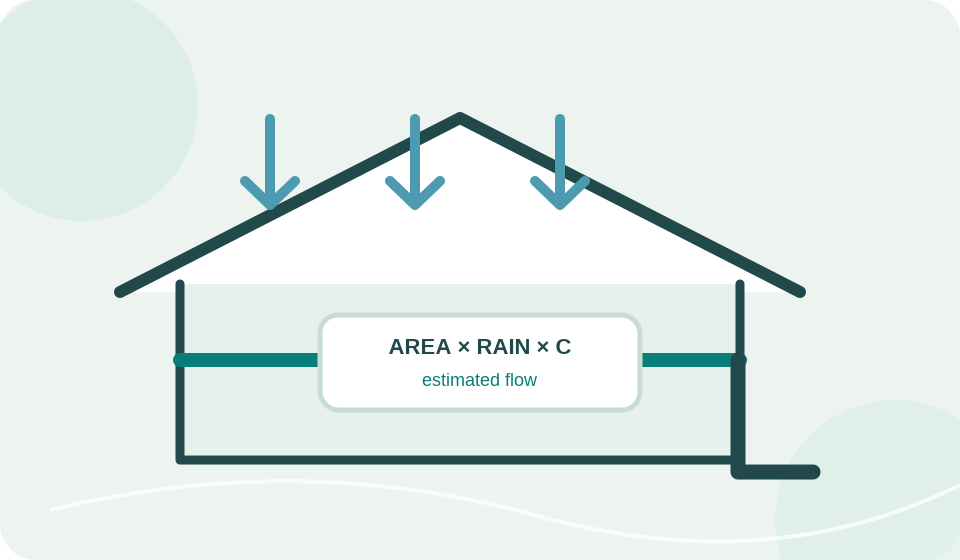

Define the roof area and rainfall input
Use the horizontal projected area that drains to the outlet, not the sloped shingle surface. For a simple roof plane, this is its plan footprint. Include only planes feeding the same gutter or collection zone. If a valley or upper roof concentrates water onto a lower section, add that contributing area deliberately.
Rainfall intensity is entered in inches per hour, not as a daily total. NOAA's Precipitation Frequency Data Server provides location-specific estimates; local rules determine the duration and frequency used for design. A short, intense storm can affect drainage differently from a longer event with the same total rain.
Understand the runoff factor and equation
The calculator uses Q ≈ intensity × area × C × 0.01039, producing U.S. gallons per minute. The factor 0.01039 converts inches per hour over square feet to a flow rate in gallons per minute. C is a dimensionless runoff factor, entered as a decimal between zero and one; 0.95 means 95 percent in this model. Do not enter 95 for a factor intended to be 0.95.
C represents the fraction of rainfall treated as runoff for this simplified scenario. Roof surfaces often use a high factor, but the design may include storage or other assumptions. Use the coefficient in the project basis. The field limits C to zero through one but cannot validate whether the chosen value is suitable.
Connect peak flow to a drainage design
Building storm-drainage codes use an applicable design rainfall rate and drainage area. The International Plumbing Code also addresses local rainfall information and system sizing. This calculator only estimates flow from supplied inputs; it does not size a roof drain, gutter, leader, overflow path, or system serving a blocked primary drain.
Use the result to compare scenarios or communicate a preliminary inflow to a designer. It can show why greater roof area or rainfall raises estimated flow. It is not a stamped drainage calculation or proof that a roof can handle ponding. Check structural rain load, secondary drainage, discharge routing, and downstream capacity separately.
Read the displayed units and precision
The calculator reports estimated runoff in U.S. gallons per minute and an equivalent flow in litres per second. The second number is a unit conversion of the first, not another model output. It also echoes the rainfall intensity so the scenario remains visible. Display precision is four decimal places for the flow results and three for the intensity echo, so small final digits may be rounded. Keep full precision in intermediate comparisons when matching a calculation sheet.
A zero runoff factor returns zero estimated flow even when rain and area are positive, while the other input controls require positive rainfall and area. These are software limits, not a judgment that a value is realistic for a particular roof. Avoid reporting more certainty than the rainfall source, area measurement, and chosen coefficient support. If inputs are estimates, label the result as a scenario rather than a measured discharge.
Document each drainage scenario
Record which roof planes feed the point, the projected area, rainfall source, duration, frequency, and runoff factor. If you compare multiple roof sections, calculate them separately where the drainage paths differ. A single combined flow number can conceal the fact that one gutter run or downspout bears most of the load. A small sketch with the drainage boundary is often more valuable than a longer list of decimal places.
Have a qualified professional confirm design rainfall and system capacity where code or property protection requires it. The model assumes constant intensity and immediate runoff represented by C. It does not simulate changing storms, storage, infiltration, clogging, splash, or flow through a specific product.
Worked examples
The examples use the entered rainfall intensity, projected area, and runoff coefficient in the calculator’s U.S.-unit equation. Flow outputs are displayed to four decimal places.
A 1,200-square-foot roof under a 3-inch-per-hour scenario
Inputs: Intensity 3 in/h; projected area 1,200 ft²; runoff factor 0.95.
Calculation: 3 × 1,200 × 0.95 × 0.01039 = 35.5338 US gal/min.
The equivalent flow is 2.2418 L/s. This is a scenario estimate, not a gutter-capacity rating.
A larger roof with a lower selected rainfall rate
Inputs: Intensity 1.5 in/h; projected area 2,400 ft²; runoff factor 0.90.
Calculation: 1.5 × 2,400 × 0.90 × 0.01039 = 33.6636 US gal/min.
The calculator reports 2.1238 L/s. Doubling area does not double this example’s flow because the selected intensity and runoff factor differ.
