
What an RSC blank estimate represents
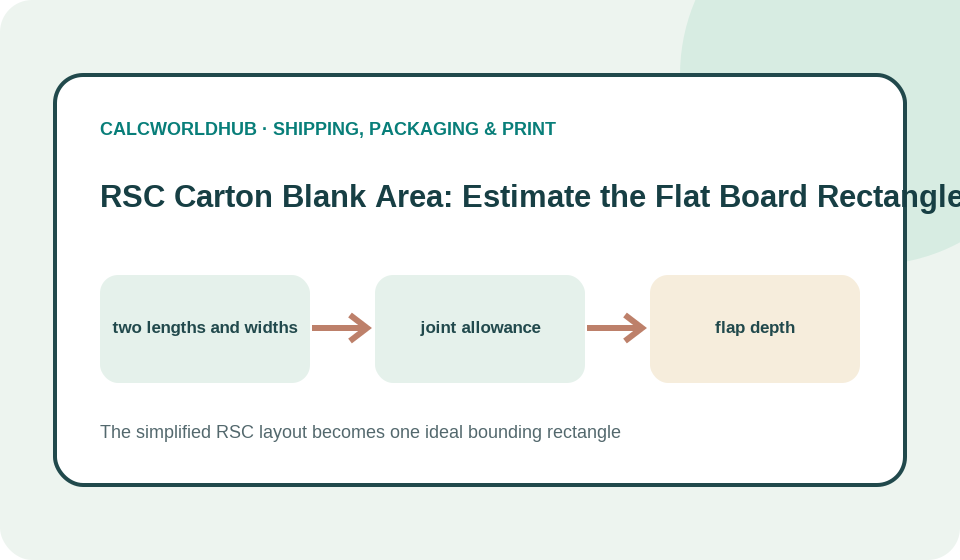
The RSC is a common carton style with four body panels and top and bottom flaps that meet at the center. The calculation begins with a simplified flat layout: two lengths and two widths around the body, plus a joint allowance, and a panel height that includes the width-based flap dimension. It estimates the area of that outer rectangle rather than the exact net area of each cut piece.
Enter the carton dimensions and joint
Enter the carton length, width, and height in millimetres, along with the manufacturer’s joint allowance in millimetres. Use the dimensions as defined by the packaging drawing—typically the intended inside dimensions—because a different convention changes the blank. The joint allowance is a separate seam allowance; it should not be guessed from the box size if a supplier’s specification is available.
Build the flat panel dimensions
The model calculates blank width as 2 × (length + width) + joint, and blank height as carton height + width. The second term represents the flap depth in this simplified RSC geometry. The source layout standard and converter’s drawing should be consulted for the exact geometry and allowances used in a particular order.
Convert a rectangle into area
Multiply the calculated blank width by blank height to get square millimetres, then divide by 1,000,000 to express the area in square metres. The arithmetic is direct, but the result is an ideal bounding rectangle. Slots and cutouts remove board from that rectangle; trim, flap gaps, scores, and die-cut layout can also make the actual consumed area differ.
Use the result in material planning
For an early comparison, keep the joint allowance and measurement convention the same across candidate sizes. A larger width affects both the body wrap and the flap term in this formula, so the area does not rise only with the footprint. When comparing material use between cartons, document which dimensions are held fixed and whether the values come from a drawing, sample, or supplier specification.
Area is a useful first measure for comparing two designs, but it is not the same as purchased board mass or cost. Board grade, flute profile, moisture, print coverage, trim, and nesting efficiency affect those quantities. Use this output as the geometric rectangle implied by the simplified layout, then add process-specific allowances from the converter or die line before quoting or ordering material.
Worked examples
The examples use the simplified width and height equations, then convert the rectangle area from mm² to m².
A compact 400 by 300 millimetre RSC
Inputs: Length = 400 mm; width = 300 mm; height = 250 mm; joint = 35 mm.
Calculation: Blank width = 2(400 + 300) + 35 = 1,435 mm; height = 250 + 300 = 550 mm; area = 1,435 × 550 ÷ 1,000,000 = 0.78925 m².
The ideal bounding rectangle is 0.78925 m² before converting allowances and cutouts.
A larger case with a wider flap dimension
Inputs: Length = 600 mm; width = 400 mm; height = 300 mm; joint = 50 mm.
Calculation: Blank width = 2(600 + 400) + 50 = 2,050 mm; height = 300 + 400 = 700 mm; area = 2,050 × 700 ÷ 1,000,000 = 1.435 m².
The simplified blank rectangle is 1.435 m²; production area may differ with the die line.

Manufacturing details still matter
A converter’s production blank may include tolerances, score allowances, slot width, flap overlap, and board thickness effects. The ideal rectangle does not account for those details, nor does it determine board grade, edge-crush strength, print layout, or how blanks nest on a larger sheet. Do not use this figure alone as a finished die-line or a purchase quantity.
Before production, confirm the flat blank dimensions and joint against the current drawing. A small joint change alters the blank width, while a change in width also affects flap geometry in this model. If the carton uses a different style, such as a telescope or die-cut case, this RSC estimate is not the appropriate layout.