
Use per-account monthly revenue
Enter average revenue per account per month for the cohort or account type being evaluated. It should be a monthly figure on the same currency basis as customer acquisition cost. If the reported amount is annual recurring revenue, convert it to a monthly basis before calculating.
The tool does not choose a cohort, remove expansion revenue, or adjust for account mix. If large accounts have very different revenue or cost profiles, a single average can conceal variation. Use a clearly defined segment and compare like with like.
Apply gross margin to revenue
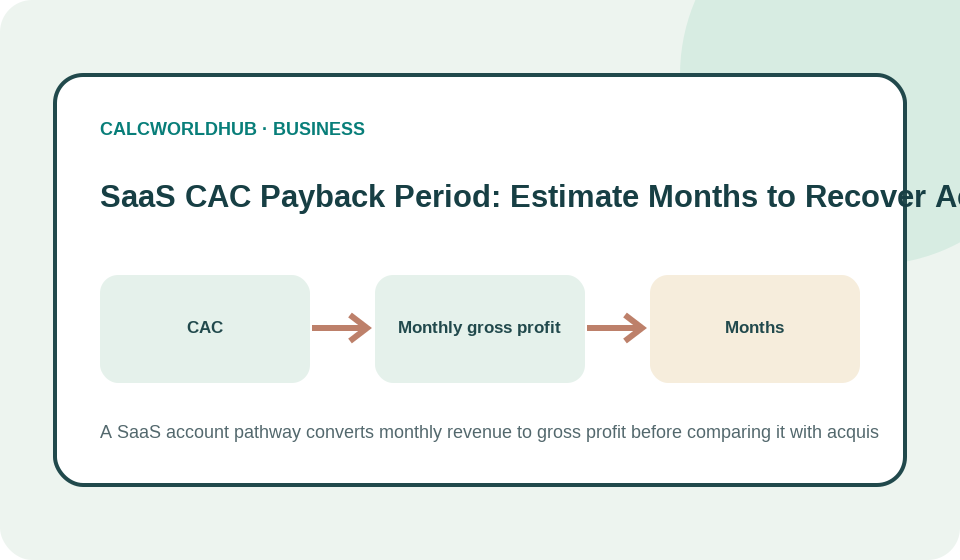
Monthly gross profit per account is monthly revenue multiplied by gross margin as a fraction. A margin of 70% becomes 0.70. Dividing CAC by that gross-profit amount estimates the number of months of gross profit required to equal the acquisition cost.
Using revenue without margin would imply that every revenue dollar is available to recover acquisition spending. Gross margin accounts for the cost of delivering the service under the chosen accounting definition, but it does not subtract sales and marketing spend twice or include every operating expense.
Interpret months as a simplified payback estimate
The output assumes the account continues to produce the entered monthly revenue and margin. It does not model churn, delayed invoices, annual prepayment, discounts, expansion, contraction, failed payments, or the time between spending and activation. Actual cash payback may be earlier or later.
A decimal result is an average time under the model, not necessarily a date when a real customer’s acquisition cost is recovered. If the service has onboarding or ramp-up, or if gross profit varies by month, use a cohort cash-flow analysis for decisions that require timing precision.
Keep CAC and gross profit on compatible scopes
CAC can be calculated across paid media alone, sales and marketing expense, or a narrower campaign. The calculator accepts one acquisition cost but cannot check which costs were included or how many customers share them. Document the denominator and attribution window behind the chosen CAC.
If CAC is a company-wide blended amount, compare it with a compatible account-level gross-profit average. A channel-specific CAC compared with a different customer cohort can produce a misleading benchmark. This is especially important when channel mix, sales cycle, or customer size changes.
Use the measure without treating it as a universal target
A shorter modeled payback can reduce the period that acquisition spending is unrecovered, but it does not prove that a channel is better. Retention, lifetime gross profit, growth goals, working capital, and the timing of cash collections also matter. No single payback cutoff applies to every SaaS business.
The SEC’s revenue-recognition guidance concerns accounting treatment rather than a CAC target; use it to keep revenue concepts distinct from cash collection. For operating definitions, preserve internal metric documentation so that “MRR,” “gross margin,” and “CAC” mean the same thing across teams.
Check the inputs and communicate the boundary
The calculator requires positive monthly revenue, gross margin above zero and no more than 100%, and nonnegative CAC. A zero margin would make monthly gross profit zero, so a finite payback cannot be computed using this division. Confirm values and periods before interpreting the result.
A useful report names the cohort, acquisition-cost scope, revenue basis, gross-margin basis, and calculation date. If a displayed month value is rounded to four decimals, retain the unrounded calculation internally. The result supports comparison and discussion; it is not an assurance of future recovery.
Worked examples
The examples use monthly gross profit, rather than revenue alone, as the recovery amount.
A $300 acquisition cost
Inputs: CAC = $300; monthly revenue/account = $80; gross margin = 70%.
Calculation: Monthly gross profit = $80 × 0.70 = $56. Payback = $300 ÷ $56 = 5.3571 months.
The simple model equals the $300 acquisition cost after about 5.36 steady months of gross profit.
Higher revenue and a larger CAC
Inputs: CAC = $900; monthly revenue/account = $150; gross margin = 80%.
Calculation: Monthly gross profit = $150 × 0.80 = $120. Payback = $900 ÷ $120 = 7.5 months.
Despite higher monthly revenue, the acquisition cost is larger relative to monthly gross profit, so the estimate is longer.
