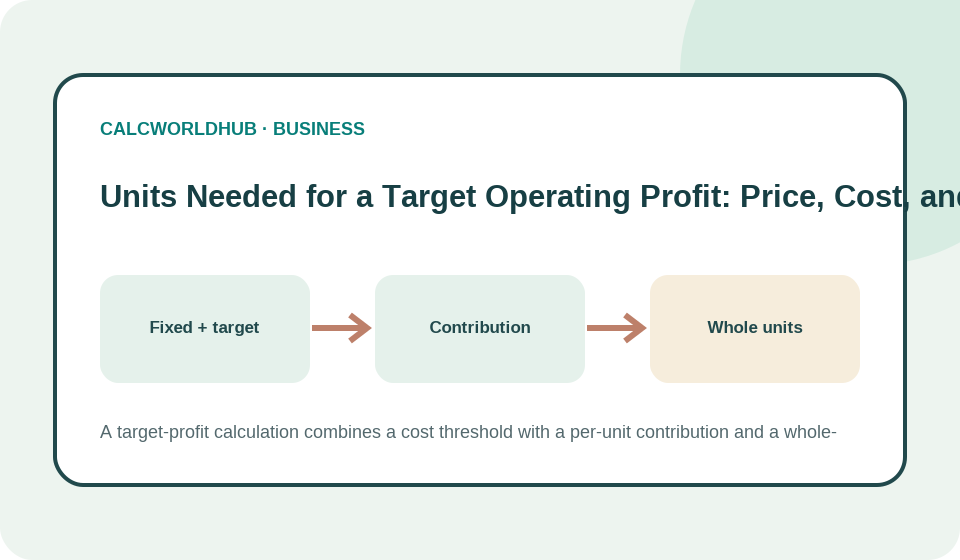

Choose a target operating-profit amount
The target is entered in dollars for the same planning period as fixed operating costs. A zero target reduces the arithmetic to break-even units; a positive target adds the amount that must remain after fixed costs are covered. Do not confuse operating profit with cash balance or net income after financing and tax.
Use fixed costs and target profit for one product, service, or stable composite unit. If the business sells a changing mix, the contribution per unit can change with the mix and a single-volume equation may no longer describe the plan.
Calculate contribution per unit
Contribution per unit equals selling price minus variable cost per unit. It is the amount available from each sale to cover fixed costs and then the target profit. A $25 price with $14 variable cost contributes $11 per unit. The selling price must be higher than variable cost for a positive target calculation.
Variable costs should move with units under the model, while fixed operating expenses are held constant over the relevant volume range. Separate one-time setup or step costs carefully; placing the same cost in both fixed and variable inputs would distort the required volume.
Apply the ceiling to whole units
The raw quotient can be fractional, but the result is a count of saleable units. The calculator uses the ceiling function: any fractional requirement moves to the next whole unit. For example, 6,200 divided by 11 is about 563.636, so 564 units are needed to meet or exceed that mathematical target.
Do not round the quotient to the nearest integer or floor it. Rounding down would leave the calculated contribution just below the required total. Keep full precision through division and apply the ceiling only once at the end.
Understand what the target includes
The calculation uses fixed operating costs plus target operating profit in the numerator. It does not include income taxes, interest, owner distributions, working capital, inventory timing, or an explicit sales commission unless those costs are included in an input on the correct basis.
A target profit described as “after tax” cannot be entered unchanged when the formula calculates operating profit before interest and tax. Translate the desired objective into the model’s profit definition with qualified accounting advice when tax or financing effects are material.
Use a stable price and cost scenario
Price discounts reduce contribution if variable cost stays the same; higher variable cost also reduces it. Either change increases required units. If a promotion changes both price and cost, calculate the contribution for that offer rather than carrying forward the list-price margin.
Fixed costs may increase in steps when a business adds capacity, another shift, or additional service coverage. If crossing the calculated volume triggers a new fixed expense, include that cost in a separate scenario. The one-line model assumes the input fixed cost remains unchanged.
Read the output as a threshold, not a forecast
The result is the minimum modelled whole-unit volume needed under the entered assumptions. It does not predict customer demand, prove production capacity, or guarantee that every unit will be sold at the entered price. Pair it with demand, inventory, and capacity planning.
Check the answer by multiplying required units by contribution and subtracting fixed costs. The remainder should meet or exceed the target. That back-check helps confirm the ceiling and catches a common mistake: using total price instead of contribution in the denominator.
Worked examples
The second example lands exactly on a whole-unit result; the first requires rounding up rather than rounding to nearest.
A fractional quotient that rounds up
Inputs: Fixed costs = $5,000; price = $25/unit; variable cost = $14/unit; target operating profit = $1,200.
Calculation: Contribution = $25 − $14 = $11/unit. Required volume = ($5,000 + $1,200) ÷ $11 = 563.63636…; ceil = 564 units. Check: 564 × $11 − $5,000 = $1,204.
Selling 564 units clears the $1,200 target by $4 under the constant-input model.
An exact whole-unit target
Inputs: Fixed costs = $18,000; price = $60/unit; variable cost = $36/unit; target profit = $6,000.
Calculation: Contribution = $60 − $36 = $24/unit. Required volume = ($18,000 + $6,000) ÷ $24 = 1,000 units; ceil = 1,000. Check: 1,000 × $24 − $18,000 = $6,000.
This scenario reaches the stated operating-profit target exactly at 1,000 units.
