How to use this calculator
Transform geocentric XYZ coordinates between reference frames with the seven-parameter position-vector Helmert method.
- Enter Source X coordinate (m), Source Y coordinate (m), Source Z coordinate (m), X translation (m), then complete the remaining labeled fields. Match the units shown beside each field and review the result together with the assumptions below.
- Read the worked example below to check the expected input format and result.
- Compare another scenario by changing one input at a time. Use Reset to return to the starting values.
How this calculation works
This geocentric transformation applies three translations, three small rotations, and one scale difference to a source Cartesian coordinate. It uses the EPSG position-vector sign convention and expects XYZ coordinates in metres, rotations in arcseconds, and scale in parts per million.
Inputs and units
x— Source X coordinate (m)- Geocentric Cartesian X in the source reference frame.
y— Source Y coordinate (m)- Geocentric Cartesian Y in the source reference frame.
z— Source Z coordinate (m)- Geocentric Cartesian Z in the source reference frame.
tx— X translation (m)- Translation from the source frame toward the target frame.
ty— Y translation (m)- Translation from the source frame toward the target frame.
tz— Z translation (m)- Translation from the source frame toward the target frame.
rxArcsec— X rotation (arcseconds)- Position-vector rotation parameter about the X axis.
ryArcsec— Y rotation (arcseconds)- Position-vector rotation parameter about the Y axis.
rzArcsec— Z rotation (arcseconds)- Position-vector rotation parameter about the Z axis.
scalePpm— Scale difference (ppm)- Scale difference added to one after conversion from parts per million.
Formula
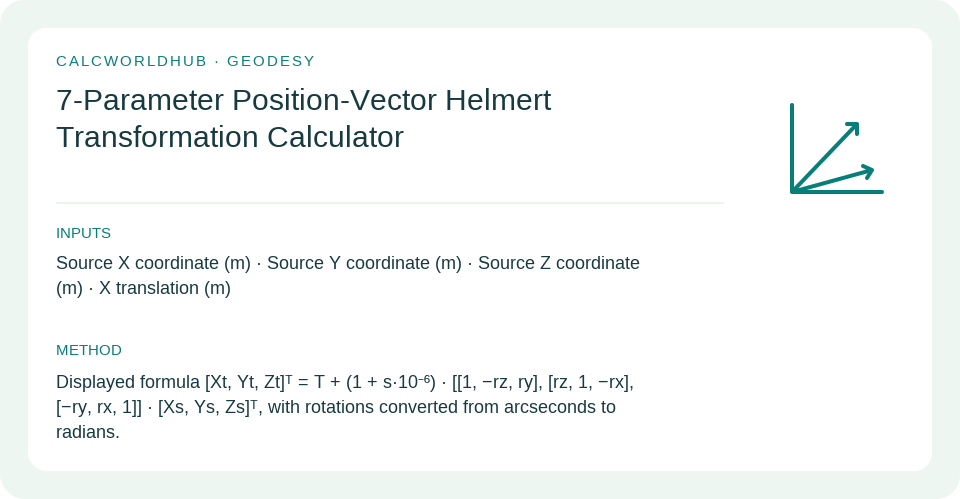
[Xt, Yt, Zt]ᵀ = T + (1 + s·10⁻⁶) · [[1, −rz, ry], [rz, 1, −rx], [−ry, rx, 1]] · [Xs, Ys, Zs]ᵀ, with rotations converted from arcseconds to radians.
Method
Convert each entered rotation from arcseconds to radians, build the first-order position-vector rotation matrix, multiply the source XYZ vector by the matrix and scale factor, then add the target-frame translations. Rotation parameters follow EPSG method 1033; a coordinate-frame rotation convention has opposite signs.
Worked example
For X=3,657,660.66 m, Y=255,768.55 m, and Z=5,201,382.11 m, applying the WGS 72 to WGS 84 example parameters (Tz=4.5 m, Rz=0.554 arcsec, scale=0.219 ppm) gives approximately X=3,657,660.78 m, Y=255,778.43 m, Z=5,201,387.75 m.
Assumptions and limits
This is the small-angle, geocentric position-vector method. It is not a geodetic latitude/longitude to ECEF converter, does not determine transformation parameters, and does not include time-dependent rates, grid shifts, or higher-order terms. Confirm the frame direction and parameter convention for the transformation you intend to apply.
Frequently asked questions
Are these latitude and longitude inputs?
No. Enter geocentric Cartesian X, Y, and Z coordinates. Convert geodetic coordinates to geocentric XYZ first if needed.
Which rotation sign convention does this use?
It uses the EPSG position-vector method 1033. Do not reuse coordinate-frame rotation parameters without converting their signs.
Does this estimate the seven transformation parameters?
No. Enter parameters already defined for the source-to-target frame transformation.
Are time-dependent transformations supported?
No. This is a static seven-parameter transform without rates or deformation grids.
How do I use the 7-Parameter Position-Vector Helmert Transformation Calculator?
Enter Source X coordinate (m), Source Y coordinate (m), Source Z coordinate (m), X translation (m), then complete the remaining labeled fields. Match the units shown beside each field and review the result together with the assumptions below.
Reference: EPSG method 1033 and Guidance Note #7-2 for the position-vector geocentric Helmert transformation. See our calculation methodology.