How to use this calculator
Check a heat-driven refrigerator against the reversible limit for its generator, rejection and evaporator temperatures.
- Enter Generator heat-source temperature (K), Absorber and condenser rejection temperature (K), Evaporator temperature (K), Generator heat input (kW), then complete the remaining labeled fields. Match the units shown beside each field and review the result together with the assumptions below.
- Read the worked example below to check the expected input format and result.
- Compare another scenario by changing one input at a time. Use Reset to return to the starting values.
Absorption refrigerator thermal COP and reversible bound explained
How the calculation works
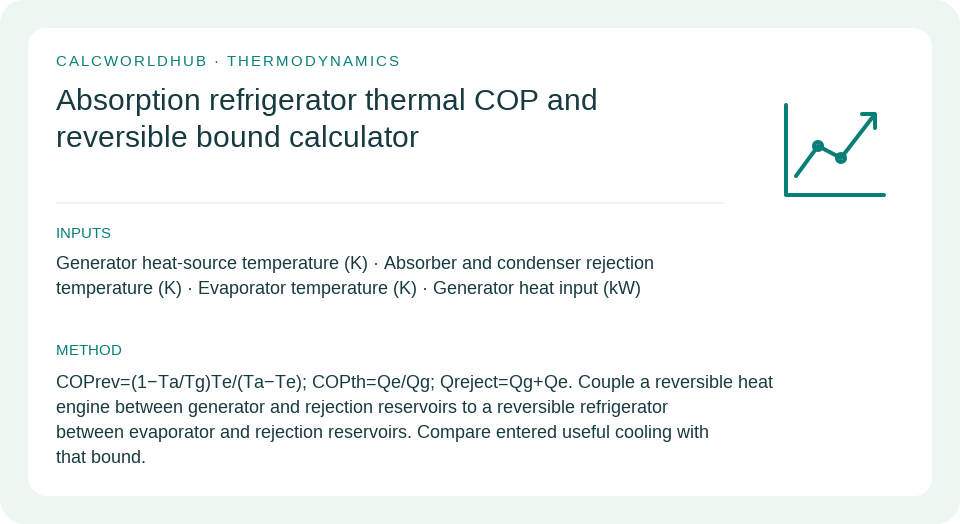
COPrev=(1−Ta/Tg)Te/(Ta−Te); COPth=Qe/Qg; Qreject=Qg+Qe.
Couple a reversible heat engine between generator and rejection reservoirs to a reversible refrigerator between evaporator and rejection reservoirs. Compare entered useful cooling with that bound.
Set up the calculation
Tg— Generator heat-source temperature (K)- Hot generator heat-source temperature on an absolute Kelvin scale.
Ta— Absorber and condenser rejection temperature (K)- Common absorber/condenser heat-rejection temperature in Kelvin; the reversible bound assumes this is between generator and evaporator temperatures.
Te— Evaporator temperature (K)- Cold evaporator temperature in Kelvin, below the heat-rejection temperature for a refrigerator.
Qg— Generator heat input (kW)- Heat supplied to the generator, in kW; it is the denominator of the entered thermal COP.
Qe— Evaporator cooling duty (kW)- Cooling duty absorbed at the evaporator, in kW; Qe/Qg is the entered-cycle thermal COP.
Limits of this model
Three uniform thermal reservoirs; absorber and condenser share a temperature. Negligible solution-pump work; no working-pair equilibrium model.
Check this example
Generator heat-source temperature (K) = 400; Absorber and condenser rejection temperature (K) = 310; Evaporator temperature (K) = 280; Generator heat input (kW) = 100; Evaporator cooling duty (kW) = 60.
- Reversible thermal COP bound: 2.1
- Entered thermal COP: 0.6
- Total rejected heat: 160 kW
- Second-law COP ratio: 28.571429 %
Reservoirs at generator 400 K, rejection 310 K and evaporator 280 K permit a reversible thermal COP bound of 2.1. A supplied 100 kW generator duty and 60 kW cooling load instead have thermal COP 0.6 and reject 160 kW.
Reading the outputs
The first COP is a thermodynamic upper bound; entered COP is actual heat duty ratio. Rejected heat neglects pump work.
Frequently asked questions
Is thermal COP comparable to electric COP?
The denominators differ: this page divides cooling by generator heat, not purchased electricity.
Why is a temperature ordering required?
The heat engine must have a hotter source, while refrigeration must lift heat above the evaporator temperature.
Does the bound predict a real absorption chiller?
No. It screens physical feasibility; solution chemistry and component losses determine actual performance.
How do I use the Absorption refrigerator thermal COP and reversible bound calculator?
Enter Generator heat-source temperature (K), Absorber and condenser rejection temperature (K), Evaporator temperature (K), Generator heat input (kW), then complete the remaining labeled fields. Match the units shown beside each field and review the result together with the assumptions below.
What is a worked example of Absorption refrigerator thermal COP and reversible bound?
Generator heat-source temperature (K) = 400; Absorber and condenser rejection temperature (K) = 310; Evaporator temperature (K) = 280; Generator heat input (kW) = 100; Evaporator cooling duty (kW) = 60. Reversible thermal COP bound: 2.1 Entered thermal COP: 0.6 Total rejected heat: 160 kW Second-law COP ratio: 28.571429 % Reservoirs at generator 400 K, rejection 310 K and evaporator 280 K permit a reversible thermal COP bound of 2.1. A supplied 100 kW generator duty and 60 kW cooling load instead have thermal COP 0.6 and reject 160 kW.
Background or definition reference: DOE Fundamentals Handbook: thermodynamic energy balances.
Read our calculation methodology.