How to use this calculator
Budget how timing uncertainty degrades a sinusoidal ADC measurement even when converter voltage noise is low.
- Enter Input sine frequency (Hz), Combined RMS jitter (s), Other-noise SNR (dB). Match the units shown beside each field and review the result together with the assumptions below.
- Read the worked example below to check the expected input format and result.
- Compare another scenario by changing one input at a time. Use Reset to return to the starting values.
ADC aperture jitter and total SNR explained
How the calculation works
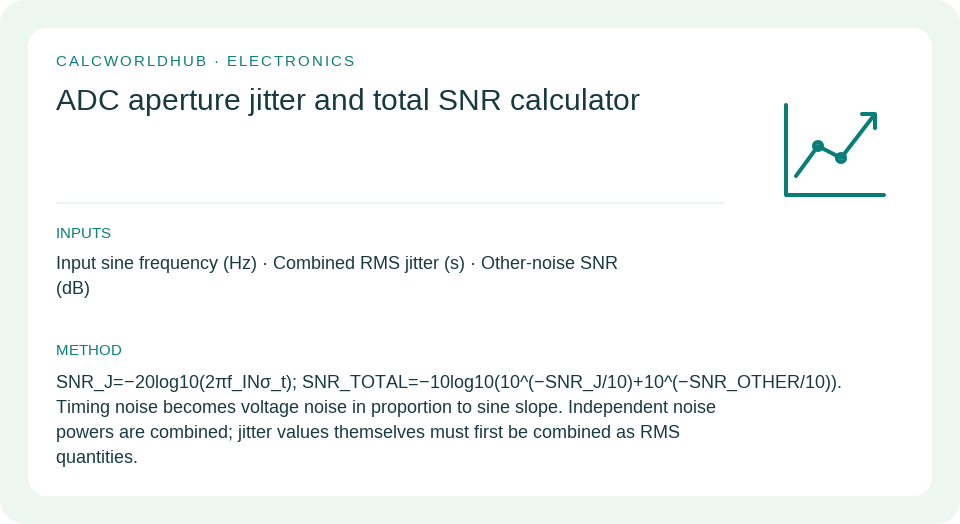
SNR_J=−20log10(2πf_INσ_t); SNR_TOTAL=−10log10(10^(−SNR_J/10)+10^(−SNR_OTHER/10)).
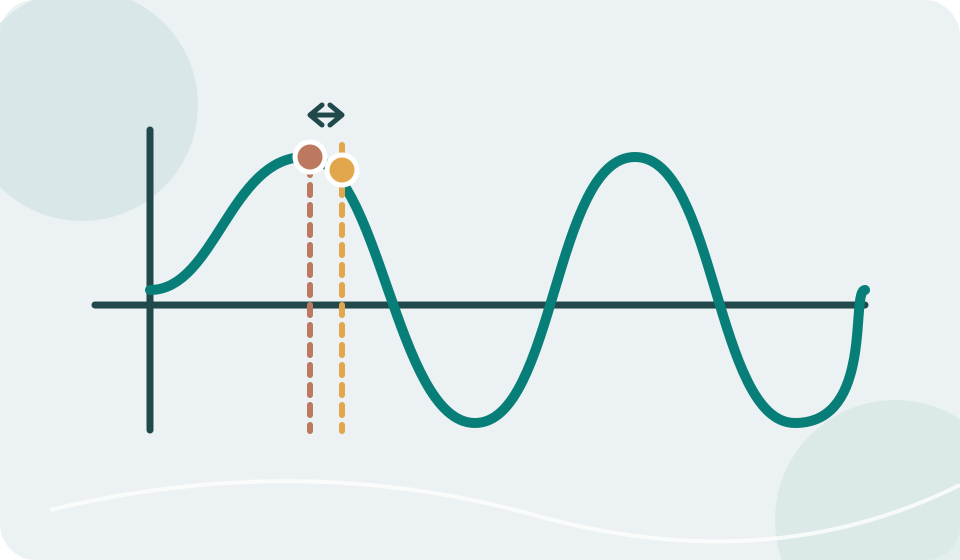
Timing noise becomes voltage noise in proportion to sine slope. Independent noise powers are combined; jitter values themselves must first be combined as RMS quantities.
Set up the calculation
fin— Input sine frequency (Hz)- Frequency of the sinusoidal input, not the sample clock.
tj— Combined RMS jitter (s)- Root-sum-square clock and aperture timing uncertainty.
snr— Other-noise SNR (dB)- SNR from all independent non-jitter sources at the same signal level.
Limits of this model
Small, uncorrelated RMS jitter and a single sine. Deterministic spurs, correlated clocks and arbitrary waveforms need a different spectral analysis.
Check this example
Input sine frequency (Hz) = 10000000; Combined RMS jitter (s) = 1.00000000e-12; Other-noise SNR (dB) = 80.
- Total SNR: 78.55493 dB
- Jitter-only SNR: 84.036403 dB
- Sine-equivalent ENOB: 12.75521 bits
A 10 MHz sine sampled with 1 ps total RMS jitter has a jitter ceiling near 84 dB; combining it with an 80 dB converter noise floor lowers the system SNR.
Reading the outputs
ENOB is a full-scale-sine SNR-equivalent number and does not add distortion that was absent from the entered SNR.
Frequently asked questions
Which frequency belongs in the equation?
The analog input frequency; sample rate is not a substitute.
Can I add two jitter specifications directly?
Uncorrelated RMS jitter combines by root-sum-square. Correlated components require their covariance.
Is ENOB from SNR the same as ENOB from SINAD?
No; SINAD includes distortion, while an SNR-only equivalent omits it.
How do I use the ADC aperture jitter and total SNR calculator?
Enter Input sine frequency (Hz), Combined RMS jitter (s), Other-noise SNR (dB). Match the units shown beside each field and review the result together with the assumptions below.
What is a worked example of ADC aperture jitter and total SNR?
Input sine frequency (Hz) = 10000000; Combined RMS jitter (s) = 1.00000000e-12; Other-noise SNR (dB) = 80. Total SNR: 78.55493 dB Jitter-only SNR: 84.036403 dB Sine-equivalent ENOB: 12.75521 bits A 10 MHz sine sampled with 1 ps total RMS jitter has a jitter ceiling near 84 dB; combining it with an 80 dB converter noise floor lowers the system SNR.
Background or definition reference: Analog Devices sampling clock jitter analysis.
Read our calculation methodology.