How to use this calculator
Compute likelihood-based AIC, small-sample AICc, and BIC from a model log-likelihood and parameter count.
- Enter Maximized log-likelihood, ℓ, Estimated parameter count, k, Sample size, n. Match the units shown beside each field and review the result together with the assumptions below.
- Read the worked example below to check the expected input format and result.
- Compare another scenario by changing one input at a time. Use Reset to return to the starting values.
How this calculation works
Information criteria combine maximized log-likelihood with a complexity penalty to compare candidate statistical models fitted to the same data. AICc adds a finite-sample correction to AIC, while BIC uses a logarithmic sample-size penalty.
Inputs and units
logLikelihood— Maximized log-likelihood, ℓ- Maximized log-likelihood for the candidate model on the comparison dataset.
parameterCount— Estimated parameter count, k- Count all estimated model parameters under the chosen likelihood convention.
sampleSize— Sample size, n- Number of observations or effective sample size used by the likelihood.
Formula
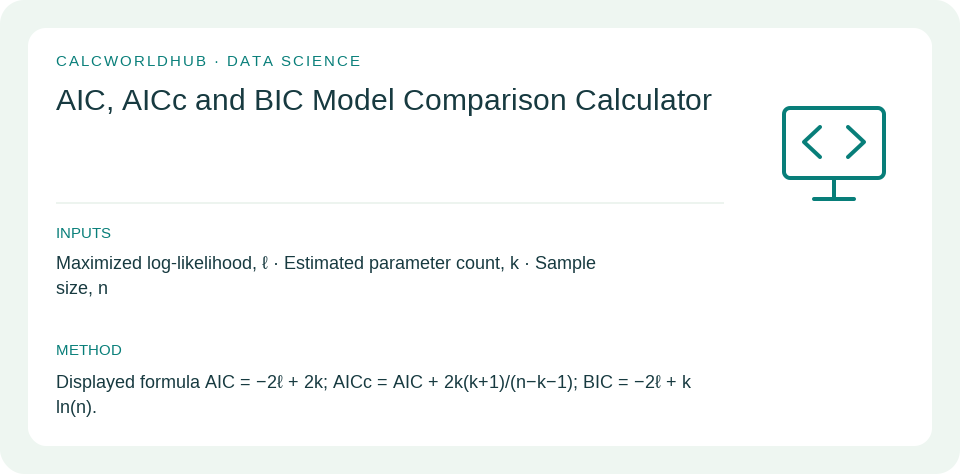
AIC = −2ℓ + 2k; AICc = AIC + 2k(k+1)/(n−k−1); BIC = −2ℓ + k ln(n).
Method
Enter the maximized log-likelihood ℓ, the total number of estimated parameters k, and sample size n. Smaller values rank better among models fit to the same observations under compatible likelihood conventions.
Worked example
For maximized log-likelihood −120, k = 5 parameters, and n = 100 observations, AIC = 250, AICc ≈ 250.6383, and BIC ≈ 263.0259.
Assumptions and limits
These scores do not test absolute goodness of fit and are not comparable when likelihoods use incompatible data, response scales, or constants. Include all estimated parameters consistently; AICc requires n greater than k + 1.
Frequently asked questions
Which direction is better?
For a compatible set of candidate fits, lower information-criterion values indicate a preferred trade-off under that criterion.
Why report AICc?
Its additional penalty corrects AIC for finite samples and can matter when sample size is modest relative to parameter count.
Can I compare scores from different datasets?
No. Use compatible likelihoods fitted to the same data and response definition.
How do I use the AIC, AICc and BIC Model Comparison Calculator?
Enter Maximized log-likelihood, ℓ, Estimated parameter count, k, Sample size, n. Match the units shown beside each field and review the result together with the assumptions below.
What is a worked example of AIC, AICc and BIC Model Comparison?
For maximized log-likelihood −120, k = 5 parameters, and n = 100 observations, AIC = 250, AICc ≈ 250.6383, and BIC ≈ 263.0259.
Reference: Hurvich and Tsai original small-sample AICc derivation. See our calculation methodology.