Algorithm input growth ratio calculator
Compare operation counts at two input sizes under a chosen polynomial growth degree. Enter your values below to see the result and method.
inputs.
Related calculators and articles
Use these performance calculators to separate asymptotic operation growth from parallel efficiency and measured execution time.
How to use the Algorithm input growth ratio calculator
Compare operation counts at two input sizes under a chosen polynomial growth degree. Use the free tool above without creating an account.
What it calculates
Compare operation counts at two input sizes under a chosen polynomial growth degree. The output reflects the input definitions and conventions used by the formula, so keep formats and units consistent when comparing scenarios.
Inputs and units
Enter the two positive input sizes and the assumed polynomial degree k. The ratio compares modeled work at the second size with work at the first.
- First input size: enter a value in the unit shown; the browser checks the accepted format and range.
- Second input size: enter a value in the unit shown; the browser checks the accepted format and range.
Formula and method
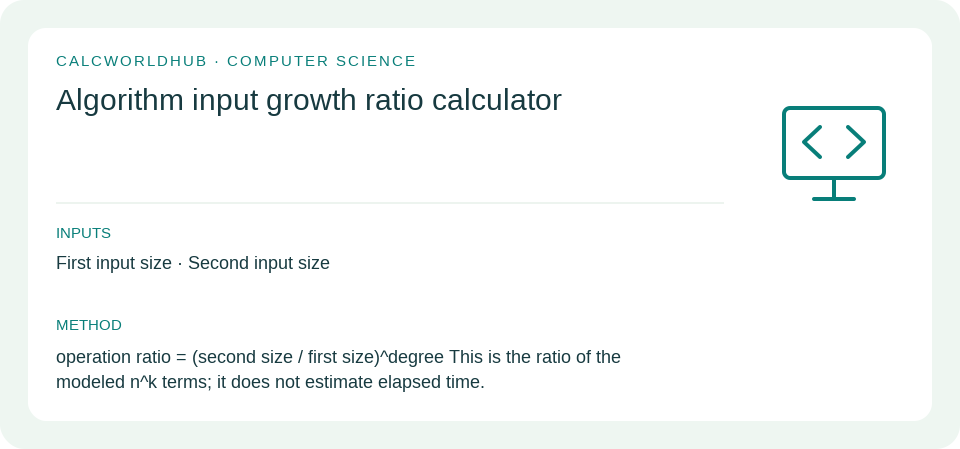
operation ratio = (second size / first size)^degree
This is the ratio of the modeled n^k terms; it does not estimate elapsed time.
Worked example
For cubic growth, increasing input size from 100 to 1,000 multiplies the modeled operation count by 1,000.
How to interpret the result
Use the result to answer the specific sizing, encoding, performance, or representation question stated on this page. It is conditional on the chosen inputs; change one input at a time to see how the estimate responds.
Assumptions and limitations
This models only a polynomial term n^k and ignores constant factors, lower-order terms, data distribution, and hardware effects.
Frequently asked questions
What does polynomial degree represent?
The degree is the exponent k in an operation-count model proportional to nᵏ; it is an assumed growth class, not a fitted measurement.
Why does a tenfold input increase produce a 1,000-fold ratio at degree three?
The ratio is (10)³=1,000. The exponent compounds the input-size ratio.
Does this predict wall-clock runtime?
No. It compares the polynomial term only and omits constants, lower-order work, data, implementation, parallelism, and hardware.
How do I use the Algorithm input growth ratio calculator?
Enter First input size, Second input size. Match the units shown beside each field and review the result together with the assumptions below.
What is a worked example of Algorithm input growth ratio?
For cubic growth, increasing input size from 100 to 1,000 multiplies the modeled operation count by 1,000.
Read the calculation methodology and privacy policy.