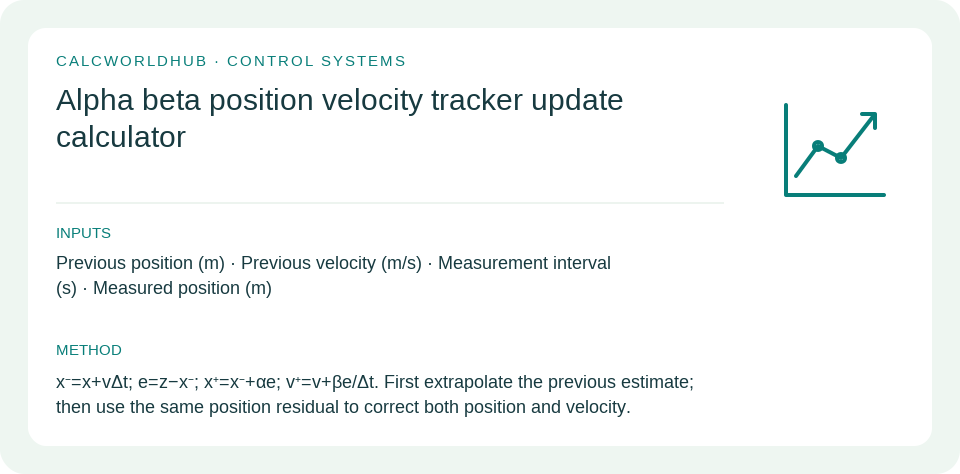
How to use this calculator
Update a lightweight constant-velocity tracker when a new position observation arrives.
- Enter Previous position (m), Previous velocity (m/s), Measurement interval (s), Measured position (m), then complete the remaining labeled fields. Match the units shown beside each field and review the result together with the assumptions below.
- Read the worked example below to check the expected input format and result.
- Compare another scenario by changing one input at a time. Use Reset to return to the starting values.
Alpha beta position velocity tracker update explained
Advance a constant-velocity position estimate, compute its measurement residual, then apply α and β corrections.
How the calculation works
x⁻=x+vΔt; e=z−x⁻; x⁺=x⁻+αe; v⁺=v+βe/Δt.
First extrapolate the previous estimate; then use the same position residual to correct both position and velocity.
Sources
- NASA Technical Report 1980-0011768: alpha-beta tracker update — Documents position and velocity updates in an alpha-beta tracking filter; fixed gains here remain user-selected.
Inputs and units
x— Previous position (m)- Position estimate after the last measurement.
v— Previous velocity (m/s)- Velocity estimate after the last correction.
dt— Measurement interval (s)- Time between previous and current observations.
z— Measured position (m)- New position observation.
alpha— Position correction gain- Fraction of position residual applied to position.
beta— Velocity correction gain- Residual-to-velocity gain, divided by dt.
Limits of this model
Fixed gains do not automatically encode a noise covariance. Gain ranges alone do not guarantee every repeated tracker is stable.
Check this example
Previous position (m) = 10; Previous velocity (m/s) = 2; Measurement interval (s) = 0.5; Measured position (m) = 11.4; Position correction gain = 0.4; Velocity correction gain = 0.1.
- Corrected position: 11.16 m
- Corrected velocity: 2.08 m/s
- Position innovation: 0.4 m
Position 10 m and speed 2 m/s predict 11 m after half a second; a measurement of 11.4 m produces a small positive correction.
Reading the outputs
Position and velocity are corrected endpoint estimates; innovation exposes disagreement before correction.
Frequently asked questions
Does beta have units of velocity?
No; division by the time interval supplies the velocity units.
Can I track negative velocity?
Yes; signed positions and speeds are accepted.
What if intervals vary?
Enter the actual interval at each update; fixed gains may need retuning.
How do I use the Alpha beta position velocity tracker update calculator?
Enter Previous position (m), Previous velocity (m/s), Measurement interval (s), Measured position (m), then complete the remaining labeled fields. Match the units shown beside each field and review the result together with the assumptions below.
What is a worked example of Alpha beta position velocity tracker update?
Previous position (m) = 10; Previous velocity (m/s) = 2; Measurement interval (s) = 0.5; Measured position (m) = 11.4; Position correction gain = 0.4; Velocity correction gain = 0.1. Corrected position: 11.16 m Corrected velocity: 2.08 m/s Position innovation: 0.4 m Position 10 m and speed 2 m/s predict 11 m after half a second; a measurement of 11.4 m produces a small positive correction.
Read our calculation methodology.