How to use this calculator
Solve the attached shock angle and downstream state for a compressive flow turn.
- Enter Upstream Mach number, Flow turning angle (degrees), Heat-capacity ratio, Shock branch. Match the units shown beside each field and review the result together with the assumptions below.
- Read the worked example below to check the expected input format and result.
- Compare another scenario by changing one input at a time. Use Reset to return to the starting values.
Attached oblique shock weak strong solution explained
Solve the attached shock angle and downstream state for a compressive flow turn.
How the calculation works
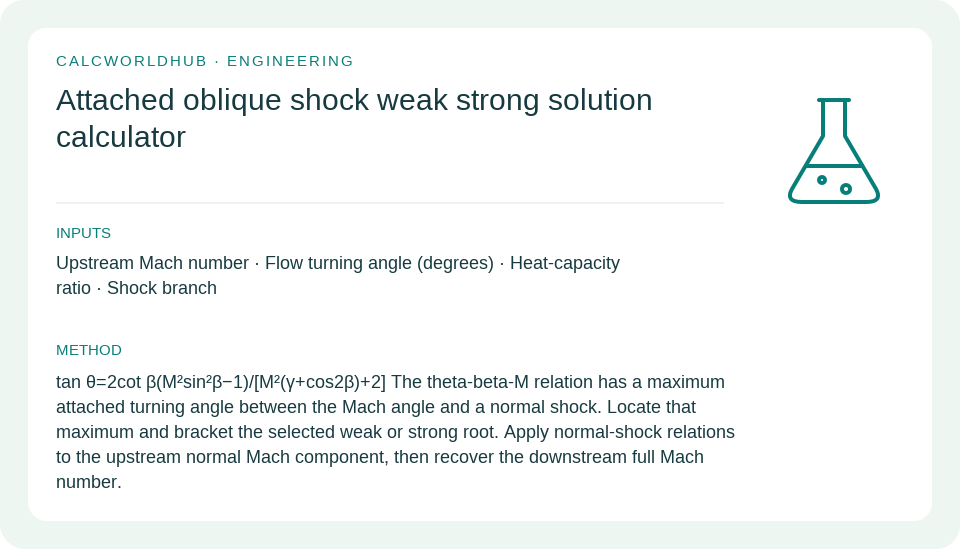
tan θ=2cot β(M²sin²β−1)/[M²(γ+cos2β)+2]
The theta-beta-M relation has a maximum attached turning angle between the Mach angle and a normal shock. Locate that maximum and bracket the selected weak or strong root. Apply normal-shock relations to the upstream normal Mach component, then recover the downstream full Mach number.
Set up the calculation
m— Upstream Mach number- Upstream Mach number relative to the incoming flow; an attached oblique shock requires supersonic inflow.
theta— Flow turning angle (degrees)- Flow deflection angle in degrees across the shock, not the shock angle β.
g— Heat-capacity ratio- Perfect-gas heat-capacity ratio γ=cp/cv used in the shock relations.
b— Shock branch- Select the weak or strong root of the θ–β–M relation; both branches are possible below the maximum attached turn.
Limits of this model
Steady perfect gas and an attached planar oblique shock. Turning angles above the attached-shock limit are rejected rather than treated as detached shocks.
Check this example
Upstream Mach number = 2; Flow turning angle (degrees) = 10; Heat-capacity ratio = 1.4; Shock branch = weak.
- Shock angle beta: 39.31393184 degrees
- Downstream Mach number: 1.64052223
- Static pressure ratio: 1.7065786
- Static temperature ratio: 1.17015128
- Maximum attached turning angle: 22.97353176 degrees
Interpreting the result
The weak-branch β≈39.314° is the shock-front angle measured from the incoming flow; it differs from the 10° flow-turn angle. The downstream Mach number is a separate output, and turns above the attached limit need a detached-shock model.
Frequently asked questions
Why are there two branches?
Weak and strong shock angles can satisfy the same attached-turn relation.
Does weak always mean downstream supersonic?
Not for every near-limit turn.
Is a detached bow shock supported?
No.
How do I use the Attached oblique shock weak strong solution calculator?
Enter Upstream Mach number, Flow turning angle (degrees), Heat-capacity ratio, Shock branch. Match the units shown beside each field and review the result together with the assumptions below.
What is a worked example of Attached oblique shock weak strong solution?
Upstream Mach number = 2; Flow turning angle (degrees) = 10; Heat-capacity ratio = 1.4; Shock branch = weak. Shock angle beta: 39.31393184 degrees Downstream Mach number: 1.64052223 Static pressure ratio: 1.7065786 Static temperature ratio: 1.17015128 Maximum attached turning angle: 22.97353176 degrees
Method reference: NASA oblique-shock relations.
Read our calculation methodology.