How to use this calculator
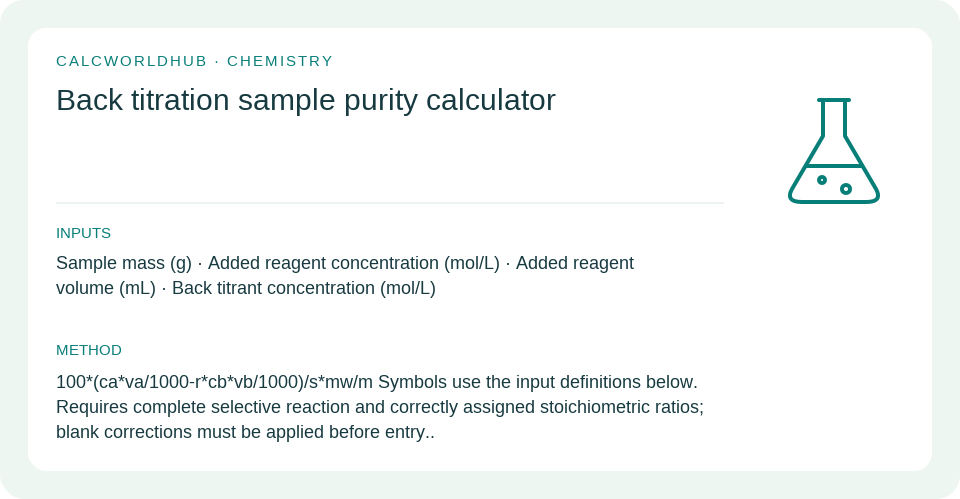
Infer analyte mass fraction from reagent added in excess and the amount remaining after reaction.
- Enter Sample mass (g), Added reagent concentration (mol/L), Added reagent volume (mL), Back titrant concentration (mol/L), then complete the remaining labeled fields. Match the units shown beside each field and review the result together with the assumptions below.
- Read the worked example below to check the expected input format and result.
- Compare another scenario by changing one input at a time. Use Reset to return to the starting values.
Back titration sample purity explained
Use Sample mass (g) with Added reagent concentration (mol/L) to reproduce the sample calculation, then review the stated limits before carrying the result into another scenario.
A numerical walkthrough
Sample mass (g) = 0.5; Added reagent concentration (mol/L) = 0.2; Added reagent volume (mL) = 50; Back titrant concentration (mol/L) = 0.1; Back titrant volume (mL) = 20; Added reagent moles per back-titrant mole = 1; Added reagent moles per analyte mole = 2; Analyte molar mass (g/mol) = 100.
- Apparent analyte purity: 80 %
The added reagent is 0.010 mol and the back titration measures 0.002 mol remaining. With the entered stoichiometric ratios, the consumed excess corresponds to 0.004 mol analyte, or 0.40 g; that is 80% of the 0.50 g sample. A value above 100% calls for checking blanks, concentrations, and stoichiometry.
The model behind the numbers
100*(ca*va/1000-r*cb*vb/1000)/s*mw/m
Symbols use the input definitions below. Requires complete selective reaction and correctly assigned stoichiometric ratios; blank corrections must be applied before entry..
What to enter
m— Sample mass (g)- Sample mass (g).
ca— Added reagent concentration (mol/L)- Added reagent concentration (mol/L).
va— Added reagent volume (mL)- Added reagent volume (mL).
cb— Back titrant concentration (mol/L)- Back titrant concentration (mol/L).
vb— Back titrant volume (mL)- Back titrant volume (mL).
r— Added reagent moles per back-titrant mole- Added reagent moles per back-titrant mole.
s— Added reagent moles per analyte mole- Added reagent moles per analyte mole.
mw— Analyte molar mass (g/mol)- Analyte molar mass (g/mol).
Interpreting the result
Requires complete selective reaction and correctly assigned stoichiometric ratios; blank corrections must be applied before entry.
Sources
Frequently asked questions
Why subtract the back titration?
It measures reagent left over, not reagent consumed by the sample.
What if apparent purity exceeds 100%?
Check stoichiometry, blanks, concentration, and interferences.
Does sample mass include solvent?
Use the mass basis on which purity is requested.
How do I use the Back titration sample purity calculator?
Enter Sample mass (g), Added reagent concentration (mol/L), Added reagent volume (mL), Back titrant concentration (mol/L), then complete the remaining labeled fields. Match the units shown beside each field and review the result together with the assumptions below.
What is a worked example of Back titration sample purity?
Sample mass (g) = 0.5; Added reagent concentration (mol/L) = 0.2; Added reagent volume (mL) = 50; Back titrant concentration (mol/L) = 0.1; Back titrant volume (mL) = 20; Added reagent moles per back-titrant mole = 1; Added reagent moles per analyte mole = 2; Analyte molar mass (g/mol) = 100. Apparent analyte purity: 80 % The added reagent is 0.010 mol and the back titration measures 0.002 mol remaining. With the entered stoichiometric ratios, the consumed excess corresponds to 0.004 mol analyte, or 0.40 g; that is 80% of the 0.50 g sample. A value above 100% calls for checking blanks, concentrations, and stoichiometry.
Read our calculation methodology.