How to use this calculator
Calculate period and annualized net interest margin from interest income, interest expense, average earning assets, and period length.
- Enter Interest income for period ($), Interest expense for period ($), Average interest-earning assets ($), Reporting period length (days). Match the units shown beside each field and review the result together with the assumptions below.
- Read the worked example below to check the expected input format and result.
- Compare another scenario by changing one input at a time. Use Reset to return to the starting values.
How this calculation works
Net interest margin (NIM) relates net interest income to the average assets that earn interest. The period ratio shows the margin over the entered interval; the annualized figure scales that interval using a simple day-count factor so periods of different lengths can be compared cautiously.
Inputs and units
interestIncome— Interest income for period ($)- Interest income recognized during the selected reporting interval.
interestExpense— Interest expense for period ($)- Interest expense recognized over the same interval and accounting basis.
averageEarningAssets— Average interest-earning assets ($)- Average balance of assets that generate the entered interest income during the period.
periodDays— Reporting period length (days)- Number of calendar days covered by the income, expense, and average balance figures.
Formula
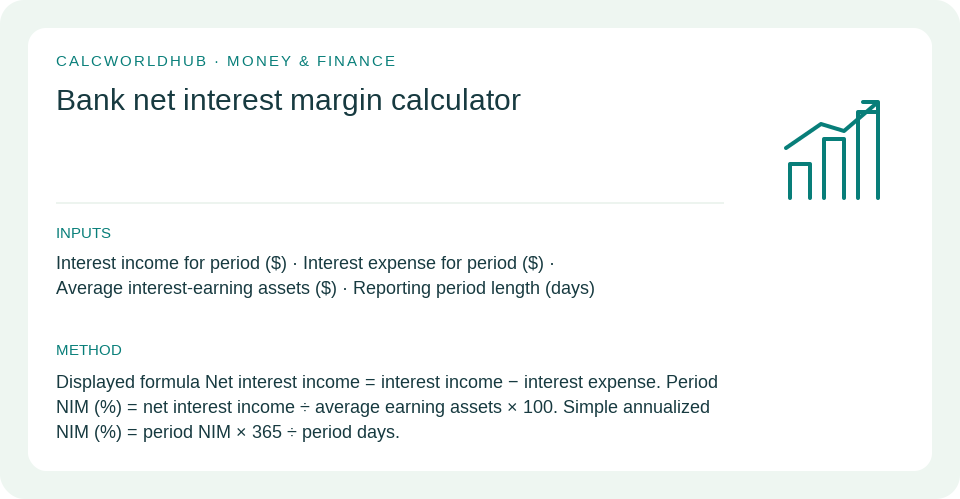
Net interest income = interest income − interest expense. Period NIM (%) = net interest income ÷ average earning assets × 100. Simple annualized NIM (%) = period NIM × 365 ÷ period days.
Method
Enter interest income and expense accrued during one reporting interval, the average balance of interest-earning assets during that interval, and the number of days in the interval. The annualized figure uses 365 divided by the period days; it is not a forecast.
Worked example
If period interest income is $100,000, interest expense is $40,000, and average earning assets are $4,000,000 over 90 days, net interest income is $60,000. Period NIM is 1.50%; the simple annualized figure is 1.50% × 365 ÷ 90 = 6.08%.
Assumptions and limits
Institutions may annualize quarterly values using reporting conventions and may use tax-equivalent interest income or other accounting adjustments. This calculator uses the supplied figures without such adjustments and assumes the average earning-asset balance represents the same period as the interest values.
Frequently asked questions
What assets belong in the NIM denominator?
Use average interest-earning assets for the period, not total assets, and match the balance basis to the interest figures.
Why does the calculator show both period and annualized NIM?
The period value describes the entered interval; simple annualization scales it to a year using the entered interval length.
Is annualized NIM the same as a forecast?
No. It mechanically scales one period and does not predict future rates, balances, credit losses, or funding costs.
How do I use the Bank net interest margin calculator?
Enter Interest income for period ($), Interest expense for period ($), Average interest-earning assets ($), Reporting period length (days). Match the units shown beside each field and review the result together with the assumptions below.
What is a worked example of Bank net interest margin?
If period interest income is $100,000, interest expense is $40,000, and average earning assets are $4,000,000 over 90 days, net interest income is $60,000. Period NIM is 1.50%; the simple annualized figure is 1.50% × 365 ÷ 90 = 6.08%.
Reference: FDIC net interest margin reporting definition. See our calculation methodology.