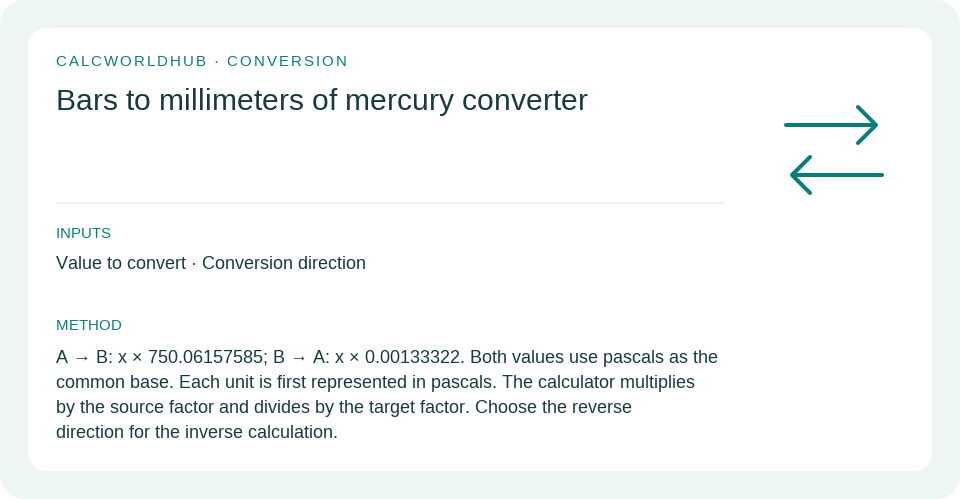
How to use this calculator
Convert bars to millimeters of mercury, or switch direction to convert back.
- Enter Value to convert, Conversion direction. Match the units shown beside each field and review the result together with the assumptions below.
- Read the worked example below to check the expected input format and result.
- Compare another scenario by changing one input at a time. Use Reset to return to the starting values.
How to convert bars and millimeters of mercury
One bar is 100,000 Pa, while one conventional millimetre of mercury is about 133.322 Pa. Their ratio is about 750.06, so the bar-to-mmHg conversion scales the entered pressure by that factor.
Inputs and units
amount— Value to convert- Enter a numeric value measured in the selected source unit. The same value is used whichever direction is selected.
direction— Conversion direction- A = bars (bar); B = millimeters of mercury (mmHg).
Formula and method
A → B: x × 750.06157585; B → A: x × 0.00133322. Both values use pascals as the common base.
Each unit is first represented in pascals. The calculator multiplies by the source factor and divides by the target factor. Choose the reverse direction for the inverse calculation.
Worked example
Enter 10 bar and select A to B. The calculator returns 7500.61575846 mmHg. Reverse the direction and enter 10 mmHg to see the reciprocal conversion. The formula and examples use the same unit definitions as the interactive tool.
Assumptions and limits
The conversion changes pressure units only. It does not tell whether a pressure is gauge or absolute; that reference must come from the instrument or specification.
Reading the result
The main output is the entered quantity expressed in the other unit. Supporting outputs show the factor and the common-unit value so the conversion path can be checked.
Frequently asked questions
How many mmHg are in one bar?
One bar equals 750.06157585 mmHg under the unit definition used here.
How do I convert millimeters of mercury back to bars?
Select B to A, enter the millimeters of mercury value, and calculate. The conversion factor is inverted automatically.
Does the converter turn gauge pressure into absolute pressure?
No. It changes units only; the reference zero must be supplied separately.
How do I use the Bars to millimeters of mercury converter?
Enter Value to convert, Conversion direction. Match the units shown beside each field and review the result together with the assumptions below.
What is a worked example of Bars to millimeters of mercury converter?
Enter 10 bar and select A to B. The calculator returns 7500.61575846 mmHg . Reverse the direction and enter 10 mmHg to see the reciprocal conversion. The formula and examples use the same unit definitions as the interactive tool.
Reference: NIST Guide to the SI, Appendix B: Conversion Factors. NIST distinguishes exact factors from rounded factors; the selected unit convention and display rounding are stated on this page.
Read our calculation methodology.