How to use this calculator
Normalize earned runs allowed to nine innings. Enter outs instead of decimal innings to handle partial innings unambiguously.
- Enter Earned runs, Outs recorded. Match the units shown beside each field and review the result together with the assumptions below.
- Read the worked example below to check the expected input format and result.
- Compare another scenario by changing one input at a time. Use Reset to return to the starting values.
Baseball earned run average explained
Enter pitching time as outs, not decimal innings: six innings and two outs is 20 outs, so the rate scales the earned runs by 27/outs.
Inputs and units
- Earned runs
- Runs officially charged as earned.
- Outs recorded
- Three outs equal one inning.
Formula and method
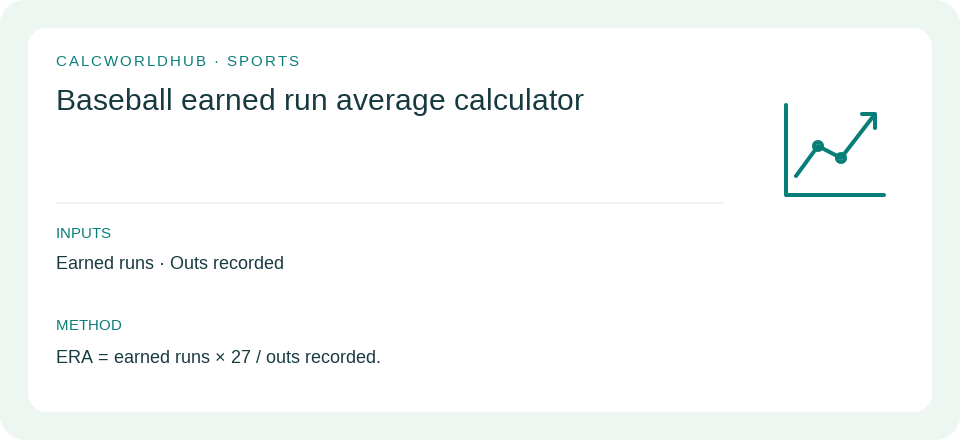
ERA = earned runs × 27 / outs recorded.
A worked example
Earned runs = 17; Outs recorded = 156.
- Earned run average: 2.942 runs per 9 innings
The 156 outs equal 52 innings; 17 earned runs over that span scale to 2.942 runs per nine innings.
Assumptions and special cases
Relief pitching and small samples can produce volatile rates. This uses the standard nine-inning normalization.
WHIP tracks walks and hits. ERA tracks earned runs and depends on official scoring.
Frequently asked questions
How do I enter 6.2 innings?
Enter 20 outs because .2 means two outs, not two tenths.
Do unearned runs count?
No. Enter earned runs only.
Can ERA exceed 9?
Yes. More than one earned run per inning produces ERA above 9.
How do I use the Baseball earned run average calculator?
Enter Earned runs, Outs recorded. Match the units shown beside each field and review the result together with the assumptions below.
What is a worked example of Baseball earned run average?
Earned runs = 17; Outs recorded = 156. Earned run average: 2.942 runs per 9 innings The 156 outs equal 52 innings; 17 earned runs over that span scale to 2.942 runs per nine innings.
Method reference: MLB statistical glossary (checked October 15, 2026).
See our calculation methodology.