How to use this calculator
Calculate on-base plus slugging percentage from a batter’s standard counting stats.
- Enter Singles, Doubles, Triples, Home runs, then complete the remaining labeled fields. Match the units shown beside each field and review the result together with the assumptions below.
- Read the worked example below to check the expected input format and result.
- Compare another scenario by changing one input at a time. Use Reset to return to the starting values.
How this calculation works
OPS adds on-base percentage and slugging percentage to summarize two parts of a batter’s offensive production. Enter season totals for hits by type, at-bats, walks, hit-by-pitch, and sacrifice flies; use the same sample of games for every count.
Inputs and units
singles— Singles- One-base hits in the selected batting sample.
doubles— Doubles- Two-base hits in the same sample.
triples— Triples- Three-base hits in the same sample.
hr— Home runs- Four-base hits in the same sample.
ab— At-bats- Official at-bats for the same sample.
bb— Walks- Bases on balls.
hbp— Hit by pitch- Times awarded first base after being hit.
sf— Sacrifice flies- Sacrifice flies included in the OBP denominator.
Formula
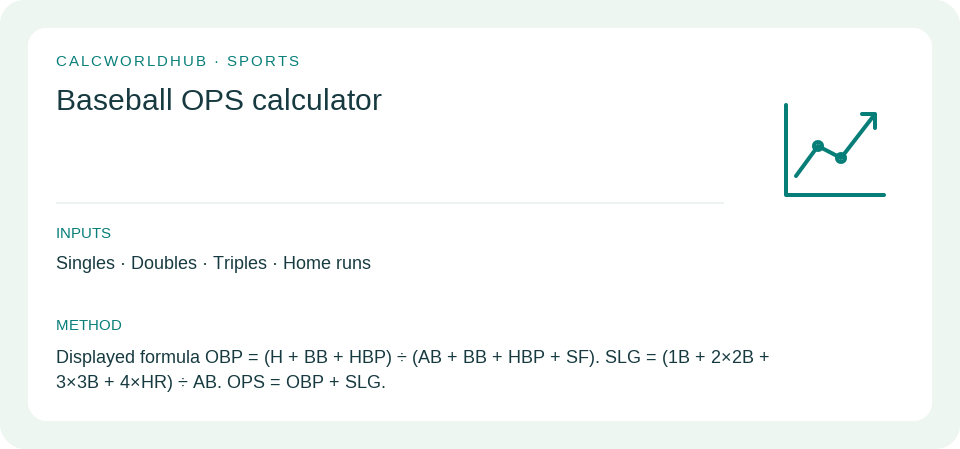
OBP = (H + BB + HBP) ÷ (AB + BB + HBP + SF). SLG = (1B + 2×2B + 3×3B + 4×HR) ÷ AB. OPS = OBP + SLG.
Worked example
With 80 singles, 30 doubles, 5 triples, 20 home runs, 400 at-bats, 50 walks, 5 hit-by-pitches, and 4 sacrifice flies: OBP = 190 ÷ 459 ≈ .414; total bases = 235, so SLG = 235 ÷ 400 = .588; OPS ≈ 1.001.
Assumptions and limits
Requires at-bats greater than zero and a positive on-base denominator. Inputs must be nonnegative whole-number counts; hits cannot exceed at-bats. OPS is a descriptive statistic, not a complete player valuation.
Frequently asked questions
What does OPS add together?
It adds on-base percentage and slugging percentage, keeping the two displayed components visible.
Are walks included in slugging percentage?
No. Walks and hit-by-pitches contribute to on-base percentage, while slugging uses at-bats and total bases from hits.
Does OPS adjust for league context or ballpark?
No. This is the unadjusted rate statistic; park- and league-adjusted measures require additional context.
How do I use the Baseball OPS calculator?
Enter Singles, Doubles, Triples, Home runs, then complete the remaining labeled fields. Match the units shown beside each field and review the result together with the assumptions below.
What is a worked example of Baseball OPS?
With 80 singles, 30 doubles, 5 triples, 20 home runs, 400 at-bats, 50 walks, 5 hit-by-pitches, and 4 sacrifice flies: OBP = 190 ÷ 459 ≈ .414; total bases = 235, so SLG = 235 ÷ 400 = .588; OPS ≈ 1.001.
Read our calculation methodology.