How to use this calculator
Estimate team possessions from field-goal attempts, offensive rebounds, turnovers, and free-throw attempts.
- Enter Field-goal attempts FGA, Free-throw attempts FTA, Offensive rebounds OREB, Turnovers TO, then complete the remaining labeled fields. Match the units shown beside each field and review the result together with the assumptions below.
- Read the worked example below to check the expected input format and result.
- Compare another scenario by changing one input at a time. Use Reset to return to the starting values.
How this calculation works
A box score does not identify every possession boundary, especially around free throws. This estimator uses field-goal attempts, turnovers, offensive rebounds, and a configurable free-throw factor to approximate the number of team possessions in a game or sample. It complements points-per-possession calculations when a play-by-play possession total is unavailable.
Inputs and units
fieldGoalAttempts— Field-goal attempts FGA- Team total for the game or sample.
freeThrowAttempts— Free-throw attempts FTA- Team total for the same game or sample.
offensiveRebounds— Offensive rebounds OREB- Team total for the same game or sample; cannot exceed field-goal attempts.
turnovers— Turnovers TO- Team total for the same game or sample.
freeThrowFactor— Free-throw possession factor y- Empirical factor from 0 to 1; 0.44 is a common NBA-style estimate.
Formula
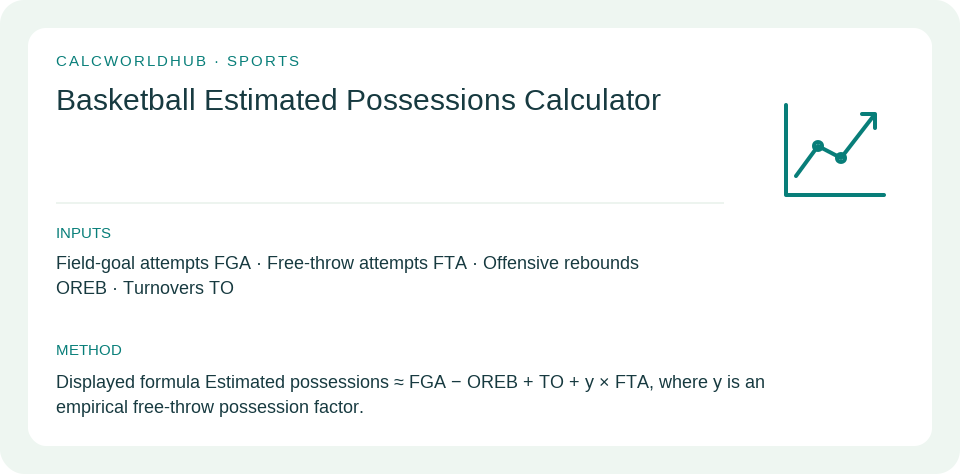
Estimated possessions ≈ FGA − OREB + TO + y × FTA, where y is an empirical free-throw possession factor.
Method
Count each field-goal attempt and turnover as a possession-ending event, subtract offensive rebounds that continue the same possession, and apply the selected factor to free-throw attempts. The default y = 0.44 is an empirical estimate; different leagues, eras, and scoring samples may use another factor.
Worked example
With 88 field-goal attempts, 22 free-throw attempts, 10 offensive rebounds, 14 turnovers, and y = 0.44, the box-score estimate is 101.68 possessions; without the free-throw term it is 92 possessions.
Assumptions and limits
This is an estimate from aggregate box-score totals, not an exact play-by-play count. The free-throw factor varies by data set; use a factor suited to the league or analysis and compare like samples.
Frequently asked questions
Why is the result not a whole number?
The free-throw term is an empirical fraction of attempts, so the estimate can be fractional even though actual possessions are discrete.
Why subtract offensive rebounds?
An offensive rebound usually continues the same possession rather than starting a new one.
Should every league use 0.44?
No. The factor is empirical and may vary by league, era, or data set; change it when your analysis uses a different convention.
How do I use the Basketball Estimated Possessions Calculator?
Enter Field-goal attempts FGA, Free-throw attempts FTA, Offensive rebounds OREB, Turnovers TO, then complete the remaining labeled fields. Match the units shown beside each field and review the result together with the assumptions below.
What is a worked example of Basketball Estimated Possessions?
With 88 field-goal attempts, 22 free-throw attempts, 10 offensive rebounds, 14 turnovers, and y = 0.44, the box-score estimate is 101.68 possessions; without the free-throw term it is 92 possessions.
Reference: technical reference. See our calculation methodology.