Bayes theorem with three hypotheses calculator
Update probabilities for three exhaustive hypotheses using their priors and the likelihood of the same evidence under each.
How to use this calculator
Update probabilities for three exhaustive hypotheses using their priors and the likelihood of the same evidence under each.
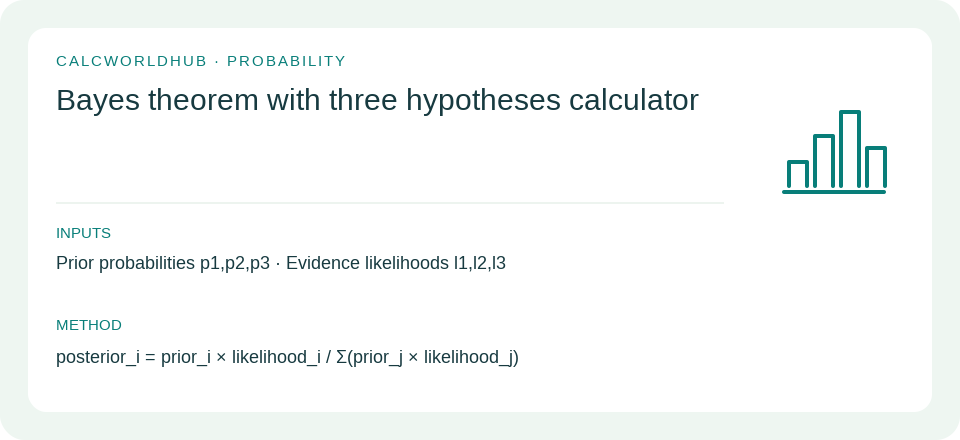
- Enter Prior probabilities p1,p2,p3, Evidence likelihoods l1,l2,l3. Match the units shown beside each field and review the result together with the assumptions below.
- Read the worked example below to check the expected input format and result.
- Compare another scenario by changing one input at a time. Use Reset to return to the starting values.
How the Bayes theorem with three hypotheses calculator works
Update probabilities for three exhaustive hypotheses using their priors and the likelihood of the same evidence under each.
Inputs and units
- Prior probabilities p1,p2,p3: Three decimal prior probabilities in hypothesis order; sum to one.
- Evidence likelihoods l1,l2,l3: Three matching probabilities of the observed evidence under those hypotheses.
Formula and method
posterior_i = prior_i × likelihood_i / Σ(prior_j × likelihood_j)
Worked example
Priors 0.333333,0.333333,0.333334 and likelihoods 0.8,0.4,0.2 give posteriors 57.1428%, 28.5714%, and 14.2858%.
Interpreting the result
The three posterior shares sum to 100%. Evidence favors hypotheses that assign it a larger likelihood, relative to their prior weight.
Assumptions and limits
Hypotheses must be mutually exclusive and exhaustive. Priors sum to one within the accepted rounding tolerance; likelihoods do not need to sum to one. Zero total evidence probability leaves the update undefined.
Sources and method
- Develops conditional probability, independence, and Bayes updating. OpenStax: probability theory
Frequently asked questions
Should likelihoods sum to one?
No. They describe the same evidence under different hypothetical conditions and are not a distribution over hypotheses.
Can a hypothesis with zero prior receive a positive posterior?
Not in this update. Its unnormalized weight remains zero.
How do I use the Bayes theorem with three hypotheses calculator?
Enter Prior probabilities p1,p2,p3, Evidence likelihoods l1,l2,l3. Match the units shown beside each field and review the result together with the assumptions below.
What is a worked example of Bayes theorem with three hypotheses?
Priors 0.333333,0.333333,0.333334 and likelihoods 0.8,0.4,0.2 give posteriors 57.1428%, 28.5714%, and 14.2858%.
What does the Bayes theorem with three hypotheses calculator calculate?
Update probabilities for three exhaustive hypotheses using their priors and the likelihood of the same evidence under each.
See the calculation methodology.