Beam bending stress calculator
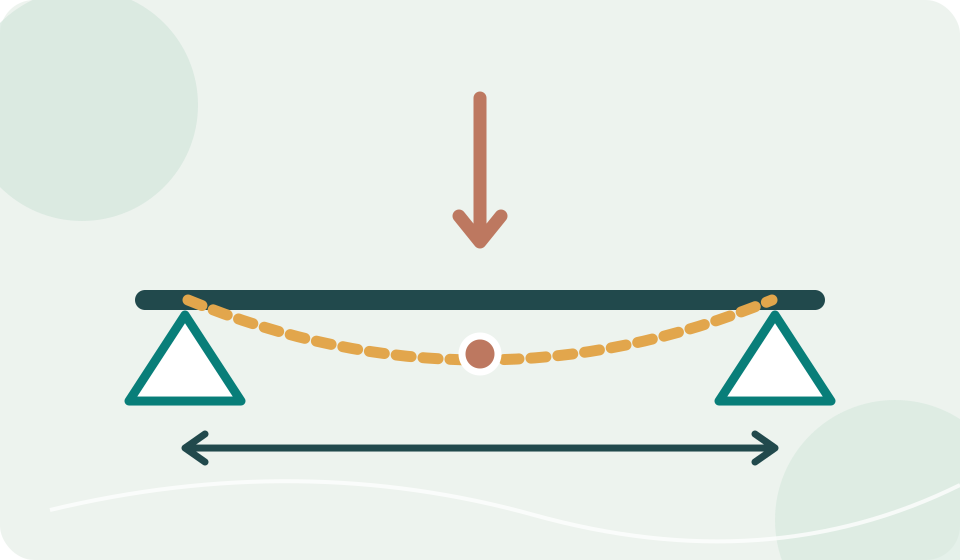
Estimate the elastic extreme-fiber stress for a simply supported beam under a center point load.
inputs.
Calculator
How to use this calculator
Estimate maximum bending stress for a simply supported beam with a centered point load.
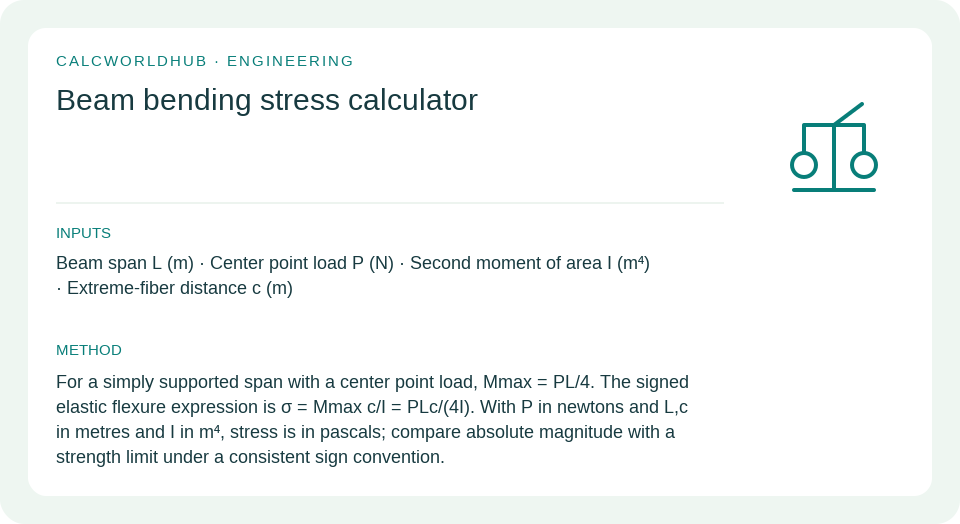
- Enter Beam span L (m), Center point load P (N), Second moment of area I (m⁴), Extreme-fiber distance c (m). Match the units shown beside each field and review the result together with the assumptions below.
- Read the worked example below to check the expected input format and result.
- Compare another scenario by changing one input at a time. Use Reset to return to the starting values.
Estimate flexural stress for a centered point load
This page assumes a simply supported beam with a point load at midspan. It first finds the maximum bending moment, then evaluates the elastic flexure formula at the extreme fiber.
Inputs and units
- Beam span L (m): Distance between the two simple supports.
- Center point load P (N): A signed point load applied at midspan; the result’s sign follows the entered load and formula convention.
- Second moment of area I (m⁴): The cross-section property about the bending axis.
- Extreme-fiber distance c (m): Distance from the neutral axis to the outermost fiber on the side being evaluated.
Formula and method
For a simply supported span with a center point load, Mmax = PL/4. The signed elastic flexure expression is σ = Mmax c/I = PLc/(4I). With P in newtons and L,c in metres and I in m⁴, stress is in pascals; compare absolute magnitude with a strength limit under a consistent sign convention.
Worked example
For L = 4 m, P = 2,000 N, I = 8×10⁻⁶ m⁴, and c = 0.08 m, Mmax = 2,000×4/4 = 2,000 N·m. Then σmax = 2,000×0.08/(8×10⁻⁶) = 20,000,000 Pa = 20 MPa.
Interpreting the result
The 20 MPa output is the nominal extreme-fiber stress for the idealized loading and section. Its sign follows the load convention; use the magnitude when comparing with a strength limit and the correct tension/compression side. This calculator does not establish structural safety.
Assumptions and limits
The formula assumes linear-elastic beam behavior, simple supports, a centered point load, and a known cross-section property about the correct axis. It does not check deflection, shear, local buckling, load combinations, connections, dynamic effects, or code requirements.
Method references
Frequently asked questions
Can I use this for a uniformly distributed load?
No. A distributed load has a different maximum-moment expression. Use a matching beam/loading case rather than substituting its total load into the center-point formula.
How do I use the Beam bending stress calculator?
Enter Beam span L (m), Center point load P (N), Second moment of area I (m⁴), Extreme-fiber distance c (m). Match the units shown beside each field and review the result together with the assumptions below.
What is a worked example of Beam bending stress?
For L = 4 m, P = 2,000 N, I = 8×10⁻⁶ m⁴, and c = 0.08 m, Mmax = 2,000×4/4 = 2,000 N·m. Then σmax = 2,000×0.08/(8×10⁻⁶) = 20,000,000 Pa = 20 MPa.
What does the Beam bending stress calculator calculate?
Estimate maximum bending stress for a simply supported beam with a centered point load.
What assumptions apply to Beam bending stress?
The formula assumes linear-elastic beam behavior, simple supports, a centered point load, and a known cross-section property about the correct axis. It does not check deflection, shear, local buckling, load combinations, connections, dynamic effects, or code requirements.
Good calculators show their work.
CalcWorldHub is built around clear inputs and visible assumptions. Results are estimates for planning; check official sources or your provider’s terms when exact figures matter.