How to use this calculator
Evaluate a scalar Bernstein polynomial with de Casteljau interpolation and display its guaranteed convex-hull enclosure on the unit interval.
- Enter Scalar Bernstein control values, Normalized parameter. Match the units shown beside each field and review the result together with the assumptions below.
- Read the worked example below to check the expected input format and result.
- Compare another scenario by changing one input at a time. Use Reset to return to the starting values.
Bernstein polynomial value and convex hull bounds explained
A numerical walkthrough
Scalar Bernstein control values = [0, 2, -1, 1]; Normalized parameter = 0.4.
- Bernstein polynomial value: 0.64 control units
- Convex hull lower bound: -1 control units
- Convex hull upper bound: 2 control units
Controls (0,2,−1,1) at t=0.4 yield 0.64, which lies inside the control enclosure [−1,2].
The model behind the numbers
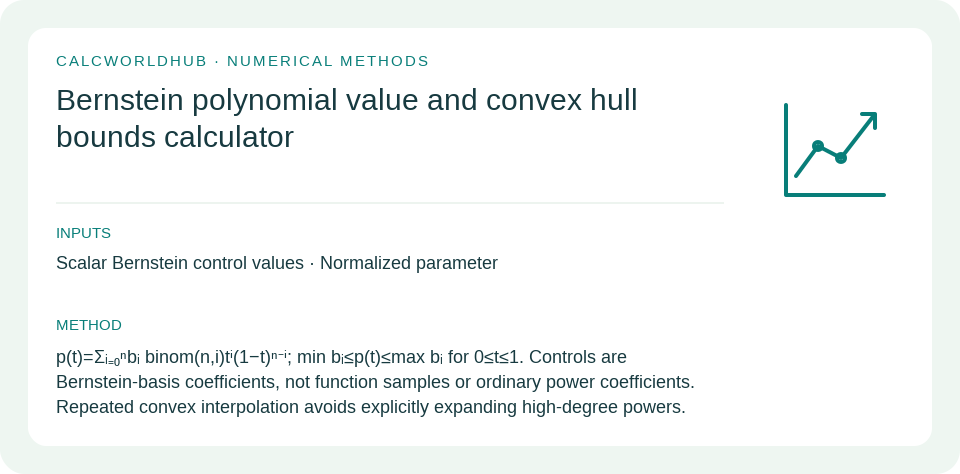
p(t)=Σᵢ₌₀ⁿbᵢ binom(n,i)tⁱ(1−t)ⁿ⁻ⁱ; min bᵢ≤p(t)≤max bᵢ for 0≤t≤1.
Controls are Bernstein-basis coefficients, not function samples or ordinary power coefficients. Repeated convex interpolation avoids explicitly expanding high-degree powers.
What to enter
controls— Scalar Bernstein control values- Control coefficients of degree count-minus-one. Use comma-separated values in the stated order.
t— Normalized parameter- Parameter in the closed unit interval.
Interpreting the result
Bounds can be loose and apply only on [0,1]. Multidimensional Bézier geometry and rational weights are not included.
Reading the outputs
Value and enclosure endpoints share the control units. The enclosure holds across the whole unit interval, not only at the requested t.
Frequently asked questions
Are the controls samples of the curve?
Generally only the first and last controls lie on the scalar curve at the endpoints.
Are these exact extrema?
No. They are a guaranteed enclosure, which can be wider than the actual range.
What happens at t=0 or t=1?
The value equals the first or last control respectively.
How do I use the Bernstein polynomial value and convex hull bounds calculator?
Enter Scalar Bernstein control values, Normalized parameter. Match the units shown beside each field and review the result together with the assumptions below.
What is a worked example of Bernstein polynomial value and convex hull bounds?
Scalar Bernstein control values = [0, 2, -1, 1]; Normalized parameter = 0.4. Bernstein polynomial value: 0.64 control units Convex hull lower bound: -1 control units Convex hull upper bound: 2 control units Controls (0,2,−1,1) at t=0.4 yield 0.64, which lies inside the control enclosure [−1,2].
Read our calculation methodology.