Binomial distribution mean calculator
Find the expected number of successes in a fixed number of independent trials. Enter your values below to see the result and method.
inputs.
Related calculators
How to use this calculator
Find the expected number of successes in a fixed number of independent trials.
- Enter Number of trials n, Success probability p. Match the units shown beside each field and review the result together with the assumptions below.
- Read the worked example below to check the expected input format and result.
- Compare another scenario by changing one input at a time. Use Reset to return to the starting values.
Set the distribution and parameter convention
Find the expected number of successes in a fixed number of independent trials.
Inputs and units
Use the units printed beside each field. Enter a nonnegative integer number of trials n and a success probability p from 0 to 1.
- Number of trials n: Use a nonnegative whole-number count.
- Success probability p: Use a probability from 0 to 1 for each independent trial.
Statistical formula and example
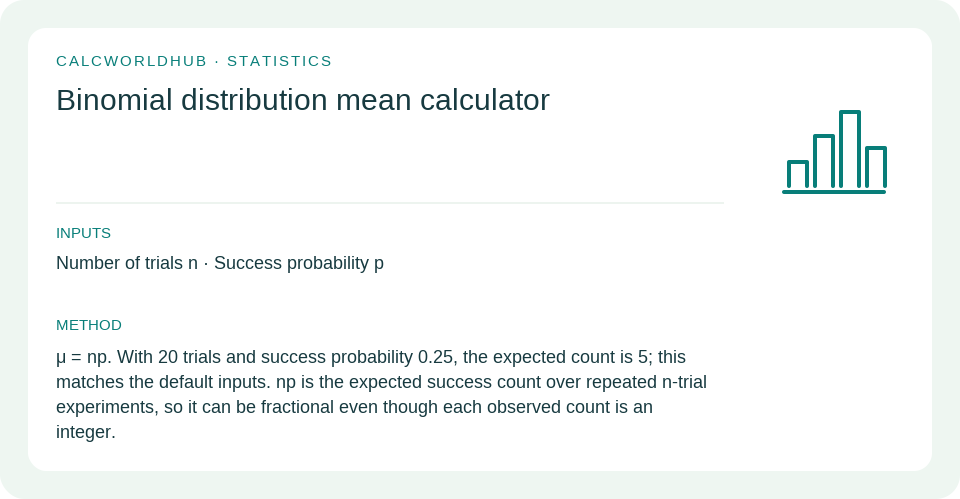
μ = np.
With 20 trials and success probability 0.25, the expected count is 5; this matches the default inputs.
np is the expected success count over repeated n-trial experiments, so it can be fractional even though each observed count is an integer.
Interpreting the statistic
The mean np is a long-run average success count across independent trials; one experiment can produce a different integer count.
Assumptions and limitations
Trials must be independent and share the same success probability; the result is an expectation, not a guaranteed count.
Source and method
NIST describes the binomial model with trial count and common success probability; its expected count is np. NIST/SEMATECH e-Handbook — Binomial distribution.
Frequently asked questions
What is the binomial mean?
For n independent trials with the same success probability p, the expected number of successes is μ=np.
Can I apply this result to any dataset?
Use it when trials are independent and share one success probability p. Different probabilities or dependent trials require a different mean model.
When is binomial probability more useful than the mean?
Use the mean np for the expected count. Use a binomial probability when you need the chance of a particular count or interval of counts.
How do I use the Binomial distribution mean calculator?
Enter Number of trials n, Success probability p. Match the units shown beside each field and review the result together with the assumptions below.
What is a worked example of Binomial distribution mean?
μ = np. With 20 trials and success probability 0.25, the expected count is 5; this matches the default inputs. np is the expected success count over repeated n-trial experiments, so it can be fractional even though each observed count is an integer.
Read the calculation methodology and privacy policy.