Binomial distribution mode calculator
Find the most likely success count for a binomial distribution under its standard mode rule. Enter the values below to see the result and method.
inputs.
Related calculators
Use these tools when your question extends to a neighboring part of the same calculation.
How to use this calculator
Find the most likely success count for a binomial distribution under its standard mode rule.
- Enter Number of trials n, Success probability p (0–1). Match the units shown beside each field and review the result together with the assumptions below.
- Read the worked example below to check the expected input format and result.
- Compare another scenario by changing one input at a time. Use Reset to return to the starting values.
Define the event or trial model
Use this page when n independent trials share success probability p and the most likely success count is needed. The mode is a count; it is not the binomial mean np.
Inputs and units
Enter n as a nonnegative whole number and p from 0 through 1. Keep the definition of success and p constant across all n independent trials.
- Number of trials n: enter the value using the unit and definition shown beside the field.
- Success probability p (0–1): enter the value using the unit and definition shown beside the field.
Formula and worked example
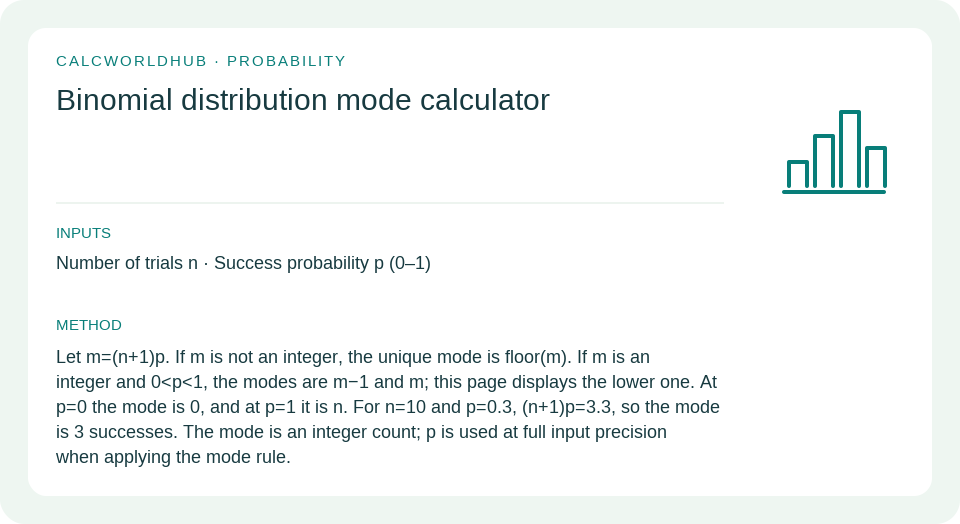
Let m=(n+1)p. If m is not an integer, the unique mode is floor(m). If m is an integer and 0<p<1, the modes are m−1 and m; this page displays the lower one. At p=0 the mode is 0, and at p=1 it is n.
For n=10 and p=0.3, (n+1)p=3.3, so the mode is 3 successes.
The mode is an integer count; p is used at full input precision when applying the mode rule.
What the probability or expectation means
The mode is the success count with the greatest probability. It can differ from np; an observed count remains between 0 and n.
Assumptions and limits
Frequently asked questions
Is the binomial distribution mode output a probability or an expected value?
The mode is a success count with the greatest probability, not a probability or the mean np. For n=10 and p=0.3, the mode is 3 successes.
Which model assumption matters most for the binomial distribution mode?
The n trials must be independent and share the same success probability p. If the event chance changes between trials or outcomes are dependent, this binomial model does not apply.
When should I use a binomial probability calculator instead?
Use a probability tool for P(X=k), cumulative probability, or a range. This page returns the most likely count; for 0<p<1 and integer (n+1)p, two adjacent counts tie.
How do I use the Binomial distribution mode calculator?
Enter Number of trials n, Success probability p (0–1). Match the units shown beside each field and review the result together with the assumptions below.
What is a worked example of Binomial distribution mode?
Let m=(n+1)p. If m is not an integer, the unique mode is floor(m). If m is an integer and 0<p<1, the modes are m−1 and m; this page displays the lower one. At p=0 the mode is 0, and at p=1 it is n. For n=10 and p=0.3, (n+1)p=3.3, so the mode is 3 successes. The mode is an integer count; p is used at full input precision when applying the mode rule.
Read the calculation methodology and privacy policy.
Method source: NIST/SEMATECH e-Handbook, Binomial distribution. Its mode bounds support the integer and endpoint cases described above.