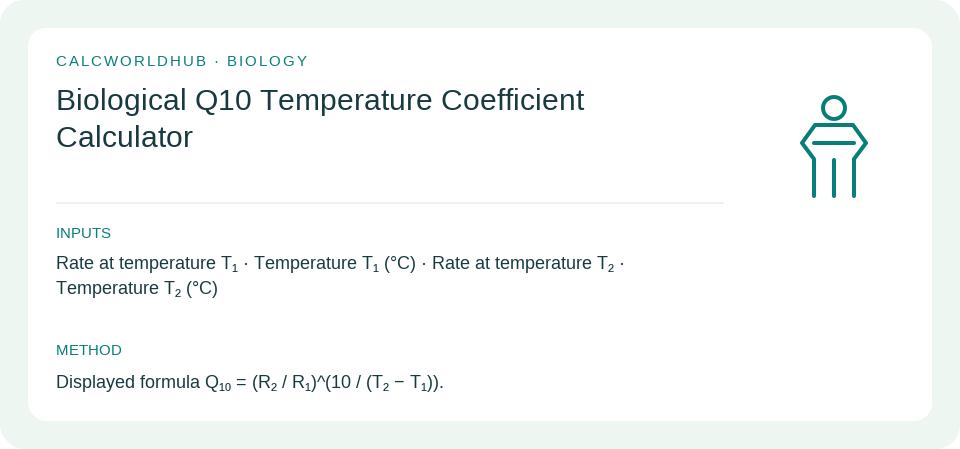
How to use this calculator
Estimate the Q10 temperature coefficient from biological process rates measured at two temperatures.
- Enter Rate at temperature T₁, Temperature T₁ (°C), Rate at temperature T₂, Temperature T₂ (°C). Match the units shown beside each field and review the result together with the assumptions below.
- Read the worked example below to check the expected input format and result.
- Compare another scenario by changing one input at a time. Use Reset to return to the starting values.
How this calculation works
The empirical Q10 coefficient expresses how a measured rate changes for a 10 °C temperature increase over a specified interval. It is computed from two positive rates and the temperature gap between their measurements.
Inputs and units
rate1— Rate at temperature T₁- Positive measured rate; use the same units for both observations.
temp1C— Temperature T₁ (°C)- Temperature at which rate R₁ was measured.
rate2— Rate at temperature T₂- Positive measured rate for the same biological process.
temp2C— Temperature T₂ (°C)- Temperature at which rate R₂ was measured; must differ from T₁.
Formula
Q₁₀ = (R₂ / R₁)^(10 / (T₂ − T₁)).
Method
Enter rates measured for the same process in matching units and the temperature associated with each rate. Celsius and kelvin have identical temperature intervals for this equation.
Worked example
A rate of 2 units at 20 °C and 4 units at 30 °C gives Q10 = (4/2)^(10/10) = 2.
Assumptions and limits
Q10 is an empirical summary over the measured temperature interval, not a universal constant. It does not model acclimation, thresholds, substrate limits, or a changing temperature response; avoid extrapolating far outside the observations.
Frequently asked questions
What does Q10 mean?
It estimates the rate multiplier associated with a 10 °C increase over the observed interval.
Must the temperature interval be exactly 10 °C?
No. The exponent scales the observed rate ratio to a 10-degree interval.
Can I compare rates in different units?
No. Both rates must describe the same process using the same rate units.
How do I use the Biological Q10 Temperature Coefficient Calculator?
Enter Rate at temperature T₁, Temperature T₁ (°C), Rate at temperature T₂, Temperature T₂ (°C). Match the units shown beside each field and review the result together with the assumptions below.
What is a worked example of Biological Q10 Temperature Coefficient?
A rate of 2 units at 20 °C and 4 units at 30 °C gives Q10 = (4/2)^(10/10) = 2.
Reference: Peer-reviewed thermal-biology definition and equation for the Q10 temperature coefficient. See our calculation methodology.