How to use this calculator
Inspect gain and phase at a selected frequency and check the roots of a real second-order denominator.
- Enter Numerator b0 b1 b2, Denominator a0 a1 a2, Evaluation frequency (Hz), Sampling rate (Hz). Match the units shown beside each field and review the result together with the assumptions below.
- Read the worked example below to check the expected input format and result.
- Compare another scenario by changing one input at a time. Use Reset to return to the starting values.
Biquad frequency response and pole stability explained
How the calculation works
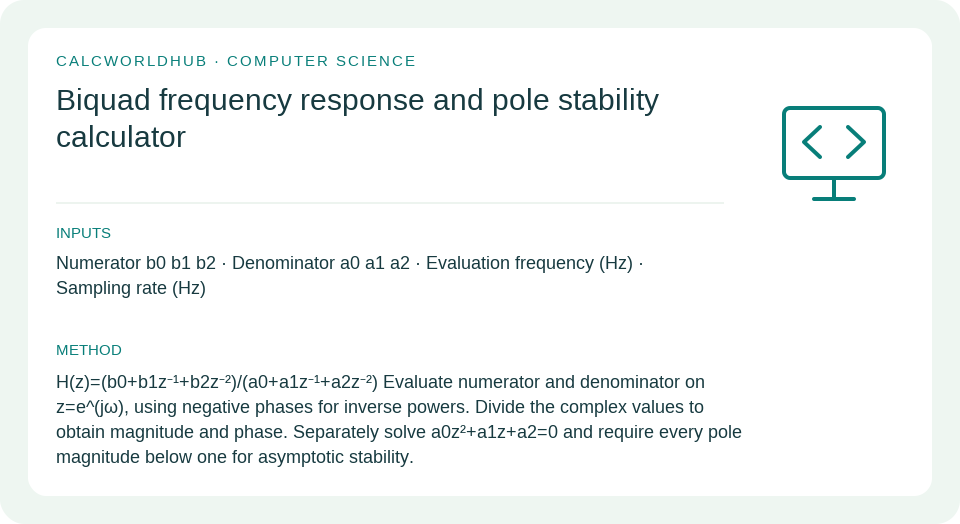
H(z)=(b0+b1z⁻¹+b2z⁻²)/(a0+a1z⁻¹+a2z⁻²)
Evaluate numerator and denominator on z=e^(jω), using negative phases for inverse powers. Divide the complex values to obtain magnitude and phase. Separately solve a0z²+a1z+a2=0 and require every pole magnitude below one for asymptotic stability.
Set up the calculation
b— Numerator b0 b1 b2- Numerator b0 b1 b2. Use comma-separated values in the stated order.
a— Denominator a0 a1 a2- Denominator a0 a1 a2. Use comma-separated values in the stated order.
f— Evaluation frequency (Hz)- Evaluation frequency (Hz).
fs— Sampling rate (Hz)- Sampling rate (Hz).
Limits of this model
Coefficients follow the explicit plus-sign denominator convention. Poles on the unit circle are not asymptotically stable; exact zero response has no finite dB value.
Check this example
Numerator b0 b1 b2 = 0.5, 0.5, 0; Denominator a0 a1 a2 = 1, 0, 0; Evaluation frequency (Hz) = 1000; Sampling rate (Hz) = 48000.
- Gain at selected frequency: -0.01861709 dB
- Linear magnitude: 0.99785892
- Principal phase: -3.75 degrees
- Maximum pole radius: 0
- Asymptotic pole stability: Stable
Source
MathWorks, freqz documentation. Defines coefficient-based discrete-filter frequency response and describes second-order sections (biquads).
Interpreting the result
Gain in dB and phase describe the response at the selected frequency. The maximum pole radius summarizes asymptotic stability for this discrete filter: values below 1 are inside the unit circle. A single-frequency gain is not a full passband or bandwidth specification.
Frequently asked questions
Do feedback coefficients need sign reversal?
Use coefficients as written in the displayed denominator.
Does stable guarantee a good filter?
No, it only describes pole location.
What happens at a denominator zero on the selected frequency?
The response is undefined and rejected.
How do I use the Biquad frequency response and pole stability calculator?
Enter Numerator b0 b1 b2, Denominator a0 a1 a2, Evaluation frequency (Hz), Sampling rate (Hz). Match the units shown beside each field and review the result together with the assumptions below.
What is a worked example of Biquad frequency response and pole stability?
Numerator b0 b1 b2 = 0.5, 0.5, 0; Denominator a0 a1 a2 = 1, 0, 0; Evaluation frequency (Hz) = 1000; Sampling rate (Hz) = 48000. Gain at selected frequency: -0.01861709 dB Linear magnitude: 0.99785892 Principal phase: -3.75 degrees Maximum pole radius: 0 Asymptotic pole stability: Stable
Read our calculation methodology.