How to use this calculator
Estimate how finite base currents and unequal collector voltages change a nominal one-to-one bipolar current mirror.
- Enter Reference terminal current (A), Matched forward beta, Early voltage (V), Reference transistor VCE (V), then complete the remaining labeled fields. Match the units shown beside each field and review the result together with the assumptions below.
- Read the worked example below to check the expected input format and result.
- Compare another scenario by changing one input at a time. Use Reset to return to the starting values.
BJT mirror base-current and Early-effect error explained
How the calculation works
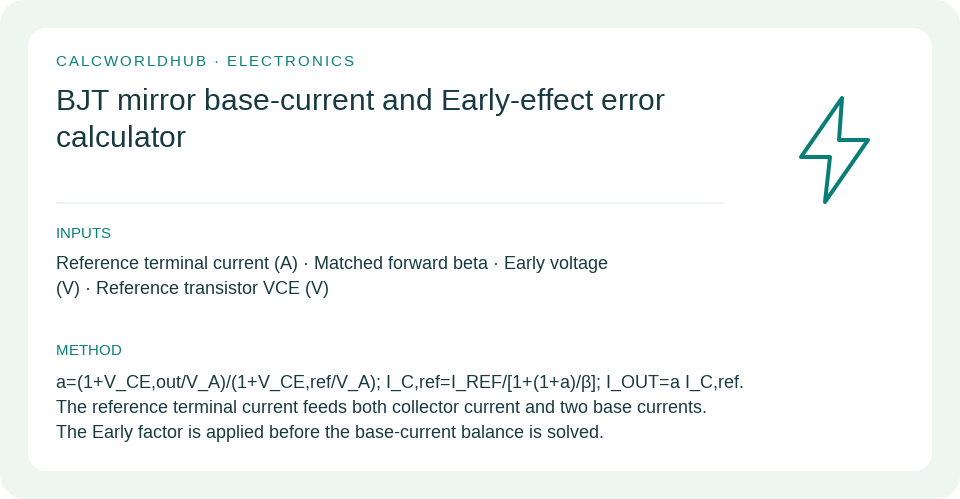
a=(1+V_CE,out/V_A)/(1+V_CE,ref/V_A); I_C,ref=I_REF/[1+(1+a)/β]; I_OUT=a I_C,ref.
The reference terminal current feeds both collector current and two base currents. The Early factor is applied before the base-current balance is solved.
Set up the calculation
Iref— Reference terminal current (A)- Total current feeding diode-connected transistor and both bases.
beta— Matched forward beta- Same finite collector/base current gain for both transistors.
Va— Early voltage (V)- Positive Early-effect parameter shared by both devices.
Vref— Reference transistor VCE (V)- Positive collector-emitter/base-emitter voltage of diode-connected reference transistor.
Vout— Output transistor VCE (V)- Output compliance voltage in active region.
Limits of this model
Matched temperature and junction area, constant beta, forward-active output and linear Early-effect approximation.
Check this example
Reference terminal current (A) = 0.001; Matched forward beta = 100; Early voltage (V) = 100; Reference transistor VCE (V) = 0.7; Output transistor VCE (V) = 5.
- Mirrored output current: 0.001022 A
- Ratio error: 2.18282 %
- Reference collector current: 0.00098 A
For 1 mA terminal reference current, beta 100 and 100 V Early voltage, raising output VCE from 0.7 V to 5 V partly offsets finite-beta current loss.
Reading the outputs
Ratio error compares output current with terminal reference current, not with the reference transistor collector alone.
Frequently asked questions
Why is reference collector current below Iref?
Some of the reference-terminal current supplies the base currents of both devices.
Can Early effect make output current too large?
Yes; larger output VCE raises collector current even when VBE is matched.
Does this support a saturated output transistor?
No; the model rejects very low compliance and does not include saturation charge.
How do I use the BJT mirror base-current and Early-effect error calculator?
Enter Reference terminal current (A), Matched forward beta, Early voltage (V), Reference transistor VCE (V), then complete the remaining labeled fields. Match the units shown beside each field and review the result together with the assumptions below.
What is a worked example of BJT mirror base-current and Early-effect error?
Reference terminal current (A) = 0.001; Matched forward beta = 100; Early voltage (V) = 100; Reference transistor VCE (V) = 0.7; Output transistor VCE (V) = 5. Mirrored output current: 0.001022 A Ratio error: 2.18282 % Reference collector current: 0.00098 A For 1 mA terminal reference current, beta 100 and 100 V Early voltage, raising output VCE from 0.7 V to 5 V partly offsets finite-beta current loss.
Background or definition reference: Analog Devices current mirror principles.
Read our calculation methodology.