How to use this calculator
Estimate a bond’s annualized yield by solving for the rate that matches its price and promised cash flows.
- Enter Current bond price (currency), Face value at maturity (currency), Annual coupon rate (%), Years to maturity, then complete the remaining labeled fields. Match the units shown beside each field and review the result together with the assumptions below.
- Read the worked example below to check the expected input format and result.
- Compare another scenario by changing one input at a time. Use Reset to return to the starting values.
How this calculation works
Yield to maturity is the periodic discount rate that makes a bond’s quoted price equal the present value of its remaining coupon payments and principal. Enter the settlement price, face value, coupon, years remaining, and coupon frequency. This calculator assumes payment dates are evenly spaced and redemption occurs at face value.
Inputs and units
price— Current bond price (currency)- Market price paid per bond, excluding accrued interest.
face— Face value at maturity (currency)- Principal repaid at maturity under the bond terms.
coupon— Annual coupon rate (%)- Nominal coupon percentage of face value per year.
years— Years to maturity- Remaining time in years; payment periods are modeled as regular.
frequency— Coupon payments per year- Use 1 for annual, 2 for semiannual, 4 for quarterly, or 12 for monthly payments.
Formula
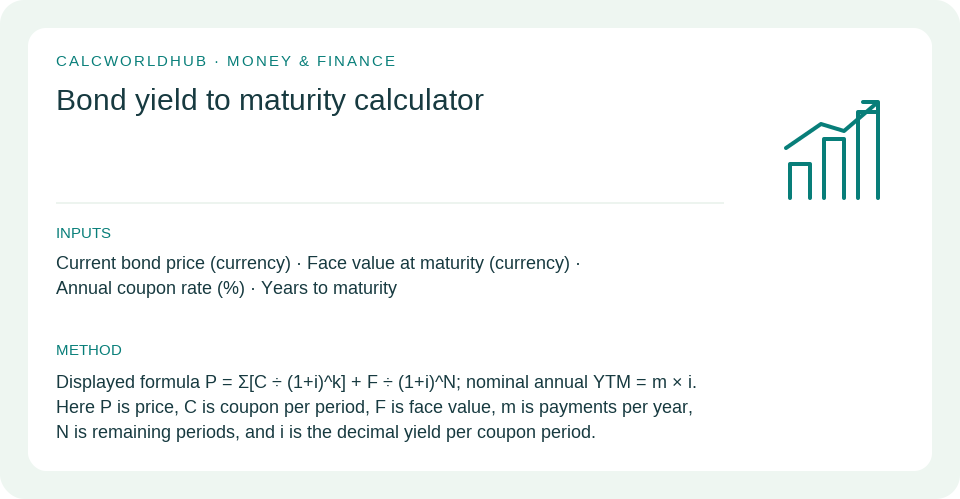
P = Σ[C ÷ (1+i)^k] + F ÷ (1+i)^N; nominal annual YTM = m × i. Here P is price, C is coupon per period, F is face value, m is payments per year, N is remaining periods, and i is the decimal yield per coupon period.
Worked example
For a $1,000 face-value bond priced at $950, with a 5% annual coupon and 10 years remaining paid semiannually, the solver gives an annualized nominal yield of about 5.66%. The price equals the present value of 20 coupons of $25 and the $1,000 maturity payment at that yield.
Assumptions and limits
The clean-price input is treated as a coupon-date price with zero accrued interest and one full period until the next coupon. Assumes coupons are paid as scheduled and reinvestment at the yield is possible. Excludes accrued interest, taxes, transaction fees, default risk, and irregular coupon dates. A premium bond can have a yield below its coupon rate.
Frequently asked questions
Is this yield the same as the coupon rate?
No. Coupon rate is based on face value; yield to maturity also reflects the price paid and remaining cash-flow timing.
Does yield to maturity include accrued interest?
This simplified solver excludes accrued interest and assumes full coupon periods. Between coupon dates, price and yield calculations need accrued interest and day-count conventions.
What does a negative yield mean here?
A bond priced above the discounted value of its cash flows can produce a negative solved yield; the modeled yield must remain above the periodic -100% boundary.
How do I use the Bond yield to maturity calculator?
Enter Current bond price (currency), Face value at maturity (currency), Annual coupon rate (%), Years to maturity, then complete the remaining labeled fields. Match the units shown beside each field and review the result together with the assumptions below.
What is a worked example of Bond yield to maturity?
For a $1,000 face-value bond priced at $950, with a 5% annual coupon and 10 years remaining paid semiannually, the solver gives an annualized nominal yield of about 5.66%. The price equals the present value of 20 coupons of $25 and the $1,000 maturity payment at that yield.
Reference: FINRA: bond yield and the present-value definition of YTM.
Read our calculation methodology.