How to use this calculator
Estimate a league bowling handicap from a bowler average, a basis score, and a percentage factor.
- Enter Bowler average, Handicap basis score, Handicap percentage, Scratch game score. Match the units shown beside each field and review the result together with the assumptions below.
- Read the worked example below to check the expected input format and result.
- Compare another scenario by changing one input at a time. Use Reset to return to the starting values.
How this calculation works
League bowling handicaps use a chosen basis score and percentage to narrow the scoring gap between averages. Enter the settings used by your league and a scratch game score to see the corresponding adjusted score. The league’s written rules govern eligibility, rounding, caps, and any special treatment.
Inputs and units
average— Bowler average- Current average used by the league for handicap purposes, in pins per game.
basis— Handicap basis score- The league or event’s basis score, in pins.
percentage— Handicap percentage- The league’s selected percentage of the difference, from 0 to 100.
scratchScore— Scratch game score- A scratch score to which the rounded handicap will be added.
Formula
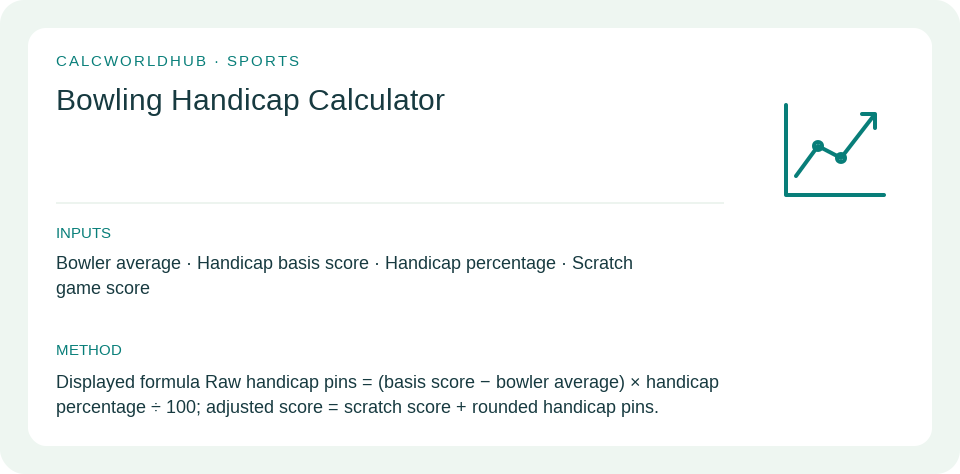
Raw handicap pins = (basis score − bowler average) × handicap percentage ÷ 100; adjusted score = scratch score + rounded handicap pins.
Method
The calculator applies the basis-minus-average difference to the selected percentage, rounds the handicap to the nearest whole pin, and adds it to the scratch score. A negative handicap is shown when the entered average exceeds the basis rather than silently changing the league rule.
Worked example
With a 160 average, 220 basis, and 90% handicap, raw handicap is (220 − 160) × 0.90 = 54 pins. A 180 scratch game therefore becomes 234 after handicap.
Assumptions and limits
Basis scores, percentages, negative-handicap treatment, rounding, and maximums are set by league or tournament rules. This tool does not determine eligibility or replace an organizer’s posted rule sheet.
Frequently asked questions
What does the basis score mean?
It is the reference score selected in the league or tournament rules. It is not automatically the same for every bowling event.
Why can the handicap be negative?
If a bowler average exceeds the basis, the configured formula produces a negative value. The league may set a zero floor or another rule; enter its actual settings and check the posted rules.
Does every league round the same way?
Rounding conventions can depend on the league’s rules. This estimate rounds to the nearest whole pin; confirm the local rule before using a score officially.
How do I use the Bowling Handicap Calculator?
Enter Bowler average, Handicap basis score, Handicap percentage, Scratch game score. Match the units shown beside each field and review the result together with the assumptions below.
What is a worked example of Bowling Handicap?
With a 160 average, 220 basis, and 90% handicap, raw handicap is (220 − 160) × 0.90 = 54 pins. A 180 scratch game therefore becomes 234 after handicap.
Reference: United States Bowling Congress handicap facts and league-rule context. See our calculation methodology.