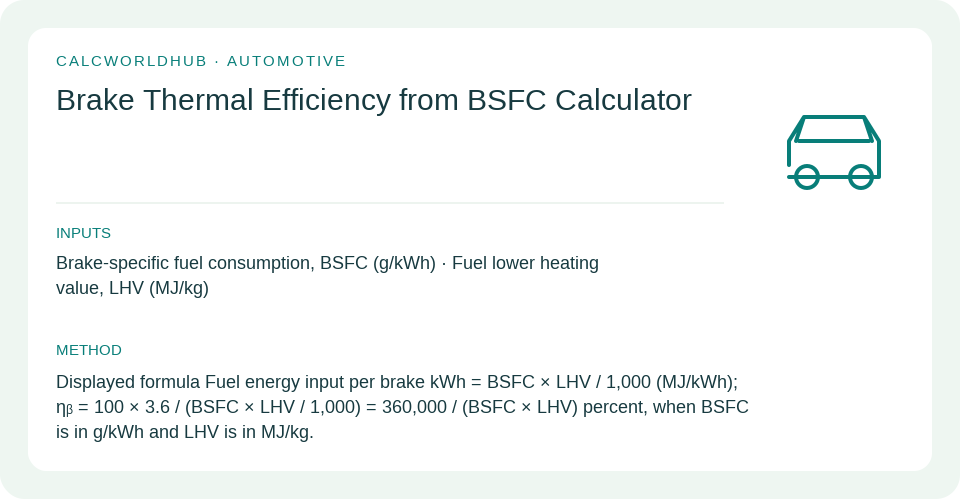
How to use this calculator
Calculate engine brake thermal efficiency from brake-specific fuel consumption and the fuel’s lower heating value.
- Enter Brake-specific fuel consumption, BSFC (g/kWh), Fuel lower heating value, LHV (MJ/kg). Match the units shown beside each field and review the result together with the assumptions below.
- Read the worked example below to check the expected input format and result.
- Compare another scenario by changing one input at a time. Use Reset to return to the starting values.
How this calculation works
Enter a brake-specific fuel consumption value and the fuel’s lower heating value (LHV). The calculator compares the brake work represented by one kilowatt-hour with the chemical energy in the fuel required to produce it.
Inputs and units
bsfcGPerKwh— Brake-specific fuel consumption, BSFC (g/kWh)- Fuel mass per unit brake work for the same engine point or test interval.
lhvMjPerKg— Fuel lower heating value, LHV (MJ/kg)- Use a fuel-specific lower heating value. The default is illustrative and should be replaced when the tested fuel value is known.
Formula
Fuel energy input per brake kWh = BSFC × LHV / 1,000 (MJ/kWh); ηᵦ = 100 × 3.6 / (BSFC × LHV / 1,000) = 360,000 / (BSFC × LHV) percent, when BSFC is in g/kWh and LHV is in MJ/kg.
Method
A BSFC of b g/kWh uses b/1,000 kg of fuel per brake kWh. Multiply that fuel mass by LHV in MJ/kg to obtain the fuel energy input in MJ per brake kWh, then divide the 3.6 MJ brake output by that input and convert the ratio to percent.
Worked example
With BSFC = 240 g/kWh and fuel LHV = 42.7 MJ/kg, fuel energy input is 10.248 MJ per brake kWh and brake thermal efficiency is 35.1288%.
Assumptions and limits
Use BSFC and LHV values for the same fuel and engine operating point or test interval. Enter the fuel’s lower heating value from an appropriate fuel specification; the displayed default is illustrative only. This is brake thermal efficiency at the shaft, not indicated thermal efficiency or vehicle fuel economy. An implied value above 100% indicates inconsistent units or measurements.
Frequently asked questions
What does brake thermal efficiency measure?
It is brake power divided by the rate of chemical heat energy supplied in the fuel, using the fuel mass rate and its lower heating value.
Why is lower heating value used?
Engine efficiency calculations use a stated fuel calorific value. This calculator uses the lower heating value so its result follows that declared basis.
What does an efficiency above 100% mean?
For this fuel-energy basis it is physically inconsistent. Check whether BSFC is in g/kWh, LHV is in MJ/kg, and both values refer to the same fuel and operating point.
How do I use the Brake Thermal Efficiency from BSFC Calculator?
Enter Brake-specific fuel consumption, BSFC (g/kWh), Fuel lower heating value, LHV (MJ/kg). Match the units shown beside each field and review the result together with the assumptions below.
What is a worked example of Brake Thermal Efficiency from BSFC?
With BSFC = 240 g/kWh and fuel LHV = 42.7 MJ/kg, fuel energy input is 10.248 MJ per brake kWh and brake thermal efficiency is 35.1288%.
Reference: ISO 6976 natural-gas calorific value, relative density, and Wobbe index standard. See our calculation methodology.