Buoyant force calculator
Calculate the upward Archimedes buoyant force from displaced fluid volume and density. Enter your values below to see the result and method.
inputs.
Related calculators
How to use this calculator
Calculate the upward Archimedes buoyant force from displaced fluid volume and density.
- Enter Fluid density (kg/m³), Displaced volume (m³). Match the units shown beside each field and review the result together with the assumptions below.
- Read the worked example below to check the expected input format and result.
- Compare another scenario by changing one input at a time. Use Reset to return to the starting values.
Set the physical situation and reference frame
Use this relationship when you need to connect measured physical quantities in a defined model. Calculate the upward Archimedes buoyant force from displaced fluid volume and density.
Inputs and units
- Fluid density (kg/m³):Density of the surrounding fluid at the relevant conditions.
- Displaced volume (m³):Volume of fluid displaced by the submerged portion of the object.
Equation and worked example
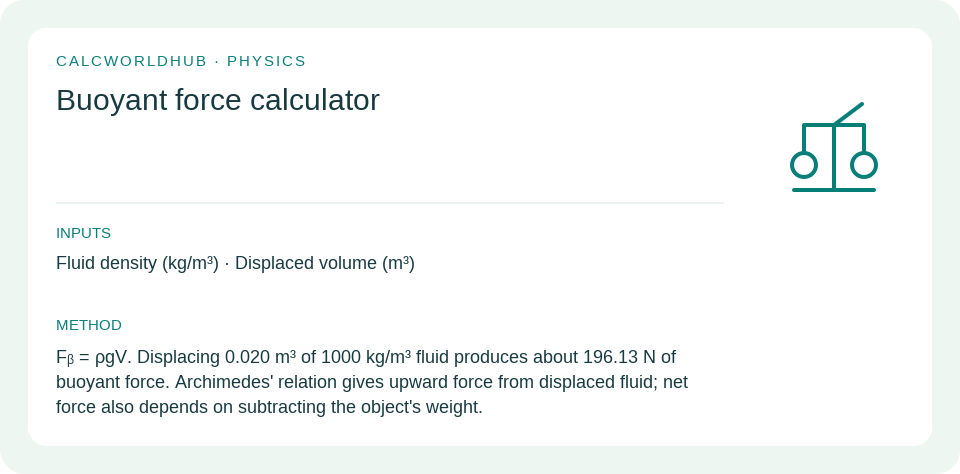
Fᵦ = ρgV.
Displacing 0.020 m³ of 1000 kg/m³ fluid produces about 196.13 N of buoyant force.
Archimedes' relation gives upward force from displaced fluid; net force also depends on subtracting the object's weight.
What the result represents
This is the upward buoyant-force magnitude from displaced fluid; it is not the object's net force or apparent weight.
Assumptions and limitations
Uses the volume of fluid displaced, not necessarily the object’s full volume; assumes uniform fluid density.
Source and method
Archimedes’ principle equates buoyant force with the weight of displaced fluid, Fᵦ=ρgV. OpenStax University Physics — Archimedes’ principle.
Frequently asked questions
Which volume belongs in Archimedes' principle?
Use the volume of fluid displaced by the submerged part of the object, not automatically the object's full volume.
What idealization is used by the buoyant force?
Uses the volume of fluid displaced, not necessarily the object’s full volume; assumes uniform fluid density.
When should I calculate density instead of buoyant force?
Density is mass divided by volume. Buoyant force is the weight of displaced fluid, ρgV; use this page when you know fluid density and displaced volume.
How do I use the Buoyant force calculator?
Enter Fluid density (kg/m³), Displaced volume (m³). Match the units shown beside each field and review the result together with the assumptions below.
What is a worked example of Buoyant force?
Fᵦ = ρgV. Displacing 0.020 m³ of 1000 kg/m³ fluid produces about 196.13 N of buoyant force. Archimedes' relation gives upward force from displaced fluid; net force also depends on subtracting the object's weight.
Read the calculation methodology and privacy policy.