How to use this calculator
Convert bytes to megabytes (decimal), or switch direction to convert back.
- Enter Value to convert, Conversion direction. Match the units shown beside each field and review the result together with the assumptions below.
- Read the worked example below to check the expected input format and result.
- Compare another scenario by changing one input at a time. Use Reset to return to the starting values.
How to convert bytes and megabytes (decimal)
A decimal megabyte is exactly 1,000,000 bytes. Select a direction to convert between B and MB; MB is distinct from the binary MiB unit.
Inputs and units
amount— Value to convert- Enter a numeric value measured in the selected source unit. The same value is used whichever direction is selected.
direction— Conversion direction- A = bytes (B); B = megabytes (decimal) (MB).
Formula and method
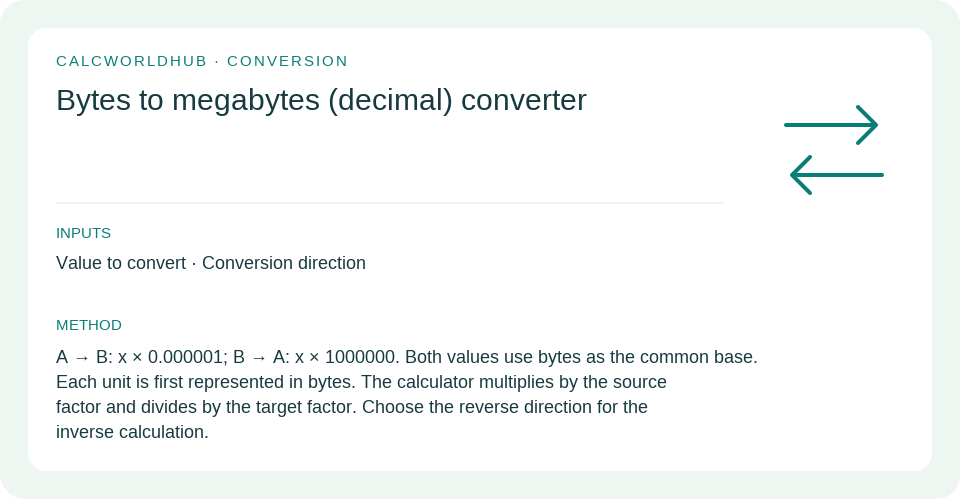
A → B: x × 0.000001; B → A: x × 1000000. Both values use bytes as the common base.
Each unit is first represented in bytes. The calculator multiplies by the source factor and divides by the target factor. Choose the reverse direction for the inverse calculation.
Worked example
Enter 10 B and select A to B. The calculator returns 0.00001 MB. Reverse the direction and enter 10 MB to see the reciprocal conversion. The formula and examples use the same unit definitions as the interactive tool.
For the reverse direction, 10 MB equals 10 × 1,000,000 = 10,000,000 B.
Assumptions and limits
Decimal prefixes use powers of 1,000 (KB, MB, GB); binary prefixes use powers of 1,024 (KiB, MiB, GiB). This reports unit size, not the usable capacity exposed by a device or filesystem.
Reading the result
The main output is the entered quantity expressed in the other unit. Supporting outputs show the factor and the common-unit value so the conversion path can be checked.
Frequently asked questions
How many MB are in one B?
One B equals 0.000001 MB under the unit definition used here.
How do I convert megabytes (decimal) back to bytes?
Select B to A, enter the megabytes (decimal) value, and calculate. The conversion factor is inverted automatically.
Why can a drive show less space than its label?
Products commonly state decimal bytes, while software may display binary units or reserve capacity for formatting.
How do I use the Bytes to megabytes (decimal) converter?
Enter Value to convert, Conversion direction. Match the units shown beside each field and review the result together with the assumptions below.
What is a worked example of Bytes to megabytes (decimal) converter?
Enter 10 B and select A to B. The calculator returns 0.00001 MB . Reverse the direction and enter 10 MB to see the reciprocal conversion. The formula and examples use the same unit definitions as the interactive tool. For the reverse direction, 10 MB equals 10 × 1,000,000 = 10,000,000 B.
Reference: NIST Guide to the SI, Appendix B: Conversion Factors. NIST distinguishes exact factors from rounded factors; the selected unit convention and display rounding are stated on this page.
Read our calculation methodology.