Cache index bits calculator
Find the number of index bits for a set-associative cache from capacity, line size, and ways. Enter your values below to see the result and method.
inputs.
Related calculators
These tools cover nearby questions while keeping this page focused on its own calculation.
How to use this calculator
Find the number of index bits for a set-associative cache from capacity, line size, and ways.
- Enter Cache capacity (bytes), Line size (bytes), Associativity (ways). Match the units shown beside each field and review the result together with the assumptions below.
- Read the worked example below to check the expected input format and result.
- Compare another scenario by changing one input at a time. Use Reset to return to the starting values.
Define the system or input
Find the number of index bits for a set-associative cache from capacity, line size, and ways.
Inputs and units
Use the units printed beside each field. These values are Cache capacity (bytes), Line size (bytes), Associativity (ways).
- Cache capacity (bytes): Cache capacity as defined for the physical or engineering situation.
- Line size (bytes): Line size as defined for the physical or engineering situation.
- Associativity (ways): Associativity as defined for the physical or engineering situation.
Calculation method and example
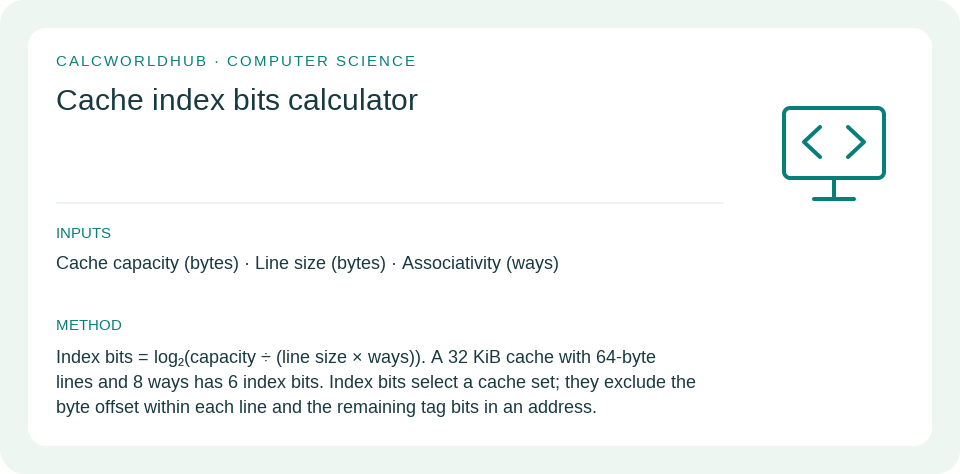
Index bits = log₂(capacity ÷ (line size × ways)).
A 32 KiB cache with 64-byte lines and 8 ways has 6 index bits.
Index bits select a cache set; they exclude the byte offset within each line and the remaining tag bits in an address.
Interpreting the output
This is a bounded estimate for the specified representation or system model. Real hardware and protocol behavior can add implementation details beyond the assumptions listed here.
Assumptions and limitations
Requires integral sets and a power-of-two set count; tag bits are calculated separately.
Frequently asked questions
What should I enter for this computer science calculator?
Provide Cache capacity (bytes), Line size (bytes), Associativity (ways). The input format and units determine how to interpret the result.
Does this include every implementation overhead?
No. Requires integral sets and a power-of-two set count; tag bits are calculated separately.
When are cache-line offset bits more useful than index bits?
Offset bits select a byte within a cache line; index bits select a cache set. Use the offset calculation when the line size is the quantity you need to address.
How do I use the Cache index bits calculator?
Enter Cache capacity (bytes), Line size (bytes), Associativity (ways). Match the units shown beside each field and review the result together with the assumptions below.
What is a worked example of Cache index bits?
Index bits = log₂(capacity ÷ (line size × ways)). A 32 KiB cache with 64-byte lines and 8 ways has 6 index bits. Index bits select a cache set; they exclude the byte offset within each line and the remaining tag bits in an address.
Read the calculation methodology and privacy policy.
Method source: University of Washington CSE 548: cache index-bit formula.