How to use this calculator
Calculate CAN bit rate, sample point, time quantum, and bit time from clock and timing segments.
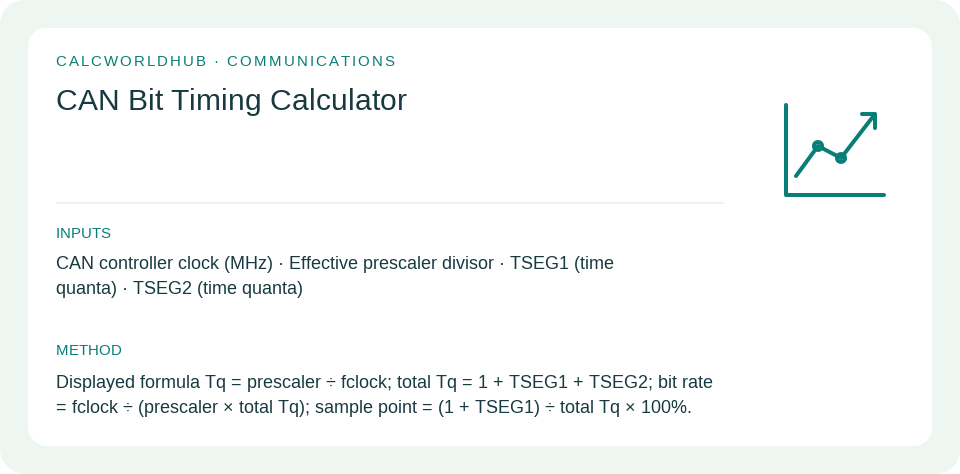
- Enter CAN controller clock (MHz), Effective prescaler divisor, TSEG1 (time quanta), TSEG2 (time quanta). Match the units shown beside each field and review the result together with the assumptions below.
- Read the worked example below to check the expected input format and result.
- Compare another scenario by changing one input at a time. Use Reset to return to the starting values.
How this calculation works
Classical CAN divides each bit into synchronization, propagation, and phase segments measured in time quanta. This calculator treats the prescaler and segment inputs as effective timing values and derives the resulting nominal bit rate and sample point.
Inputs and units
clockMhz— CAN controller clock (MHz)- Clock supplied to the CAN bit-timing prescaler, in megahertz.
prescaler— Effective prescaler divisor- Actual clock-division factor, not the encoded register value.
segment1Tq— TSEG1 (time quanta)- Actual propagation plus phase-segment-1 duration in TQ.
segment2Tq— TSEG2 (time quanta)- Actual phase-segment-2 duration in TQ.
Formula
Tq = prescaler ÷ fclock; total Tq = 1 + TSEG1 + TSEG2; bit rate = fclock ÷ (prescaler × total Tq); sample point = (1 + TSEG1) ÷ total Tq × 100%.
Method
Enter the CAN controller clock in MHz, its effective prescaler divisor, and the actual TQ counts for TSEG1 and TSEG2. TSEG1 combines propagation and phase segment 1; the leading synchronization segment is one TQ.
Worked example
For a 16 MHz clock, prescaler 2, TSEG1 = 13 TQ, and TSEG2 = 2 TQ, the nominal bit rate is 500,000 bit/s, sample point is 87.50%, and bit time is 2.000 µs.
Assumptions and limits
This derives timing arithmetic and does not encode controller register fields. Prescaler and segment register encodings, SJW, legal ranges, oscillator tolerance, propagation delay, CAN FD data-phase rules, and transceiver timing differ by controller and network; verify the selected values against the device manual and bus design.
Frequently asked questions
Does this choose legal controller register values?
No. It uses effective divisors and actual TQ counts; register offsets and legal ranges vary by controller.
What is the sample point?
It is the position in the nominal bit where the receiver samples the bus, after synchronization and TSEG1.
Does this include CAN FD data timing?
No. This calculator covers one nominal bit-timing configuration and does not model CAN FD's separate data phase.
How do I use the CAN Bit Timing Calculator?
Enter CAN controller clock (MHz), Effective prescaler divisor, TSEG1 (time quanta), TSEG2 (time quanta). Match the units shown beside each field and review the result together with the assumptions below.
What is a worked example of CAN Bit Timing?
For a 16 MHz clock, prescaler 2, TSEG1 = 13 TQ, and TSEG2 = 2 TQ, the nominal bit rate is 500,000 bit/s, sample point is 87.50%, and bit time is 2.000 µs.
Reference: NXP application note describing CAN bit-time segments, prescaling, and sample points. See our calculation methodology.