Capacitive reactance calculator
Calculate a capacitor’s AC reactance at a chosen frequency. Enter your values below to see the result and method.
inputs.
Related calculators
These AC-circuit calculators relate capacitor reactance to stored energy, RC response, and inductive reactance.
How to use this calculator
Free Capacitive reactance calculator. Calculate a capacitor’s AC reactance at a chosen frequency. Formula, example, and assumptions explained.
- Enter Frequency (Hz), Capacitance (μF). Match the units shown beside each field and review the result together with the assumptions below.
- Read the worked example below to check the expected input format and result.
- Compare another scenario by changing one input at a time. Use Reset to return to the starting values.
Relate AC frequency and capacitance
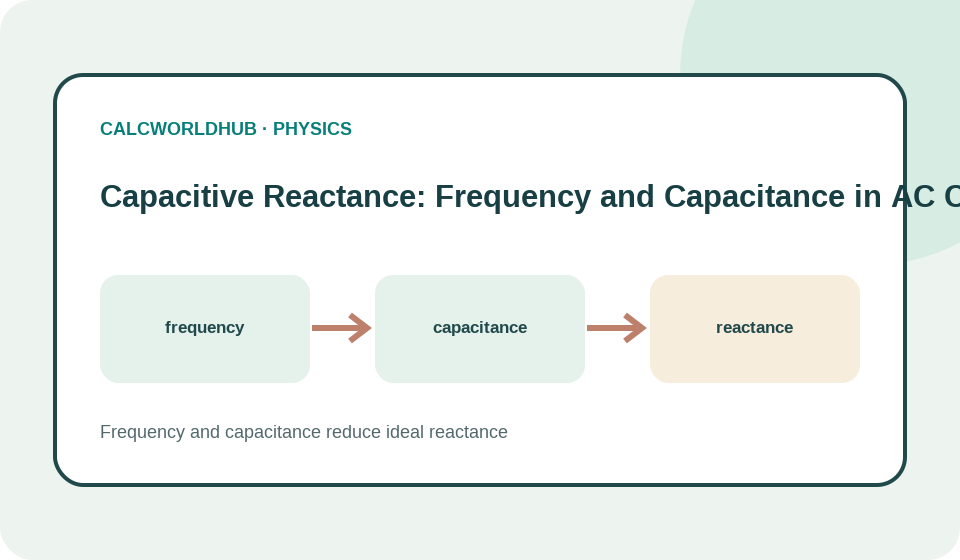
For an ideal capacitor in sinusoidal steady-state AC, increasing frequency or capacitance lowers the reactance magnitude. Calculate a capacitor’s AC reactance at a chosen frequency.
Inputs and units
Enter frequency in hertz and capacitance in microfarads; capacitance is converted to farads for Xc.
- Frequency (Hz): AC cycles per second. Higher frequency lowers ideal capacitive reactance.
- Capacitance (μF): Capacitance in microfarads; the calculator converts μF to farads before applying Xc = 1/(2πfC).
Equation and worked example
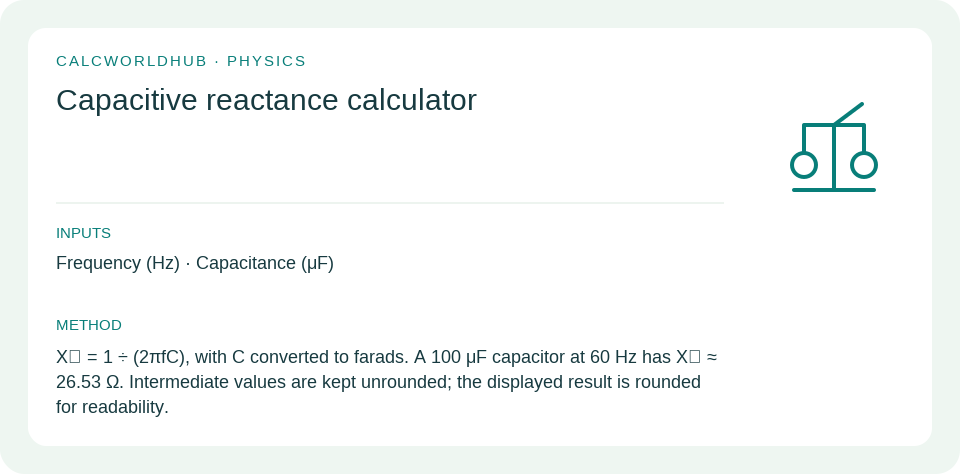
X꜀ = 1 ÷ (2πfC), with C converted to farads.
A 100 μF capacitor at 60 Hz has X꜀ ≈ 26.53 Ω.
Intermediate values are kept unrounded; the displayed result is rounded for readability.
What the result represents
The result is an ideal capacitive opposition magnitude in ohms. It falls as frequency or capacitance rises.
Assumptions and limitations
Ideal-capacitor estimate; equivalent series resistance, leakage, and frequency limits are not included.
Frequently asked questions
How is capacitive reactance calculated?
For an ideal capacitor, Xc=1/(2πfC). Convert capacitance from microfarads to farads before evaluating the formula.
What happens when frequency or capacitance increases?
Reactance decreases because both frequency and capacitance are in the denominator. At DC (f=0), this ideal AC-reactance formula is undefined.
Does Xc include losses in a real capacitor?
No. This is the ideal magnitude. Equivalent series resistance, leakage, tolerance, and frequency-dependent parasitics are not modeled.
How do I use the Capacitive reactance calculator?
Enter Frequency (Hz), Capacitance (μF). Match the units shown beside each field and review the result together with the assumptions below.
What is a worked example of Capacitive reactance?
X꜀ = 1 ÷ (2πfC), with C converted to farads. A 100 μF capacitor at 60 Hz has X꜀ ≈ 26.53 Ω. Intermediate values are kept unrounded; the displayed result is rounded for readability.
Read the calculation methodology and privacy policy.